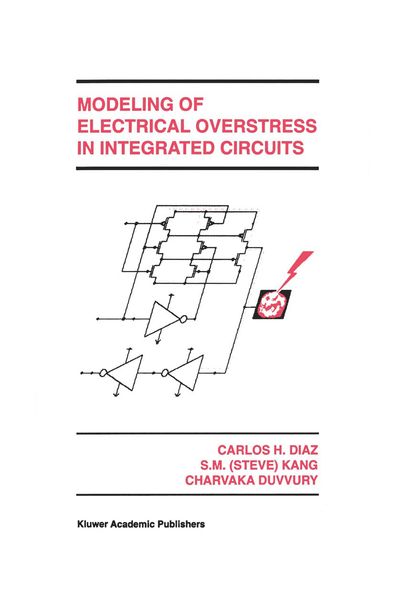
Modeling of Electrical Overstress in Integrated Circuits
-
- Hardcover ausgewählt
- Taschenbuch
- eBook
-
Sprache:Englisch
144,99 €
UVP
164,99 €
inkl. gesetzl. MwSt.,
Beschreibung
Produktdetails
Einband
Gebundene Ausgabe
Erscheinungsdatum
30.11.1994
Abbildungen
XXV, 148 p.
Verlag
Springer UsSeitenzahl
148
Maße (L/B/H)
24,1/16/1,5 cm
Gewicht
439 g
Auflage
1995
Sprache
Englisch
ISBN
978-0-7923-9505-8
Electrical overstress (EOS) and Electrostatic discharge (ESD) pose one of the most dominant threats to integrated circuits (ICs). These reliability concerns are becoming more serious with the downward scaling of device feature sizes.
Modeling of Electrical Overstress in
Integrated Circuits
presents a comprehensive analysis of EOS/ESD-related failures in I/O protection devices in integrated circuits.
The design of I/O protection circuits has been done in a hit-or-miss way due to the lack of systematic analysis tools and concrete design guidelines. In general, the development of on-chip protection structures is a lengthy expensive iterative process that involves tester design, fabrication, testing and redesign. When the technology is changed, the same process has to be repeated almost entirely. This can be attributed to the lack of efficient CAD tools capable of simulating the device behavior up to the onset of failure which is a 3-D electrothermal problem. For these reasons, it is important to develop and use an adequate measure of the EOS robustness of integrated circuits in order to address the on-chip EOS protection issue. Fundamental understanding of the physical phenomena leading to device failures under ESD/EOS events is needed for the development of device models and CAD tools that can efficiently describe the device behavior up to the onset of thermal failure.
Modeling of Electrical Overstress in Integrated Circuits
is for VLSI designers and reliability engineers, particularly those who are working on the development of EOS/ESD analysis tools. CAD engineers working on development of circuit level and device level electrothermal simulators will also benefit from the material covered. This book will also be of interest to researchers and first and second year graduate students working in semiconductor devices and IC reliability fields.
Noch keine Bewertungen vorhanden
Verfassen Sie die erste Bewertung zu diesem Artikel
Helfen Sie anderen Kundinnen und Kunden durch Ihre Meinung.
Kurze Frage zu unserer Seite
Vielen Dank für Ihr Feedback
Wir nutzen Ihr Feedback, um unsere Produktseiten zu verbessern. Bitte haben Sie Verständnis, dass wir Ihnen keine Rückmeldung geben können. Falls Sie Kontakt mit uns aufnehmen möchten, können Sie sich aber gerne an unseren Kund*innenservice wenden.
zum Kundenservice