KI-Beratung Beta

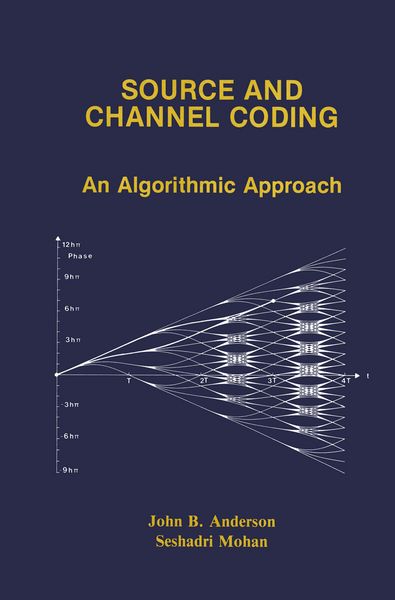
  • Produktbild: Source and Channel Coding
  • Produktbild: Source and Channel Coding
Band 150

Source and Channel Coding An Algorithmic Approach

164,99 €

inkl. gesetzl. MwSt., Versandkostenfrei


Beschreibung

oW should coded communication be approached? Is it about prob H ability theorems and bounds, or about algorithms and structures? The traditional course in information theory and coding teaches these together in one course in which the Shannon theory, a probabilistic the ory of information, dominates....

Beschreibung

oW should coded communication be approached? Is it about prob H ability theorems and bounds, or about algorithms and structures? The traditional course in information theory and coding teaches these together in one course in which the Shannon theory, a probabilistic the ory of information, dominates. The theory's predictions and bounds to performance are valuable to the coding engineer, but coding today is mostly about structures and algorithms and their size, speed and error performance. While coding has a theoretical basis, it has a practical side as well, an engineering side in which costs and benefits matter. It is safe to say that most of the recent advances in information theory and coding are in the engineering of coding. These thoughts motivate the present text book: A coded communication book based on methods and algorithms, with information theory in a necessary but supporting role. There has been muchrecent progress in coding, both inthe theory and the practice, and these pages report many new advances. Chapter 2 cov ers traditional source coding, but also the coding ofreal one-dimensional sources like speech and new techniques like vector quantization. Chapter 4 is a unified treatment of trellis codes, beginning with binary convolu tional codes and passing to the new trellis modulation codes.

Produktdetails

Einband

Gebundene Ausgabe

Erscheinungsdatum

30.09.1991

Abbildungen

XIII, 433 p.

Verlag Springer Us

Produktdetails

Einband

Gebundene Ausgabe

Erscheinungsdatum

30.09.1991

Abbildungen

XIII, 433 p.

Verlag Springer Us
Seitenzahl

433

Maße (L/B/H)

24,1/16/2,9 cm

Gewicht

782 g

Auflage

1991

Sprache

Englisch

ISBN

978-0-7923-9210-1

Herstelleradresse

Springer-Verlag GmbH
Europaplatz 3
69115 Heidelberg
DE

Email: ProductSafety@springernature.com

Noch keine Bewertungen vorhanden

Verfassen Sie die erste Bewertung zu diesem Artikel

Helfen Sie anderen Kundinnen und Kunden durch Ihre Meinung.

Kundinnen und Kunden meinen

Bewertungen (0)

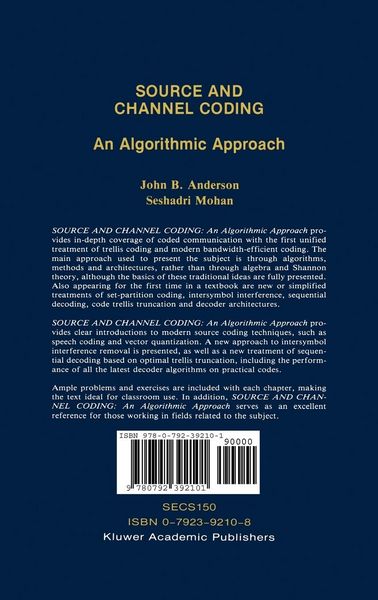
  • Produktbild: Source and Channel Coding
  • Produktbild: Source and Channel Coding
  • 1 Introduction.- 1.1 The Historical Context.- 1.2 Information and Coding.- 1.3 Bandwidth and Energy.- References.- 2 Source Coding Algorithms.- 2.1 Source Coding Preliminaries.- 2.2 Applications of Noiseless Source Coding.- 2.3 Rate-Distortion Theory.- 2.4 Predictive Source Coders.- 2.5 Some Other Rate-Distortion Approaches.- Problems.- References.- 3 Error Control Coding.- 3.1 Fundamentals of Coding.- 3.2 Linear Block Codes.- 3.3 Syndrome Decoding.- 3.4 Bounds on Performance.- 3.5 Cyclic Codes.- 3.6 Decoding Cyclic Codes.- 3.7 Algebra of Finite Fields.- 3.8 The BCH Codes.- 3.9 Decoding BCH Codes.- 3.10 Reed-Solomon Codes: Algebra in Non-Binary Fields.- 3.11 Codes for Burst Error Correction.- 3.12 Automatic Repeat Request Protocols.- Problems.- References.- 4 Trellis Codes.- 4.1 Convolutional Codes.- 4.2 Trees, Trellises and the Viterbi Algorithm.- 4.3 Continuous Phase Modulation Codes.- 4.4 Set-Partition Coding.- 4.5 Intersymbol Interference Decoding.- Problems.- References.- 5 Reduced Trellises.- 5.1 Truncation of the Impulse Response.- 5.2 Partition of the Path Map Alphabet.- 5.3 Pulse Response Simplification.- Problems.- References.- 6 Sequential Coding Algorithms.- 6.1 Basics of Sequential Coding.- 6.2 Important Channel Decoding Algorithms.- 6.3 Calculation of the Search Region Boundaries.- 6.4 Number of Paths Searched.- 6.5 Other Analyses of Sequential Decoding.- 6.6 Algorithm Steps.- 6.7 Source Coding Revisited.- Problems.- References.- 7 Architectures for Coding Algorithms.- 7.1 Parallel Architectures and Algorithms.- 7.2 Architectures for the M-Algorithm.- 7.3 Architectures for the Viterbi Algorithm.- Problems.- References.- APPENDICES.- A Signal Space Theory.- B Introduction to Algebra.- C Mathematical Details of the Stop and Drop Lines.