
KI-Beratung Beta

Gutscheinbedingungen

**Gültig bis 18.11.2026 auf englischsprachige Klassiker (klassiker-32728) online auf thalia.at und in der Thalia App. Einzelne Artikel können ausgeschlossen sein. Ausgenommen sind preisgebundene Artikel & eBooks. Pro Einkauf einmal einlösbar. Click & Collect nur bei Onlinevorabzahlung möglich. Keine Barauszahlung. Nicht kombinierbar mit anderen Aktionen und Gutscheinen. Gutschein wird auf max. 500€ Bestellwert angerechnet. Nicht gültig für Geschenkkarten, Versandkosten und Services.

  • Produktbild: Confluence of Computer Vision and Computer Graphics
  • Produktbild: Confluence of Computer Vision and Computer Graphics
Band 84

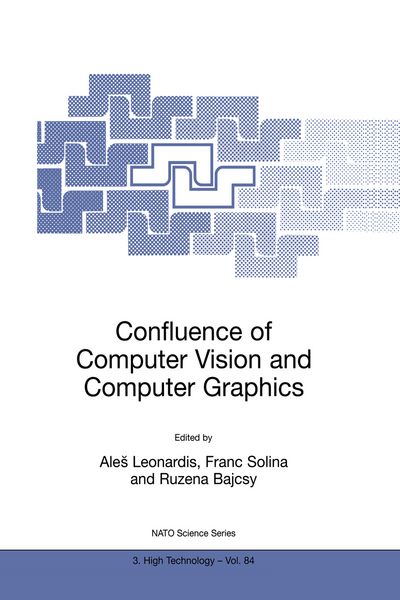
Confluence of Computer Vision and Computer Graphics

49,99 €

inkl. gesetzl. MwSt., Versandkostenfrei


Beschreibung

A collection of original contributions by researchers who work at the forefront of a new field, lying at the intersection of computer vision and computer graphics. Several original approaches are presented to the integration of computer vision and graphics techniques to aid in the realistic modelling...

Beschreibung

A collection of original contributions by researchers who work at the forefront of a new field, lying at the intersection of computer vision and computer graphics. Several original approaches are presented to the integration of computer vision and graphics techniques to aid in the realistic modelling of objects and scenes, interactive computer graphics, augmented reality, and virtual studios. Numerous applications are also discussed, including urban and archaeological site modelling, modelling dressed humans, medical visualisation, figure and facial animation, real-time 3D teleimmersion telecollaboration, augmented reality as a new user interface concept, and augmented reality in the understanding of underwater scenes.

Produktdetails

Einband

Gebundene Ausgabe

Erscheinungsdatum

30.09.2000

Abbildungen

XL, 352 p.

Herausgeber Ales Leonardis + weitere

Produktdetails

Einband

Gebundene Ausgabe

Erscheinungsdatum

30.09.2000

Abbildungen

XL, 352 p.

Herausgeber
Verlag Springer Netherland
Seitenzahl

352

Maße (L/B/H)

23,4/15,6/2,2 cm

Gewicht

735 g

Auflage

2000 edition

Sprache

Englisch

ISBN

978-0-7923-6611-9

Herstelleradresse

Libri GmbH
Europaallee 1
36244 Bad Hersfeld
DE

Email: gpsr@libri.de

Noch keine Bewertungen vorhanden

Verfassen Sie die erste Bewertung zu diesem Artikel

Helfen Sie anderen Kundinnen und Kunden durch Ihre Meinung.

Kundinnen und Kunden meinen

Bewertungen (0)

  • Produktbild: Confluence of Computer Vision and Computer Graphics
  • Produktbild: Confluence of Computer Vision and Computer Graphics
  • 1 From images to virtual and augmented reality.- 1. Introduction.- 2. Review: the correspondence problem over multiple views.- 3. Results.- 4. Construction of virtual-reality models for polyhedral scenes.- 5. Augmented reality.- 6. Future developments.- 2 Surface reconstruction from multiple views using apparent contours and surface texture.- 1. Introduction.- 2. Reconstruction from apparent contours.- 3. Computing the surface from texture information.- 4. Minimising reprojection errors using a surface representation.- 5. Summary.- 3 Consistent projective reconstruction from multiple views.- 1. Introduction.- 2. Problem of joining two independent projective reconstructions.- 3. Projective reconstruction from three views.- 4. Projective reconstruction from n views based on concatenation of trifocal constraints.- 5. Experiments.- 6. Summary.- Appendix A: Trifocal constraints.- Appendix B: The structure of matrix G.- 4 Accurate natural surface reconstruction from polynocular stereo.- 1. Introduction.- 2. The point-set model reconstruction.- 3. The fish-scale model reconstruction.- 4. The discrete manifold model reconstruction.- 5. Human face 3D model reconstruction.- 6. Summary.- 5 Building models from sensor data: An application shared by the computer vision and the computer graphics community.- 1. Introduction.- 2. Model building pipeline.- 3. Research themes.- 4. Conclusion.- 6 Acquiring range images of objects with non-uniform reflectance using high dynamic scale radiance maps.- 1. Introduction.- 2. Acquisition technique.- 3. Problem description.- 4. Our approach.- 5. Experimental results.- 6. Conclusion.- 7 Dynamic view interpolation without affine reconstruction.- 1. Introduction.- 2. Dynamic view morphing.- 3. Notation and preliminary concepts.- 4. View interpolation for a single moving object.- 5. Interpolation without H?.- 6. Interpolation with H?.- 7. Experimental results.- 8. Summary.- 8 Facial motion capturing using an explanation-based approach.- 1. Introduction.- 2. PBVD model.- 3. PBVD model-based tracking algorithm.- 4. Explanation-based motion tracking.- 5. Implementation and experimental results.- 6. Discussion.- 9 Image-based 3D modeling: Modeling from reality.- 1. Introduction.- 2. Two image-based 3D acquisition systems.- 3. Image-based texture synthesis.- 4. Face animation for speech.- 5. Conclusions and future work.- 10 Computer vision and graphics techniques for modeling dressed humans.- 1. Introduction.- 2. Human body reconstruction.- 3. Modeling and analysis of cloth draping.- 4. Experimental results.- 5. Conclusions.- 11 Urban site models: Accurate, detailed, rapid and inexpensive.- 1. Introduction.- 2. Source data.- 3. Work flow issues.- 4. The use of image matching.- 5. Setting up large blocks of imagery.- 6. Extracting details of building facades.- 7. Where will this lead?.- 12 Medical visualisation, biomechanics, figure animation and robot teleoperation: Themes and links.- 1. Introduction.- 2. Medical visualisation and biomechanics.- 3. Figure animation.- 4. Telecontrol of robots.- 5. Summary.- 13 Can virtual look real? A review of virtual studio techniques.- 1. Introduction.- 2. Real-time performance.- 3. Realism of computer-generated scenes.- 4. Lighting and chroma keying.- 5. Shadows.- 6. Camera tracking.- 7. Simulation of lens behavior.- 8. Distance keying.- 9. Conclusions.- 14 Real-time 3D-teleimmersion.- 1. Introduction.- 2. Related work.- 3. System description and scenario.- 4. Binocular stereo reconstruction.- 5. A novel trinocular stereo algorithm.- 6. Performance.- 7. Conclusions and thefuture.- 15 Augmented reality: A problem in need of many computer vision—based solutions.- 1. Introduction.- 2. Typical AR configurations.- 3. User tracking.- 4. 3D scene modeling for occlusion and reflection handling.- 5. Diminished reality.- 6. Mobile object tracking.- 7. Virtual user motion and telepresence.- 8. Summary.- 16 Registration methods for harmonious integration of real world and computer generated objects.- 1. Introduction.- 2. Contributions.- 3. Overview.- 4. Robust pose computation from various features (RPC algorithm).- 5. Improving the viewpoint computation.- 6. Results.- 7. Conclusion.- Appendix: The fundamental matrix.- 17 3D object tracking using analysis/synthesis techniques.- 1. Introduction.- 2. Models.- 3. Camera calibration.- 4. Definition of the object tracking parameters.- 5. Matching process.- 6. Optimization.- 7. Dynamic tracking.- 8. Experiments and results.- 9. Conclusion and future work.- 10. Summary.- 18 Augmented reality by integrating multiple sensory modalities for underwater scene understanding.- 1. Introduction.- 2. Segmentation.- 3. Extraction of cylinders.- 4. Augmented reality.- 5. Experimental results.- 6. Summary.