Gutscheinbedingungen

**Gültig bis 06.07.2026 auf fremdsprachige Bücher online auf thalia.at, in der Thalia App ab einem Mindestbestellwert von 30€ und in allen Thalia Buchhandlungen in Österreich. In den Buchhandlungen nur gültig auf lagernde Ware. Einzelne Artikel können ausgeschlossen sein. Ausgenommen sind preisgebundene Artikel & eBooks. Pro Einkauf einmal einlösbar. Nur gültig gegen Vorlage oder im Onlineshop hinterlegter Bonuscard. Infos zur Einlösung in der Buchhandlung sind auf der Bonuscard-Vorteilspreisseite zu finden. Click & Collect nur bei Onlinevorabzahlung möglich. Keine Einlösung bei Scan & Go-Bezahlung. Keine Barauszahlung. Nicht kombinierbar mit anderen Aktionen und Gutscheinen. Gutschein wird auf max. 500€ Bestellwert angerechnet. Nicht gültig für Versandkosten und Services.

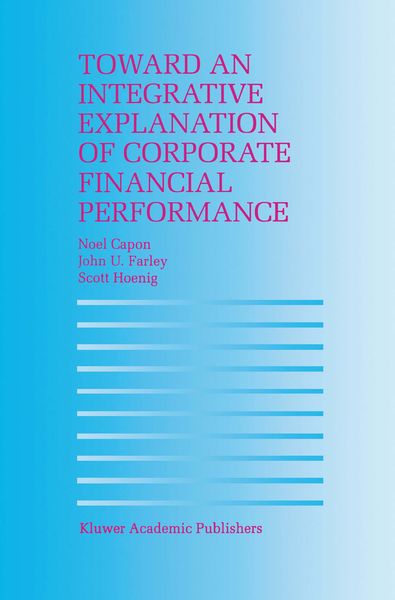
  • Produktbild: Toward an Integrative Explanation of Corporate Financial Performance
  • Produktbild: Toward an Integrative Explanation of Corporate Financial Performance
- 12%

Toward an Integrative Explanation of Corporate Financial Performance

12% sparen

144,99 € UVP 164,99 €

inkl. gesetzl. MwSt., Versandkostenfrei


Beschreibung

Produktdetails

Einband

Gebundene Ausgabe

Erscheinungsdatum

31.12.1996

Verlag

Springer Netherland

Seitenzahl

405

Maße (L/B/H)

24,1/16/2,8 cm

Gewicht

776 g

Auflage

1996

Sprache

Englisch

ISBN

978-0-7923-9831-8

Beschreibung

Produktdetails

Einband

Gebundene Ausgabe

Erscheinungsdatum

31.12.1996

Verlag

Springer Netherland

Seitenzahl

405

Maße (L/B/H)

24,1/16/2,8 cm

Gewicht

776 g

Auflage

1996

Sprache

Englisch

ISBN

978-0-7923-9831-8

Herstelleradresse

Springer-Verlag GmbH
Tiergartenstr. 17
69121 Heidelberg
DE

Email: ProductSafety@springernature.com

Noch keine Bewertungen vorhanden

Verfassen Sie die erste Bewertung zu diesem Artikel

Helfen Sie anderen Kundinnen und Kunden durch Ihre Meinung.

Kundinnen und Kunden meinen

Bewertungen (0)

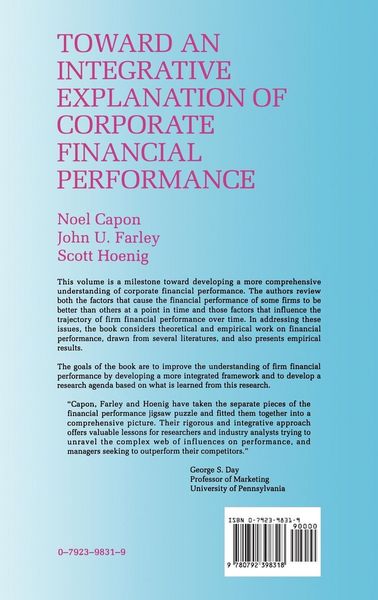
  • Produktbild: Toward an Integrative Explanation of Corporate Financial Performance
  • Produktbild: Toward an Integrative Explanation of Corporate Financial Performance
  • I. What Determines Corporate Financial Performance?.- 1.1 The Mission of This Book: Integration.- 1.2 The Three Core Approaches.- 1.3 Why Do We Need Integration?.- 1.4 What Do We Mean by an Integrative or Holistic Explanation of Performance?.- 1.5 The Plan of the Book.- II. What We Know (or Think We Know) About The Causes of Superior Financial Performance.- II.1 What People Expect: Theoretical Perspectives on Financial Performance.- II.2 Trends of Integration among Theoretical Perspectives on Financial Performance.- II.3 What We Know Empirically about Firm Financial Performance.- II.4 Major Studies: Summary and Replication.- II.5 Summary.- III. An Epirical Examination of Financial Performance: Distilling The Essential Causal Factors.- III.1 The Performance Function: A Framework for Integration.- III.2 Measuring Financial Performance.- III.3 What Correlates with Financial Performance? Empirical Characteristics of “Good” Performing Firms.- III.4 Summary of the Causal Factors: From Variables to Scales.- III.5 Integrating with the Performance Function.- III.6 Using an Abbreviated Form of the Performance Function and Estimated Scales to Predict and Track Performance of a Firm.- III.7 Profiles of Firms Based on the Causal Factors: A Performance Exploration.- III.8 Summary.- IV. Improving Financial Performance: Summary And Research Agenda.- IV.1 What We’ve Done in Context of Research on Firm Performance.- IV.2 Our General Perspective Regarding Empirical Studies of Firm Performance: Good Performance Is a Complex Matter Requiring a Comprehensive Approach to Both Analysis and Measurement.- IV.3 A Research Agenda for the Study of Corporate Financial Performance.- IV.4 To the Manager.- Appendices.- I. A Short Selected Background to the Building Blocks.- AI.l Environment.-AI.2 Strategy.- AI.3 Organization Structure.- AI.4 Organizational Climate.- II. A brief description of the empirical study of 113 Major U.S. Manufacturing Firms.- AII.l Study Design.- AII.2 Data Collection.- III. An Empirical Test of in Search of Excellence.- AIII.1 Methodology.- AIII. 1.1 Strategy and Performance Measures.- AIII. 1.2 Measures of the Eight Peters and Waterman Principles.- AIII.2 Results.- AIII.2.1 Peters and Waterman Dimensions.- AIII.2.2 Strategic Dimensions.- AIII.3 Caveats.- IV. Conducting the Meta-Analysis.- AIV.l Methodology.- AIV. 1.1 Counting Methodology.- AIV. 1.2 ANCOVA Methodology.- AIV.2 The Financial Performance Literature.- AIV.2.1 Empirical Methodology in the Literature.- AIV.2.2 Levels of Analysis.- AIV.3 Results.- AIV.3.1 Counting Methodology.- AIV.3.2 ANCOVA Results.- AIV.4 Publication Bias.- V. Detailed Results of The Partial Replication of the “top 100 Plus” Studies.- VI. Survival in our Sample of Fortune 500 Firms.- VII. Developing the Scales that Summarize Environment, Strategy and Organization.- AVII.1 Categorization of Resource Inputs into Subsystems.- AVII.1.1 Classification Procedure.- AVII. 1.2 Results of the Classification Procedure.- AVII.2 Forming the Scales.- VIII. Detailed Statistical Results on how the Scales Relate to Financial Performance.- IX. Technical Characteristics of the Translog Performance Function.- AIX.l The Performance Function.- AIX.2 Specific Characteristics of the Firm.- AIX.3 Specific Functional Form.- AIX.3.1 Technical Characteristics.- AIX.3.2 Choice of Form.- X. Toward Estimating Scale Values From Publicly Available Data.- AX.1 Gathering and Assessing the Data.- AX.2 Assembling the Data.- AX.2.1 Environmental Scales.- AX.2.2 Strategy Scales.- AX.2.3 Organization Structure Scales.- AX.2.4Organizational Climate Scales.- AX.2.5 “Other Performance”Scales.- AX.3 Using the Data.- XI Developing Firm Profiles by Cluster Analysis.- XII. Authors who have Studied the Underlying Concepts Summarized in our 34 Scales.- References.- 1. General References.- 2. References for Hambrick’s 1980-1985 “Top 50” Strategy Studies.- 3. References for Our 1984-1993 “Top 50 Plus” Strategy Studies.- 4. References for the Meta-Analysis of Financial Performance Literature.