KI-Beratung Beta

Gutscheinbedingungen

**Gültig bis 30.11.2026 auf Spielzeug, Schreibwaren, Filme, Geschenke & Trends, Musik, tolino eReader & Zubehör, Hörbücher und Hörbuch-Downloads, nicht preisgebundene Bücher und Kalender online auf thalia.at und in der Thalia App. Einzelne Artikel können ausgeschlossen sein. Aufgrund der Buchpreisbindung sind deutschsprachige Bücher und eBooks ausgenommen. Zusätzlich ausgenommen sind Abos & Flatrates, Games, Geschenkkarten/-boxen, Shelfies, Software, Zeitschriften sowie einzelne Artikel von tonies®. Pro Einkauf einmal einlösbar. Nur gültig mit im Onlineshop hinterlegter Bonuscard. Click & Collect nur bei Onlinevorabzahlung möglich. Keine Barauszahlung. Nicht kombinierbar mit anderen Aktionen und Gutscheinen. Gutschein wird auf max. 500€ Bestellwert angerechnet. Nicht gültig für Versandkosten und Services.

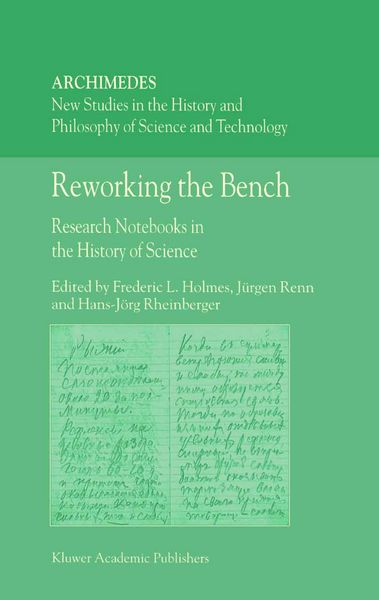
  • Produktbild: Reworking the Bench
  • Produktbild: Reworking the Bench
Band 7 - 12%

Reworking the Bench Research Notebooks in the History of Science

Aus der Reihe Archimedes
12% sparen

144,99 € UVP 164,99 €

inkl. gesetzl. MwSt., Versandkostenfrei


Beschreibung

Research records composed of notes and protocols have long played a role in the efforts to understand the origins of what have come to be seen as the established milestones in the development of modern science. The use of research records to probe the nature of scientific investigation itself however...

Beschreibung

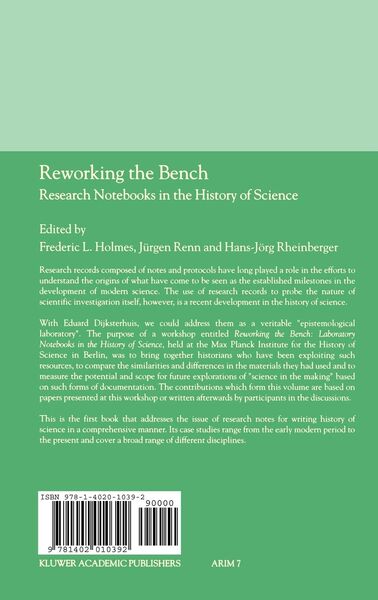
Research records composed of notes and protocols have long played a role in the efforts to understand the origins of what have come to be seen as the established milestones in the development of modern science. The use of research records to probe the nature of scientific investigation itself however is a recent development in the history of science.
With Eduard Dijksterhuis, we could address them as a veritable "epistemologiCal laboratory". The purpose of a workshop entitled "Reworking the Bench: Laboratory Notebooks in the History of Science", held at the Max Planck Institute for the History of Science in Berlin was to bring together historians who have been exploiting such resources, to compare the similarities and differences in the materials they had used and and to measure the potential and scope for future explorations of "science in the making" based on such forms of documentation. The contributions which form this volume are based on papers presented at this workshop or written afterward by participants in the discussions.
This is the first book that addresses the issue of research notes for writing history of science in a comprehensive manner. Its case studies range from the early modern period to present and cover a broad range of different disciplines.

Rezension

From the reviews:


"Reworking the Bench provides a splendid survey of the work of 15 historians of science, experts in different areas and periods of modern age, with many years of experience in this kind of historical investigation. … the essays also contain interesting general epistemological results. … research notes prove to be indispensable for disclosing the underlying aspects of research that are kept secret by the official accounts like published articles or autobiographical records." (Ariane Dröscher, History and Philosophy of the Life Sciences, Vol. 27, 2005)

Produktdetails

Einband

Gebundene Ausgabe

Erscheinungsdatum

31.05.2003

Abbildungen

XVI, 326 p.

Herausgeber F.L. Holmes + weitere

Produktdetails

Einband

Gebundene Ausgabe

Erscheinungsdatum

31.05.2003

Abbildungen

XVI, 326 p.

Herausgeber
Verlag Springer Netherland
Seitenzahl

326

Maße (L/B/H)

24,5/16,5/2,3 cm

Gewicht

671 g

Auflage

2003 edition

Sprache

Englisch

ISBN

978-1-4020-1039-2

Herstelleradresse

Libri GmbH
Europaallee 1
36244 Bad Hersfeld
DE

Email: gpsr@libri.de

Noch keine Bewertungen vorhanden

Verfassen Sie die erste Bewertung zu diesem Artikel

Helfen Sie anderen Kundinnen und Kunden durch Ihre Meinung.

Kundinnen und Kunden meinen

Bewertungen (0)

  • Produktbild: Reworking the Bench
  • Produktbild: Reworking the Bench
  • The Hanging Chain: A Forgotten “Discovery” Buried in Galileo’s Notes on Mition.- The Chymical Laboratory Notebooks of George Starkey.- Newton’s Optical Notebooks: Public Versus Private Data.- At Play with Nature: Luigi Galvani’s Experimental Approach to Muscular Physiology.- The Practice of Studying Practice: Analyzing Research Records of Ampère and Faraday.- From Agents to Cells: Theodor Schwann’s Research Notes of the Years 1835–1838.- Narrating by Numbers: Keeping an Account of Early 19th Century Laboratory Experiences.- Exploring Contents and Boundaries of Experimental Practice in Laboratory Notebooks: Samuel Pierpont Langley and the Mapping of the Infra-Red Region of the Solar Spectrum.- The Pocket Schedule.- From Lone Investigator to Laboratory Chief: Ivan Pavlov’s Research Notebooks as a Reflection of His Managerial and Interpretive Style.- Carl Correns’ Experiments with Pisum, 1896–1899.- Errors and Insights: Reconstructing the Genesis of General Relativity from Einstein’s Zurich Notebook.- Hans Krebs’ and Kurt Henseleit’s Laboratory Notebooks and Their Discovery of the Urea Cycle-Reconstructed with Computer Models.- Laboratory Notebooks and Investigative Pathways.- The Scholar’s Seeing Eye.