Gutscheinbedingungen

**Gültig bis 24.09.2026 ab einem Mindestbestellwert von 30€ auf Spielzeug, Schreibwaren, Filme, Geschenke & Trends, Musik, tolino eReader & Zubehör, Hörbücher und Hörbuch-Downloads, nicht preisgebundene Bücher und Kalender online auf thalia.at und in der Thalia App. Einzelne Artikel können ausgeschlossen sein. Aufgrund der Buchpreisbindung sind deutschsprachige Bücher und eBooks ausgenommen. Zusätzlich ausgenommen sind Abos & Flatrates, Games, Geschenkkarten/-boxen, Shelfies, Software, Zeitschriften sowie einzelne Artikel von tonies®. Pro Einkauf einmal einlösbar. Click & Collect nur bei Onlinevorabzahlung möglich. Keine Barauszahlung. Nicht kombinierbar mit anderen Aktionen und Gutscheinen. Gutschein wird auf max. 500€ Bestellwert angerechnet. Nicht gültig für Versandkosten und Services. Preisgebundene Artikel sind vom Mindestbestellwert ausgeschlossen.

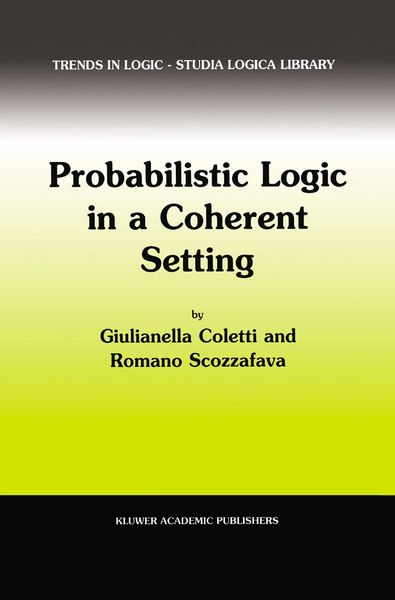
  • Produktbild: Probabilistic Logic in a Coherent Setting
  • Produktbild: Probabilistic Logic in a Coherent Setting
Band 15

Probabilistic Logic in a Coherent Setting

Aus der Reihe Trends in Logic

105,99 €

inkl. gesetzl. MwSt., Versandkostenfrei


Beschreibung

Produktdetails

Einband

Taschenbuch

Erscheinungsdatum

31.10.2002

Abbildungen

IV, 291 p.

Verlag

Springer Netherland

Seitenzahl

291

Maße (L/B/H)

24/16/1,7 cm

Gewicht

483 g

Sprache

Englisch

ISBN

978-1-4020-0970-9

Beschreibung

Produktdetails

Einband

Taschenbuch

Erscheinungsdatum

31.10.2002

Abbildungen

IV, 291 p.

Verlag

Springer Netherland

Seitenzahl

291

Maße (L/B/H)

24/16/1,7 cm

Gewicht

483 g

Sprache

Englisch

ISBN

978-1-4020-0970-9

Herstelleradresse

Springer-Verlag KG
Sachsenplatz 4-6
1201 Wien
AT

Email: ProductSafety@springernature.com

Noch keine Bewertungen vorhanden

Verfassen Sie die erste Bewertung zu diesem Artikel

Helfen Sie anderen Kundinnen und Kunden durch Ihre Meinung.

Kundinnen und Kunden meinen

Bewertungen (0)

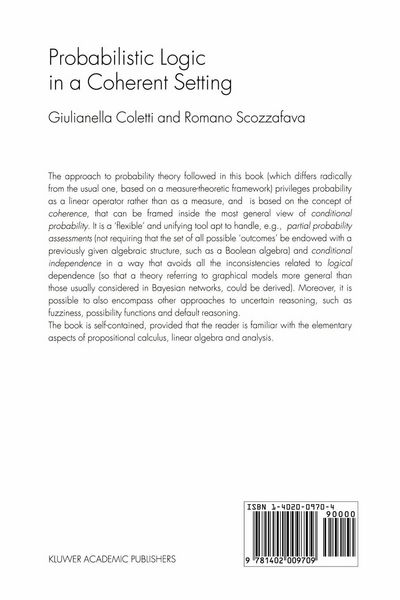
  • Produktbild: Probabilistic Logic in a Coherent Setting
  • Produktbild: Probabilistic Logic in a Coherent Setting
  • 1 Introduction.- 1.1 Aims and motivation.- 1.2 A brief historical perspective.- 2 Events as Propositions.- 2.1 Basic concepts.- 2.2 From “belief” to logic?.- 2.3 Operations.- 2.4 Atoms (or “possible worlds”).- 2.5 Toward probability.- 3 Finitely Additive Probability.- 3.1 Axioms.- 3.2 Sets (of events) without structure.- 3.3 Null probabilities.- 4 Coherent probability.- 4.1 Coherence.- 4.2 Null probabilities (again).- 5 Betting Interpretation of Coherence.- 6 Coherent Extensions of Probability Assessments.- 6.1 de Finetti's fundamental theorem.- 6.2 Probabilistic logic and inference.- 7 Random Quantities.- 8 Probability Meaning and Assessment: a Reconciliation.- 8.1 The “subjective” view.- 8.2 Methods of evaluation.- 9 To Be or not To Be Compositional?.- 10 Conditional Events.- 10.1 Truth values.- 10.2 Operations.- 10.3 Toward conditional probability.- 11 Coherent Conditional Probability.- 11.1 Axioms.- 11.2 Assumed or acquired conditioning?.- 11.3 Coherence.- 11.4 Characterization of a coherent conditional probability.- 11.5 Related results.- 11.6 The role of probabilities 0 and 1.- 12 Zero-Layers.- 12.1 Zero-layers induced by a coherent conditional probability.- 12.2 Spohn's ranking function.- 12.3 Discussion.- 13 Coherent Extensions of Conditional Probability.- 14 Exploiting Zero Probabilities.- 14.1 The algorithm.- 14.2 Locally strong coherence.- 15 Lower and Upper Conditional Probabilities.- 15.1 Coherence intervals.- 15.2 Lower conditional probability.- 15.3 Dempster's theory.- 16 Inference.- 16.1 The general problem.- 16.2 The procedure at work.- 16.3 Discussion.- 16.4 Updating probabilities 0 and 1.- 17 Stochastic Independence in a Coherent Setting.- 17.1 “Precise” probabilities.- 17.2 “Imprecise” probabilities.- 17.3 Discussion.- 17.4Concluding remarks.- 18 A Random Walk in the Midst of Paradigmatic Examples.- 18.1 Finite additivity.- 18.2 Stochastic independence.- 18.3 A not coherent “Radon-Nikodym” conditional probability.- 18.4 A changing “world”.- 18.5 Frequency vs. probability.- 18.6 Acquired or assumed (again).- 18.7 Choosing the conditioning event.- 18.8 Simpson’s paradox.- 18.9 Belief functions.- 19 Fuzzy Sets and Possibility as Coherent Conditional Probabilities.- 19.1 Fuzzy sets: main definitions.- 19.2 Fuzziness and uncertainty.- 19.3 Fuzzy subsets and coherent conditional probability.- 19.4 Possibility functions and coherent conditional probability.- 19.5 Concluding remarks.- 20 Coherent Conditional Probability and Default Reasoning.- 20.1 Default logic through conditional probability equal to 1.- 20.2 Inferential rules.- 20.3 Discussion.- 21 A Short Account of Decomposable Measures of Uncertainty.- 21.1 Operations with conditional events.- 21.2 Decomposable measures.- 21.3 Weakly decomposable measures.- 21.4 Concluding remarks.