Gutscheinbedingungen

**Gültig bis 25.06.2026 auf fremdsprachige Bücher online auf thalia.at und in der Thalia App. Einzelne Artikel können ausgeschlossen sein. Ausgenommen sind preisgebundene Artikel & eBooks. Pro Einkauf einmal einlösbar. Click & Collect nur bei Onlinevorabzahlung möglich. Keine Barauszahlung. Nicht kombinierbar mit anderen Aktionen und Gutscheinen. Gutschein wird auf max. 500€ Bestellwert angerechnet. Nicht gültig für Geschenkkarten, Versandkosten und Services.

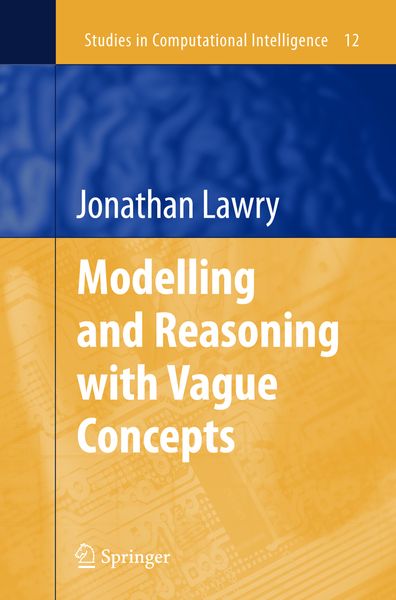
  • Produktbild: Modelling and Reasoning with Vague Concepts
  • Produktbild: Modelling and Reasoning with Vague Concepts
Band 12 - 12%

Modelling and Reasoning with Vague Concepts

12% sparen

95,99 € UVP 109,99 €

inkl. gesetzl. MwSt., Versandkostenfrei


Beschreibung

Produktdetails

Einband

Gebundene Ausgabe

Erscheinungsdatum

11.01.2006

Verlag

Springer Us

Seitenzahl

246

Maße (L/B/H)

24,4/16,4/2,2 cm

Gewicht

526 g

Auflage

2006 edition

Sprache

Englisch

ISBN

978-0-387-29056-0

Beschreibung

Produktdetails

Einband

Gebundene Ausgabe

Erscheinungsdatum

11.01.2006

Verlag

Springer Us

Seitenzahl

246

Maße (L/B/H)

24,4/16,4/2,2 cm

Gewicht

526 g

Auflage

2006 edition

Sprache

Englisch

ISBN

978-0-387-29056-0

Herstelleradresse

Libri GmbH
Europaallee 1
36244 Bad Hersfeld
DE

Email: gpsr@libri.de

Kundinnen und Kunden meinen

0 Bewertungen

Informationen zu Bewertungen

Zur Abgabe einer Bewertung ist eine Anmeldung im Konto notwendig. Die Authentizität der Bewertungen wird von uns nicht überprüft. Wir behalten uns vor, Bewertungstexte, die unseren Richtlinien widersprechen, entsprechend zu kürzen oder zu löschen.

Die Bewertungen sind nach Format, Anzahl Sterne und Datum sortiert.

Verfassen Sie die erste Bewertung zu diesem Artikel

Helfen Sie anderen Kund*innen durch Ihre Meinung

Kundinnen und Kunden meinen

0 Bewertungen filtern

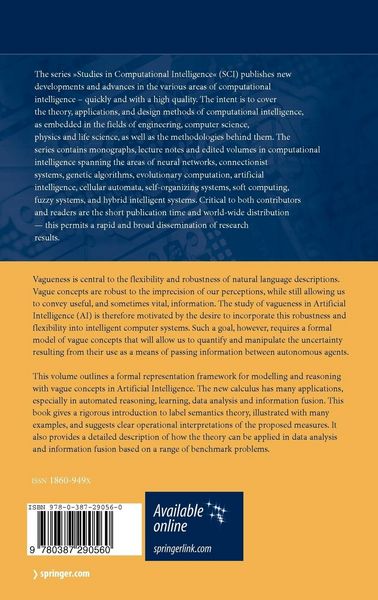
  • Produktbild: Modelling and Reasoning with Vague Concepts
  • Produktbild: Modelling and Reasoning with Vague Concepts
  • List of Figures
    Preface
    Acknowledgments
    Foreword

    1: Introduction

    2: Vague Concepts And Fuzzy Sets
    2.1 Fuzzy Set Theory
    2.2 Functionality and Truth-Functionality
    2.3 Operational Semantics for Membership Functions

    3: Label Semantics
    3.1 Introduction and Motivation
    3.2 Appropriateness Measures and Mass Assignments on Labels
    3.3 Label Expressions and lambda-Sets
    3.4 A Voting Model for Label Semantics
    3.5 Properties of Appropriateness Measures
    3.6 Functional Label Semantics
    3.7 Relating Appropriateness Measures to Dempster-Shafer Theory
    3.8 Mass Selection Functions based on t-norms
    3.9 Alternative Mass Selection Functions
    3.10 An Axiomatic Approach to Appropriateness Measures
    3.11 Label Semantics as a Model of Assertions
    3.12 Relating Label Semantics to Existing Theories of Vagueness

    4: Multi-Dimensional And Multi-Instance Label Semantics
    4.1 Descriptions Based on Many Attributes
    4.2 Multi-dimensional Label Expressions and A-Sets
    4.3 Properties of Multi-dimensional Appropriateness Measures
    4.4 Describing Multiple Objects
    5: Information From Vague Concepts
    5.1 Possibility Theory
    5.2 The Probability of Fuzzy Sets
    5.3 Bayesian Conditioning in Label Semantics
    5.4 Possibilistic Conditioning in Label Semantics
    5.5 Matching Concepts
    5.6 Conditioning From Mass Assignments in Label Semantics

    6: Learning Linguistic Models From Data
    6.1 Defining Labels for Data Modelling
    6.2 Bayesian Classification using Mass Relations
    6.3 Prediction using Mass Relations
    6.4 Qualitative Information from Mass Relations
    6.5 Learning Linguistic Decision Trees
    6.6 Prediction using Decision Trees
    6.7 Query evaluation and Inference from Linguistic Decision Trees

    7: Fusing Knowledge And Data
    7.1 From Label Expressions to Informative Priors
    7.2 Combining Label Expressions with Data

    8: Non-Additive Appropriateness Measures
    8.1 Properties of Generalised Appropriateness Measures
    8.2 Possibilstic Appropriateness Measures
    8.3 An Axiomatic Approach to Generalised Appropriateness Measures
    8.4 The Law of Excluded Middle

    References
    Index