• Produktbild: The Evolution of The Milky Way
  • Produktbild: The Evolution of The Milky Way
Band 255 - 12%

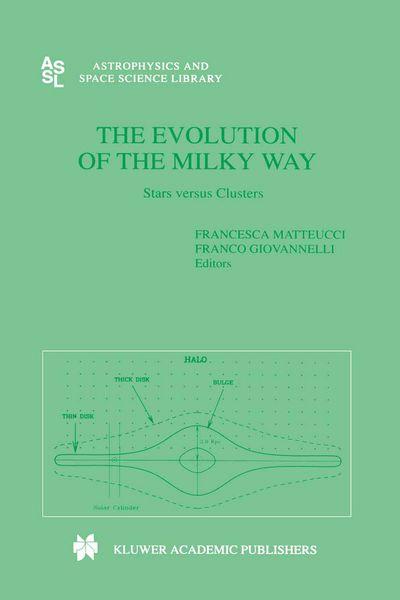
The Evolution of The Milky Way Stars versus Clusters

12% sparen

144,99 € UVP 164,99 €

inkl. gesetzl. MwSt., Versandkostenfrei


Beschreibung

Produktdetails

Einband

Gebundene Ausgabe

Erscheinungsdatum

31.01.2001

Herausgeber

Francesca Matteucci + weitere

Verlag

Springer Netherland

Seitenzahl

624

Maße (L/B/H)

24,1/16/3,9 cm

Gewicht

2370 g

Auflage

2000

Sprache

Englisch

ISBN

978-0-7923-6679-9

Beschreibung

Produktdetails

Einband

Gebundene Ausgabe

Erscheinungsdatum

31.01.2001

Herausgeber

Verlag

Springer Netherland

Seitenzahl

624

Maße (L/B/H)

24,1/16/3,9 cm

Gewicht

2370 g

Auflage

2000

Sprache

Englisch

ISBN

978-0-7923-6679-9

Herstelleradresse

Springer-Verlag GmbH
Tiergartenstr. 17
69121 Heidelberg
DE

Email: ProductSafety@springernature.com

Noch keine Bewertungen vorhanden

Verfassen Sie die erste Bewertung zu diesem Artikel

Helfen Sie anderen Kundinnen und Kunden durch Ihre Meinung.

Kundinnen und Kunden meinen

Bewertungen (0)

  • Produktbild: The Evolution of The Milky Way
  • Produktbild: The Evolution of The Milky Way
  • The Chemical Evolution of the Milky Way: Some Important Facts.- S/¦Á/Fe Abundance Ratios in Galactic Metal Poor Stars.- S/?/Abundance Ratios in Halo Field Stars: is there a Globular Cluster Connection?.- Early Galactic Evolution of Carbon, Nitrogen and Oxygen.- The Origin and Kinematical Evolution of SMR Stars.- Abundances in Supernovae.- Obser-vations of Candidate SMR Stars.- Planetary Nebulae: Abundances and Abundance Gradients.- Planetary Nebulae as Probes of Stellar Evolution and Populations.- Clump Stars in the Solar Neighbourhood.- Mixing Along the Red Giant Branch in Metal-Poor Field Stars.- The Metal Abundance of Galactic Cepheids as Derived from their Pulsational Properties.- Wolf-Rayet Stars, Binaries, Black Holes.- The Evolution of Binaries.- The Origin of X-Ray Pulsars in Binary Systems.- Metal Abundances in Globular Clusters.- On the Globular Cluster IMF below 1M®.- The Effect of CNO and Enhanced a-Elements on Globular Cluster Stars.- HST-UV Observations of Stellar Clusters: Looking for BSS.- HST-WFPC2 Photometry of the Globular Cluster NGC288•Binary Systems, Blue Stragglers and Very Blue Stars.- Infrared Observations of Stellar Clusters.- Can Mira Variables Tell us the Chemical Abundances in Stellar Systems?.- Abundances in Open Star Clusters: What we have to work with.- Galactic Globular Clusters Relative Ages:Clues on the Milky Way Early Evolution.- Infrared Observations of Globular Clusters.- Absolute Magnitude of RR Lyrae in Globular Clusters from Pulsational Properties.- Galactic Globular Clusters as Calibrators of Synthetic Line Indices.- Old Open Clusters as Tracers of Galactic Evolution.- Abundances of Globular Clusters in the Galactic Bulge.- The Globular Clusters and Field Stars in the Galactic Bulge.- The Initial Mass Function of theGalactic Bulge down to ’ 0.15M®.- Radial Variables as Tracers of Stellar Populations.- Abundance Gradients along the Galactic Disk.- The Age of the Galactic Disk.- Compact High Velocity Clouds at High Resolutions.- The Present Rate of Supernovae.- The Role of Classical Novae in the Galactic Nucleo-synthesis.- Faint Stars in the Ursa Minor Dwarf Spheroidal Galaxy: Implications for the Stellar IMF.- Evolution of Heavy Elements in wCen: the Puzzle of s-Enrichments.- Stellar Evolution with Rotation.- The Explosive Yields of Massive Stars.- Asymptotic Giant Branch Stars.- Yields from Type la Supernovae.- The Evolution of Zero Metal Intermediate Mass Stars.- The Effect of External Pollution on the Evolution of Low-Mass Metal-Free Stars.- Explosive Nucleosynthesis of Massive Stars. The Effect of the Metallicity.- Chemical Yields from Low-and Intermediate-Mass Stars.- AGB Stars New Models: Lithium Production in the Galaxy and Magellanic Clouds.- Observational Constraints to the Evolution of Massive Star.- The Chemical Evolution of the Milky Way.- Reconstructing the Star Formation History of the Galaxy.- Inhomogeneous Chemical Evolution of the Galactic Halo.- Stellar Yields and Chemical Evolution.- The Influence of Nova Nucleosynthesis on the Chemical Evolution of the Galaxy.- The Evolution of the Milky Way Disk.- The effects of a Variable IMF on the Chemical Evolution of the Galaxy.- Metallicity Effects on Type Ia Supernovae and Galactic and Cosmic Chemical Evolution.- On the Abundance Gradients in the Galactic Disk.- Formation of Disk Galaxies: on the Angular Momentum Problem, the Tully-Fisher Relation and Magnetohydro-dynamics.- Has the IMF of EG’s Always been the Same?.- Concluding Remarks.- Concluding Address.