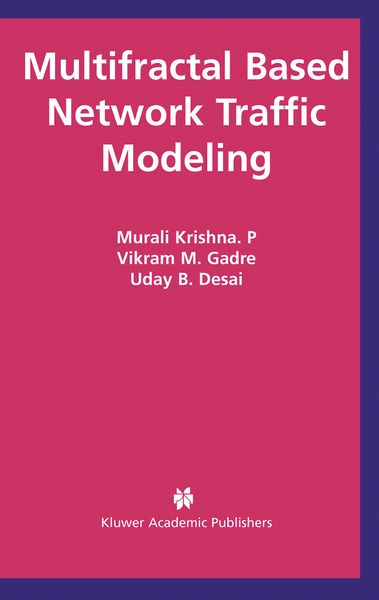

• Produktbild: Multifractal Based Network Traffic Modeling
  • Produktbild: Multifractal Based Network Traffic Modeling
- 12%

Multifractal Based Network Traffic Modeling

12% sparen

95,99 € UVP 109,99 €

inkl. gesetzl. MwSt., Versandkostenfrei


Beschreibung

Produktdetails

Einband

Gebundene Ausgabe

Erscheinungsdatum

31.12.2003

Verlag

Springer Us

Seitenzahl

210

Maße (L/B/H)

23,4/15,6/1,4 cm

Gewicht

520 g

Auflage

2003

Sprache

Englisch

ISBN

978-1-4020-7566-7

Beschreibung

Produktdetails

Einband

Gebundene Ausgabe

Erscheinungsdatum

31.12.2003

Verlag

Springer Us

Seitenzahl

210

Maße (L/B/H)

23,4/15,6/1,4 cm

Gewicht

520 g

Auflage

2003

Sprache

Englisch

ISBN

978-1-4020-7566-7

Herstelleradresse

Libri GmbH
Europaallee 1
36244 Bad Hersfeld
DE

Email: gpsr@libri.de

Noch keine Bewertungen vorhanden

Verfassen Sie die erste Bewertung zu diesem Artikel

Helfen Sie anderen Kundinnen und Kunden durch Ihre Meinung.

Kundinnen und Kunden meinen

Bewertungen (0)

  • Produktbild: Multifractal Based Network Traffic Modeling
  • Produktbild: Multifractal Based Network Traffic Modeling
  • List of Symbols. List of Acronyms. List of Figures. List of Tables. Acknowledgments. Preface.
    -1: Introduction. 1. Complexity of Broadband Network Traffic. 2. Teletraffic Modeling: Historical Perspective. 3. Motivation for the Problem. 4. Contributions of the Monograph. 5. Organization of the Monograph.
    -2: Mathematical Preliminaries. 1. Random Processes. 2. Bernoulli (Counting) Process. 3. Poisson Process. 4. Markov Process. 5. Independent Increment Processes. 6. Self Similar Processes. 7. Fractional Brownian Motion. 8. Heavy Tailed Processes. 9. Analysis and Estimation Techniques for Self Similar Processes. 10. Wavelet Based Analysis of Self Similar Process. 11. The Need for Multifractal Processes. 12. Salient points from the chapter.
    -3: Broadband Network Traffic Modeling. 1. Broadband Network Traffic Characteristics. 2. Network Traffic Modeling Methodology. 3. State-of-the-Art in Teletraffic Modeling. 4. Video Traffic Modeling. 5. Summary of Broadband Traffic Models.
    - 4: Multiplicative Cascades. 1. Binomial Multiplicative Cascade. 2. Characterizing Multifractals through Multifractal Spectrum. 3. Methods to Estimate Multifractal Spectrum. 4. Interpreting the Multifractal Spectrum. 5. Generalized Dimensions. 6. Summary of the Chapter.
    - 5: V.V.G.M Multifractal Model. 1. Development of V.V.G.M Multifractal Model. 2. Statistical Comparison Tests. 3. Test for Robustness of the Parametric Model. 4. Performance and Queuing Tests. 5. Inter Departure Process. 6. V.V.G.M and MWM: A Comparison. 7. Salient Points of the V.V.G.M Model.
    - 6: Analysis of the Multiplexing of Traffic. 1. Analysis of Multiplexing using V.V.G.M Model. 2. Analysis of Multiplexing using Multifractal Spectrum. 3. Analysis of the Multiplexing using Entropy. 4. How Complex is Inter Arrival Data? 5. Salient points from the chapter.
    - 7: Modeling of VBR Video Traces. 1. VBR Video Modeling Using Multifractals. 2. Statistical Tests for Model Evaluation. 3. Results of Queuing Simulations. 4. Complexity of VBR Video Traces. 5. Salient points from the Chapter.
    - 8: QOS Issues and Control of Broadband Traffic. 1. Statistics of Multiplicative Cascade Processes. 2. Queuing Theory for Cascade Processes. 3. Effective Bandwidth Estimation for QoS. 4. Estimation and Prediction of Burstiness. 5. Salient points from the chapter. 9: Conclusions. 1. V.V.G.M Cascade Process for Broadband Network Traffic. 2. Future Work. Appendices: A. Wavelet Transform. B. Legendre Transform. C. Large Deviation Theory. D. Norros's Queuing Model. D.1. Parameterizing QoS Requirements. D.1.1. Parameterizing Buffer Length. D.1.2. Parameterizing Service Rate. D.1.3. Parameterizing Queue Length Distribution. E. Effective Bandwidth. E.1. Properties. E.2. Application in Queuing Systems. F. Kalman Filter.