Gutscheinbedingungen

**Gültig bis 17.08.2026 auf Schreibwaren & Office-Artikel online auf thalia.at, in der Thalia App und in teilnehmenden Thalia Buchhandlungen in Österreich mit Schulsortiment. In den Buchhandlungen nur gültig auf lagernde Ware. Einzelne Artikel können ausgeschlossen sein. Ausgenommen sind preisgebundene Artikel. Pro Einkauf einmal einlösbar. Nur gültig gegen Vorlage oder im Onlineshop hinterlegter Bonuscard. Infos zur Einlösung in der Buchhandlung sind auf der Bonuscard-Vorteilspreisseite zu finden. Click & Collect nur bei Onlinevorabzahlung möglich. Keine Einlösung bei Scan & Go-Bezahlung. Keine Barauszahlung. Nicht kombinierbar mit anderen Aktionen und Gutscheinen. Gutschein wird auf max. 500€ Bestellwert angerechnet. Nicht gültig für Geschenkkarten, Versandkosten und Services.

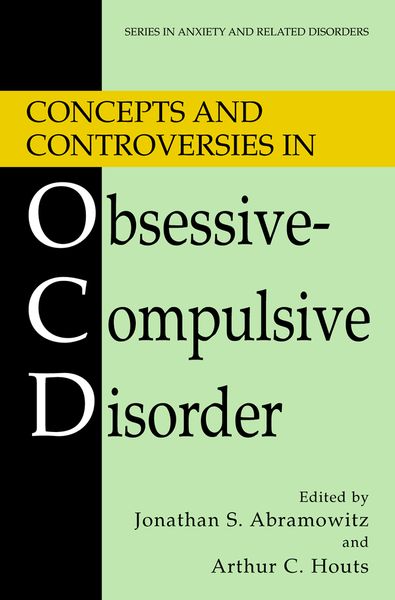
Produktbild: Concepts and Controversies in Obsessive-Compulsive Disorder
- 12%

Concepts and Controversies in Obsessive-Compulsive Disorder

12% sparen

95,99 € UVP 109,99 €

inkl. gesetzl. MwSt., Versandkostenfrei


Beschreibung

Produktdetails

Einband

Gebundene Ausgabe

Erscheinungsdatum

14.09.2005

Herausgeber

Jonathan S. Abramowitz + weitere

Verlag

Springer Us

Seitenzahl

438

Maße (L/B/H)

26,4/18,4/3,2 cm

Gewicht

1149 g

Auflage

2005

Sprache

Englisch

ISBN

978-0-387-23280-5

Beschreibung

Rezension

From the reviews:


Abramowitz and Houts' volume on Concepts and Controversies in OCD is a winner. This is a must read for discerning clinicians, graduate students and researchers wanting to stay on top of the latest information and clinical disagreements about OCD. Experts formally debate the important issues about symptom subtypes, the relationship of OCD and spectrum conditions, biological and psychological models, and cognitive versus behavioral versus pharmacological treatments. This is a cutting edge work likely to catalyze important discoveries about OCD and related problems.


Gail Steketee, PhD

Professor, Co-Chair of Clinical Practice

Boston University School of Social Work


"Over the past 30 years, clinical scientists have devoted considerable attention to the experiences of people suffering from obsessive-compulsive disorder (OCD). … The unique feature of this volume is that it revolves around a series of exchanges or discussions. ... The book’s principal value lies in the presentation of information from a number of different fields of study. … The topics included in the volume are well chosen … . The editors have done the field a great service … ." (Thomas F. Oltmanns, PsycCRITIQUES, Vol. 51 (27), July, 2006)

Produktdetails

Einband

Gebundene Ausgabe

Erscheinungsdatum

14.09.2005

Herausgeber

Verlag

Springer Us

Seitenzahl

438

Maße (L/B/H)

26,4/18,4/3,2 cm

Gewicht

1149 g

Auflage

2005

Sprache

Englisch

ISBN

978-0-387-23280-5

Herstelleradresse

Libri GmbH
Europaallee 1
36244 Bad Hersfeld
DE

Email: GPSR Kontakt

Noch keine Bewertungen vorhanden

Verfassen Sie die erste Bewertung zu diesem Artikel

Helfen Sie anderen Kundinnen und Kunden durch Ihre Meinung.

Kundinnen und Kunden meinen

Bewertungen (0)

  • Produktbild: Concepts and Controversies in Obsessive-Compulsive Disorder
  • PART I. PHENOMENOLOGY 1. Symptom Dimensions in OCD: Developmental and Evolutionary Perspectives.
    James F. Leckman, David Mataix-Cols, and Maria Conceição do Rosario-Campos 2. Dimensional and Subtype Models of OCD
    Steven Taylor Reply to Taylor. Combined Dimensional and Categorical Perspectives as an Integrative Approach to OCD
    James F. Leckman, David Mataix-Cols, and Maria Conceição do Rosario-Capos Reply to Leckman et al. Putting the Symptom Dimension Model to the Test
    Steven Taylor 3. Animal Models of Obsessive Compulsive Disorder: A Neurobiological and Ethological Perspective
    Nicholas H. Dodman and Louis Shuster 4. Behavioral and Functional Models of OCD
    Arthur C. Houts Reply to Houts. A Dysfunctional Animal Model of OCD
    Nicholas H. Dodman Reply to Dodman. Animal Models and Two Traditions in OCD Research
    Arthur C. Houts 5. The Case for the OCD Spectrum
    Eric Hollander, Jennifer P. Friedberg, Stacey Wasserman, Chin-Chin Yeh, and Rupa Iyengar 6. Obsessive-Compulsive Disorder: Essential Phenomenology and Overlap with Other Anxiety Disorders
    Jonathan S. Abramowitz and Brett J. Deacon Reply to Abramowitz and Deacon. Beyond Anxiety: Etiological and Functional Overlaps Between OCD and OC Spectrum Disorders
    Eric Hollander and Chin-Chin Yeh Reply to Hollander et al. The OC Spectrum: A Closer Look at the Arguments and the Data
    Jonathan S. Abramowitz and Brett J. Deacon 7. Trichotillomania: An Obsessive-Compulsive Spectrum Disorder
    Dan J. Stein, Christine Lochner, Sian Hemmings, and Craig Kinnear 8. Overlap of Body Dysmorphic Disorder and Hypochondriasis with OCD
    FugenNeziroglu and SonyKhemlani-Patel 9. Contrasting Nonparaphilic Sexual Addictions and OCD
    Stefanie A. Schwartz and Jonathan S. Abramowitz 10. Compulsive Buying: A Disorder of Compulsivity or Impulsivity
    Lorraine A. Swan-Kremeir, James E. Mitchell and Ronald J. Faber 11. Contrasting Tourette’s Syndrome and Tic Disorders with OCD
    Kieron O’Connor PART II. ETIOLOGY 12. Neuropsychiatric Models of OCD
    David R. Rosenberg, Aileen Russell, and Andrea Fougere 13. Cognitive-Behavioral Models of OCD
    Roz Shafran Reply to Shagran. Biological and Cognitive Models of OCD: Seeking Similarities and Achieving Progress Together
    David R. Rosenberg, Aileen Russell, and Andrea Fougere Reply to Rosenberg et al. Biological Versus Psychological Approaches to OCD: War or Peace?Roz Shafran and Anne Speckens PART III. TREATMENT 14. Formal Cognitive Therapy: A New Treatment for OCD
    Jeanne Fama and Sabine Wilhelm 15. Treatment for OCD: Unleashing the Power of Exposure
    Reply to Kozak and Coles. Expanding the Conceptualization of Cognitive Therapy and its Therapeutic Potential
    Jeanne Fama and Sabine Wilhelm Reply to Fama and Wilhelm. Cognitive Therapy and Exposure Treatment for OCD: Contrast and Rapprochment
    Michael J. Kozak and Meredith E. Coles 16. The Role of the Therapist in Behavior Therapy for OCD
    David F. Tolin and Scott Hannan 17. Self-Directed Exposure in the Treatment of OCD
    Cheryl N. Carmin, Pamela S. Wiegartz, and Kevin D. Wu Reply to Carmin et al. What’s in a Name? The Distinction Between Self-Directed and