Gutscheinbedingungen

**Gültig bis 06.07.2026 auf fremdsprachige Bücher online auf thalia.at, in der Thalia App ab einem Mindestbestellwert von 30€ und in allen Thalia Buchhandlungen in Österreich. In den Buchhandlungen nur gültig auf lagernde Ware. Einzelne Artikel können ausgeschlossen sein. Ausgenommen sind preisgebundene Artikel & eBooks. Pro Einkauf einmal einlösbar. Nur gültig gegen Vorlage oder im Onlineshop hinterlegter Bonuscard. Infos zur Einlösung in der Buchhandlung sind auf der Bonuscard-Vorteilspreisseite zu finden. Click & Collect nur bei Onlinevorabzahlung möglich. Keine Einlösung bei Scan & Go-Bezahlung. Keine Barauszahlung. Nicht kombinierbar mit anderen Aktionen und Gutscheinen. Gutschein wird auf max. 500€ Bestellwert angerechnet. Nicht gültig für Versandkosten und Services.

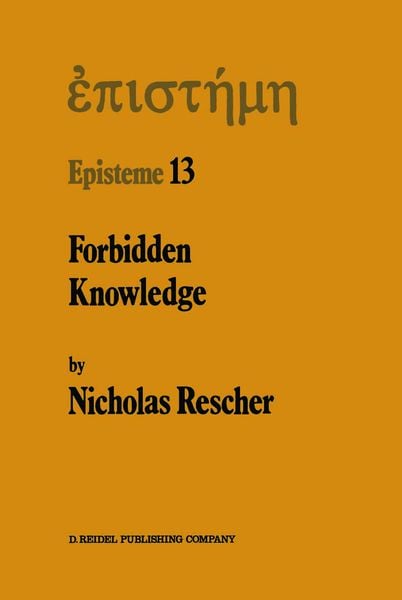
Produktbild: Forbidden Knowledge
Band 13 - 11%

Forbidden Knowledge And Other Essays on the Philosophy of Cognition

Aus der Reihe Episteme
11% sparen

96,99 € UVP 109,99 €

inkl. gesetzl. MwSt., Versandkostenfrei


Beschreibung

Produktdetails

Einband

Gebundene Ausgabe

Erscheinungsdatum

31.08.1987

Verlag

Springer Netherland

Seitenzahl

154

Maße (L/B/H)

23,5/15,7/1,3 cm

Gewicht

426 g

Auflage

1. Auflage

Sprache

Englisch

ISBN

978-90-277-2410-6

Beschreibung

Produktdetails

Einband

Gebundene Ausgabe

Erscheinungsdatum

31.08.1987

Verlag

Springer Netherland

Seitenzahl

154

Maße (L/B/H)

23,5/15,7/1,3 cm

Gewicht

426 g

Auflage

1. Auflage

Sprache

Englisch

ISBN

978-90-277-2410-6

Herstelleradresse

Springer-Verlag GmbH
Tiergartenstr. 17
69121 Heidelberg
DE

Email: ProductSafety@springernature.com

Noch keine Bewertungen vorhanden

Verfassen Sie die erste Bewertung zu diesem Artikel

Helfen Sie anderen Kundinnen und Kunden durch Ihre Meinung.

Kundinnen und Kunden meinen

Bewertungen (0)

  • Produktbild: Forbidden Knowledge
  • One/Forbidden Knowledge: Moral Limits of Scientific Research.- 1. A Range of Positions.- 2. Regulation vs. Laissez Faire.- 3. Moral Limits Pertain to Different Aspects of Knowledge.- 4. Can Knowledge as Such be Morally Inappropriate?.- 5. Knowledge is Only One Good among Others.- 6. The Enforcement of Morals.- 7. Coda.- Two/Truth as Ideal Coherence.- 1. The ‘Continuity Condition’ Relating a Criterion to the Definition of Truth.- 2. Truth as Ideal Coherence.- 3. Coherentism and Truth as Adequation.- 4. Postscript: The Gap Between the Real and the Ideal.- Three/Rationality and Consistency.- 1. Consistency: Initial Requisite or Ultimate Ideal?.- 2. Linearly Inferential vs. Dialectically Cyclic Reasoning.- 3. Ampliative vs. Reductive Reasoning.- 4. Two Very Different Sorts of Acceptability: Qualified vs. Outright Belief.- 5. Different Attitudes Towards Consistency.- 6. The Place of Dialectics in the Human Sciences.- 7. Must Inconsistency-Tolerance Be Motivated Epistemically?.- 8. Consistency as a Cognitive Ideal.- Four/An End to Science?.- 1. Is Scientific Discovery an Inherently Bounded Venture?.- 2. Nature Might Exhibit an Unending Complexity of Physical Constitution.- 3. Nature Might Exhibit an Unending Complexity of Lawful Comportment.- 4. The Phenomena of Nature Might Be Unendingly Diverse.- 5. The Basis for an Unending Prospect of Scientific Discovery Might Lie Wholly in the Character of Our Inquiry Processes.- 6. The Regulative Rationale for Supposing the Cognitive Inexhaustibility of Nature.- Five/On the Probabilistic Bearing of Testimony.- 1. Introduction.- 2. The Reliability of Sources.- 3.The Knowledgeability of Sources.- 4. Some Variations.- 5. A Survey of Probative Virtues.- 6. The Taxicab Problem.- 7. Hume and Laplace on Human Testimony.- 8. Laplace on Testimonial Chains.- 9. The Moral of the Story.- Six/The Limits of Probabilistic Epistemology.- 1. The Probabilist Program.- 2. Probability Is Not Enough.- Seven/The Threefold Way.- 1. The Three Levels.- 2. Some Examples.- 3. Man as a Creature of the Threefold Way.- 4. The Question of Legitimacy: The Utility of the Ideal.- Eight/Number Idolatry and Fallacies of Quantification.- Nine/Life’s Seasons: The Conceptual Phenomenology of Age-Periodization.- 1. The General Idea of a Life Cycle.- 2. The Rationale of Human Age-Periodization Phase Transitions.- 3. The Diversity of Age.- 4. The Conventionality of Phase Transition.- 5. Thought Experiments.- 6. The Upshot.- 7. Broader Vistas.- Ten/Philosophical Taxonomy as A Philosophical Issue.- 1. The Shape of Philosophy: Some Ancient Views.- 2. The Middle Ages and Early Modern Times.- 3. A Later Picture.- 4. Taxonomic Dynamics.- 5. The Post-Kantian Transformation.- 6. Taxonomic Proliferation.- 7. The Contemporary Situation.- 8. The Problem of Progress.- 9. The Dialectic of the Individual and the Community.- 10. Conclusion.- Eleven/Is Philosophy a Guide to Life?.- 1. Philosophy: The Problematic Guide.- 2. The Problem of ‘Applied Philosophy’: Only One’s Own Philosophy Can Provide Guidance.- 3. What Philosophy Per Se Can Contribute.- 4. Some Examples of ‘Applied Philosophy’ in the Public Domain.- 5. The Limited Utility of Methodological Applications.- 6. A Danger of ‘Applied Philosophy’.- Notes.- Index of Names.