
KI-Beratung Beta

  • Produktbild: Philosophical Medical Ethics: Its Nature and Significance
  • Produktbild: Philosophical Medical Ethics: Its Nature and Significance
Band 3

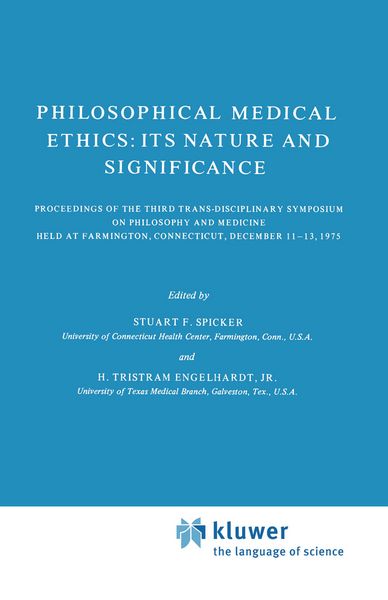
Philosophical Medical Ethics: Its Nature and Significance Proceedings of the Third Trans-Disciplinary Symposium on Philosophy and Medicine Held at Farmington, Connecticut, December 11–13, 1975

Aus der Reihe Philosophy and Medicine

164,99 €

inkl. gesetzl. MwSt., Versandkostenfrei


Beschreibung

in a scientific way, and takes the patient and his family into his confidence. Thus he learns something from the sufferer, and at the same time instructs the invalid to the best of his power. He does not give his prescriptions until he has won the patient's support, and when he has done so, he steadilY...

Beschreibung

in a scientific way, and takes the patient and his family into his confidence. Thus he learns something from the sufferer, and at the same time instructs the invalid to the best of his power. He does not give his prescriptions until he has won the patient's support, and when he has done so, he steadilY aims at producing complete restoration to health by persuading the sufferer in to compliance (Laws 4. 720 b-e, [28]). This passage shows the perennial nature of the problems of treating the patient as a person. It shows as well the historical'depth of philosophical interest in medicine. The history of philosophy includes more reflections upon medical ethics than the casual reader might suspect. Many of these reflections are pertinent to contemporary issues such as abortion and population control. Plato, for example, recommends abortion in cases of incest (Republic 5. 461c); and Aristotle argues for letting seriously deformed children die, while forbidding infanticide as a means of popUlation control, suggesting instead the use of early abortions. 'As to the exposure in rearing of children, let there be a law that no deformed child shall live, but that on the ground of an excess in the number of children . . . let abortion be procured before sense and life have begun; what mayor may not be lawfully done in these cases depends on the question of life and sensation' (Politics VII, 16,335 b20-26, [4]).

Produktdetails

Einband

Gebundene Ausgabe

Erscheinungsdatum

31.08.1977

Abbildungen

VI, 252 p.

Herausgeber S.F. Spicker + weitere

Produktdetails

Einband

Gebundene Ausgabe

Erscheinungsdatum

31.08.1977

Abbildungen

VI, 252 p.

Herausgeber
Verlag Springer Netherland
Seitenzahl

252

Maße (L/B/H)

24,1/16/1,9 cm

Gewicht

510 g

Auflage

1977

Sprache

Englisch

ISBN

978-90-277-0772-7

Herstelleradresse

Springer-Verlag GmbH
Europaplatz 3
69115 Heidelberg
DE

Email: ProductSafety@springernature.com

Noch keine Bewertungen vorhanden

Verfassen Sie die erste Bewertung zu diesem Artikel

Helfen Sie anderen Kundinnen und Kunden durch Ihre Meinung.

Kundinnen und Kunden meinen

Bewertungen (0)

  • Produktbild: Philosophical Medical Ethics: Its Nature and Significance
  • Produktbild: Philosophical Medical Ethics: Its Nature and Significance
  • Prologue.- Section I / From Past Perspectives to Present Perplexities.- American Medical Ethics: Some Historical Roots.- Do No Harm: Axiom of Medical Ethics.- Discussion of ‘Do No Harm’.- Section II / Ethics and Medical Ethics.- Medical Ethics: Can the Moral Philosopher Help?.- Medical Ethics and the Rule Against Killing: Comments on Professor Hare’s Paper.- Section III / Special Rights and Duties: From Euthanasia to Experimentation.- Euthanasia and the Right to Life.- Euthanasia, the Right to Life, and Moral Structures: A Reply to Professor Kohl.- Experimentation and Consent: A Note.- Medical Experimentation: The Consent of Prisoners and Children.- Section IV / Changing Human Nature: Medicine in the Service of Virtue.- Aristotelian Ethics, Medicine, and the Changing Nature of Man.- Medicine’s Influence on Ethics: Reflections on the Putative Moral Role of Medicine.- Section V / Metaphysics and Medical Ethics.- Ethics in Evolution.- Coming Into Being and Passing Away: Can the Metaphysician Help?.- Some Persons are Humans, Some Humans are Persons, and the World is What We Persons Make of It.- Section VI / Moral Agents in Medicine.- Patients as Agents.- Moral Agency and Professional Ethics: Some Notes on Transformation of the Physician-Patient Encounter.- Section VII / The Physician as Moral Agent.- Round Table Discussion.- Opening Remarks.- Closing Reflections.- Notes on Contributors.