KI-Beratung Beta

Gutscheinbedingungen

**Gültig bis 18.11.2026 auf englischsprachige Klassiker (klassiker-32728) online auf thalia.at und in der Thalia App. Einzelne Artikel können ausgeschlossen sein. Ausgenommen sind preisgebundene Artikel & eBooks. Pro Einkauf einmal einlösbar. Click & Collect nur bei Onlinevorabzahlung möglich. Keine Barauszahlung. Nicht kombinierbar mit anderen Aktionen und Gutscheinen. Gutschein wird auf max. 500€ Bestellwert angerechnet. Nicht gültig für Geschenkkarten, Versandkosten und Services.

  • Produktbild: Learning Mathematics
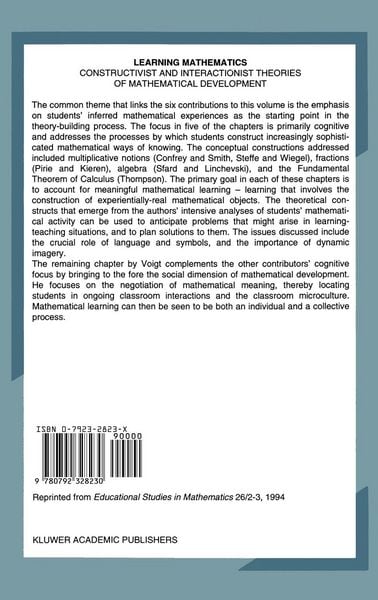
  • Produktbild: Learning Mathematics

Learning Mathematics Constructivist and Interactionist Theories of Mathematical Development

109,99 €

inkl. gesetzl. MwSt., Versandkostenfrei


Beschreibung

The first five contributions to this Special Issue on Theories of Mathematical Learning take a cognitive perspective whereas the sixth, that by Voigt, takes an interactionist perspective. The common theme that links the six articles is the focus on students' inferred experiences as the starting point...

Beschreibung

The first five contributions to this Special Issue on Theories of Mathematical Learning take a cognitive perspective whereas the sixth, that by Voigt, takes an interactionist perspective. The common theme that links the six articles is the focus on students' inferred experiences as the starting point in the theory-building process. This emphasis on the meanings that objects and events have for students within their experiential realities can be contrasted with approaches in which the goal is to specify cognitive behaviors that yield an input-output match with observed behavior. It is important to note that the term 'experience' as it is used in these articles is not restricted to physical or sensory-motor experience. A perusal of the first five articles indicates that it includes reflective experiences that involve reviewing prior activity and anticipating the results of potential activity. In addition, by emphasizing interaction and communication, Voigt's contribution reminds us that personal experiences do not arise in a vacuum but instead have a social aspect. In taking a cognitive perspective, the first five contributions analyze the pro cesses by which students conceptually reorganize their experiential realities and thus construct increasingly sophisticated mathematical ways of knowing. The conceptual constructions addressed by these theorists, ranging as they do from fractions to the Fundamental Theorem of Calculus, indicate that experiential approaches to mathematical cognition are viable at all levels of mathematical development. Although the authors use different theoretical constructs, several additional commonalities can be discerned in their work.

Produktdetails

Einband

Gebundene Ausgabe

Erscheinungsdatum

30.04.1994

Abbildungen

VI, 194 p.

Herausgeber Paul Cobb

Produktdetails

Einband

Gebundene Ausgabe

Erscheinungsdatum

30.04.1994

Abbildungen

VI, 194 p.

Herausgeber Paul Cobb
Verlag Springer Netherland
Seitenzahl

194

Maße (L/B/H)

24,1/16/1,6 cm

Gewicht

425 g

Auflage

Reprinted from EDUCATIONAL STUDIES IN MATHEMATICS, 26:2-3, 1994

Sprache

Englisch

ISBN

978-0-7923-2823-0

Herstelleradresse

Springer-Verlag GmbH
Europaplatz 3
69115 Heidelberg
DE

Email: ProductSafety@springernature.com

Noch keine Bewertungen vorhanden

Verfassen Sie die erste Bewertung zu diesem Artikel

Helfen Sie anderen Kundinnen und Kunden durch Ihre Meinung.

Kundinnen und Kunden meinen

Bewertungen (0)

Weitere Artikel finden Sie in

  • Produktbild: Learning Mathematics
  • Produktbild: Learning Mathematics
  • Cognitive Play and Mathematical Learning in Computer Microworlds.- Exponential Functions, Rates of Change, and the Multiplicative Unit.- Growth in Mathematical Understanding: How Can We Characterise It and How Can We Represent It?.- The Gains and the Pitfalls of Reification — The Case of Algebra.- Images of Rate and Operational Understanding of the Fundamental Theorem of Calculus†.- Negotiation of Mathematical Meaning and Learning Mathematics.