
Three-Dimensional Machine Vision
-
- Hardcover ausgewählt
- Taschenbuch
-
Sprache:Englisch
289,99 €
inkl. gesetzl. MwSt.,
Beschreibung
Produktdetails
Einband
Gebundene Ausgabe
Erscheinungsdatum
31.03.1987
Verlag
Springer UsSeitenzahl
610
Maße (L/B/H)
23,4/15,6/3,3 cm
Gewicht
1039 g
Auflage
1987
Sprache
Englisch
ISBN
978-0-89838-188-7
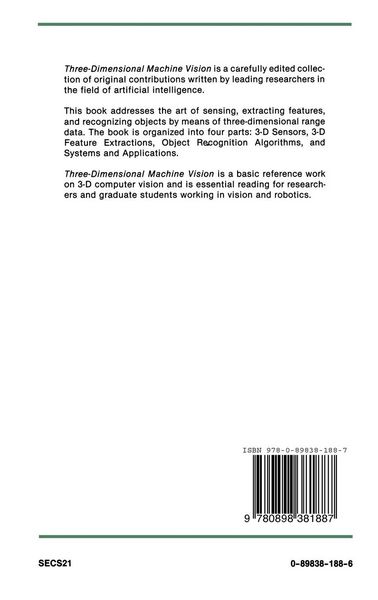
Arobotmustperceivethethree-dimensionalworldifitistobeeffective there. Yet recovering 3-D information from projected images is difficult, and still remains thesubjectofbasic research. Alternatively, onecan use sensorsthatcanprovidethree-dimensionalrangeinformationdirectly. The technique ofprojecting light-stripesstartedto be used in industrialobject recognition systems asearly asthe 1970s,andtime-of-flight laser-scanning range finders became available for outdoor mobile robotnavigation in the mid-eighties. Once range data are obtained, a vision system must still describe the scene in terms of 3-D primitives such as edges, surfaces, and volumes, and recognize objeCts of interest. Today, the art of sensing, extractingfeatures, and recognizing objectsbymeans ofthree-dimensional rangedataisoneofthemostexcitingresearchareasincomputervision. Three-Dimensional Machine Vision is a collection of papers dealing withthree-dimensionalrangedata. Theauthorsarepioneeringresearchers: some are founders and others are bringingnew excitements in thefield. I have tried to select milestone papers, and my goalhas beento make this bookareferenceworkforresearchersinthree-dimensionalvision. The book is organized into four parts: 3-D Sensors, 3-D Feature Extractions,ObjectRecognitionAlgorithms,andSystemsandApplications. Part I includes four papers which describe the development of unique, capable 3-D range sensors, as well as discussions of optical, geometrical, electronic, and computational issues. Mundy and Porter describe asensor systembasedonstructuredilluminationforinspectingmetalliccastings. In order to achieve high-speed data acquisition, it uses multiple lightstripes withwavelength multiplexing. Case, Jalkio,andKim alsopresentamulti- stripe system and discuss various design issues in range sensing by triangulation. ThenumericalstereocameradevelopedbyAltschuler, Bae, Altschuler, Dijak, Tamburino, and Woolford projects space-coded grid patterns which are generated by an electro-optical programmable spatial viii PREFACE light modulator. Kanade and Fuhrman present a proximity sensor using multipleLEDswhich areconically arranged. Itcan measurebothdistance andorientationofanobject'ssurface.
Noch keine Bewertungen vorhanden
Verfassen Sie die erste Bewertung zu diesem Artikel
Helfen Sie anderen Kundinnen und Kunden durch Ihre Meinung.
Kurze Frage zu unserer Seite
Vielen Dank für Ihr Feedback
Wir nutzen Ihr Feedback, um unsere Produktseiten zu verbessern. Bitte haben Sie Verständnis, dass wir Ihnen keine Rückmeldung geben können. Falls Sie Kontakt mit uns aufnehmen möchten, können Sie sich aber gerne an unseren Kund*innenservice wenden.
zum Kundenservice