
Gutscheinbedingungen

**Gültig bis 15.06.2026 auf Spiele & Spielzeug online auf thalia.at, in der Thalia App ab einem Mindestbestellwert von 30€ und in allen Thalia Buchhandlungen in Österreich. In den Buchhandlungen nur gültig auf lagernde Ware. Einzelne Artikel können ausgeschlossen sein. Ausgenommen sind preisgebundene Artikel sowie online auf thalia.at und in der Thalia App einzelne Artikel von tonies®. Pro Einkauf einmal einlösbar. Nur gültig gegen Vorlage oder im Onlineshop hinterlegter Bonuscard. Infos zur Einlösung in der Buchhandlung sind auf der Bonuscard-Vorteilspreisseite zu finden. Click & Collect nur bei Onlinevorabzahlung möglich. Keine Einlösung bei Scan & Go-Bezahlung. Keine Barauszahlung. Nicht kombinierbar mit anderen Aktionen und Gutscheinen. Gutschein wird auf max. 500€ Bestellwert angerechnet. Nicht gültig für Geschenkkarten, Versandkosten und Services.

  • Produktbild: Philosophy of Geometry from Riemann to Poincaré
  • Produktbild: Philosophy of Geometry from Riemann to Poincaré
Band 7 - 12%

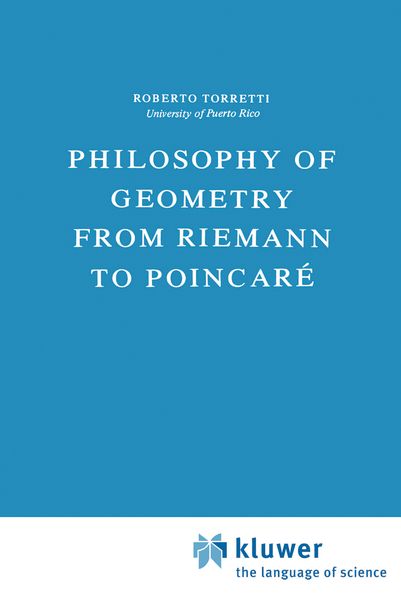
Philosophy of Geometry from Riemann to Poincaré

Aus der Reihe Episteme
12% sparen

192,99 € UVP 219,99 €

inkl. gesetzl. MwSt., Versandkostenfrei


Beschreibung

Produktdetails

Einband

Gebundene Ausgabe

Erscheinungsdatum

30.11.1978

Verlag

Springer Netherland

Seitenzahl

461

Maße (L/B/H)

24,1/16/3,1 cm

Gewicht

848 g

Auflage

1. Auflage

Sprache

Englisch

ISBN

978-90-277-0920-2

Beschreibung

Rezension

`
...a carefull and scholarly discussion of the history and philosophy of geometry from the 1850's, marked by Riemann's generalized conception of space, and ending with Hilbert's axiomatics and Poincaré's conventionalism at the beginning of the century.
'

The Modern Schoolman

`
This is a deeply learned, scrupulously careful, very informative book which was well worth writing... In sum, Toretti has written carefully, with much insight, deep and broad learning, and sober judgement on a topic of profound difficulty and interest.
'

Australian Journal of Philosophy

`
Torretti has written a very useful book which helps fill a large gap in the literature on the philosophy of mathematics.
'

The Philosophical Quarterly

`
It delves into the contributions of many neglected writers and dispells myths concerning the contributions of others, which have too often been perpetuated in the philosophical literature... I suggest that it deserves to become a standard word.
'

Dialogue

Produktdetails

Einband

Gebundene Ausgabe

Erscheinungsdatum

30.11.1978

Verlag

Springer Netherland

Seitenzahl

461

Maße (L/B/H)

24,1/16/3,1 cm

Gewicht

848 g

Auflage

1. Auflage

Sprache

Englisch

ISBN

978-90-277-0920-2

Herstelleradresse

Springer-Verlag GmbH
Tiergartenstr. 17
69121 Heidelberg
DE

Email: ProductSafety@springernature.com

Kundinnen und Kunden meinen

0 Bewertungen

Informationen zu Bewertungen

Zur Abgabe einer Bewertung ist eine Anmeldung im Konto notwendig. Die Authentizität der Bewertungen wird von uns nicht überprüft. Wir behalten uns vor, Bewertungstexte, die unseren Richtlinien widersprechen, entsprechend zu kürzen oder zu löschen.

Die Bewertungen sind nach Format, Anzahl Sterne und Datum sortiert.

Verfassen Sie die erste Bewertung zu diesem Artikel

Helfen Sie anderen Kund*innen durch Ihre Meinung

Kundinnen und Kunden meinen

0 Bewertungen filtern

  • Produktbild: Philosophy of Geometry from Riemann to Poincaré
  • Produktbild: Philosophy of Geometry from Riemann to Poincaré
  • 1 / Background.- 1.0.1 Greek Geometry and Philosophy.- 1.0.2 Geometry in Greek Natural Science.- 1.0.3 Modern Science and the Metaphysical Idea of Space.- 1.0.4 Descartes’ Method of Coordinates.- 2 / Non-Euclidean Geometries.- 2.1 Parallels.- 2.1.1 Euclid’s Fifth Postulate.- 2.1.2 Greek Commentators.- 2.1.3 Wallis and Saccheri.- 2.1.4 Johann Heinrich Lambert.- 2.1.5 The Discovery of Non-Euclidean Geometry.- 2.1.6 Some Results of Bolyai-Lobachevsky Geometry.- 2.1.7 The Philosophical Outlook of the Founders of Non-Euclidean Geometry.- 2.2 Manifolds.- 2.2.1 Introduction.- 2.2.2 Curves and their Curvature.- 2.2.3 Gaussian Curvature of Surfaces.- 2.2.4 Gauss’ Theorema Egregium and the Intrinsic Geometry of Surfaces.- 2.2.5 Riemann’s Problem of Space and Geometry.- 2.2.6 The Concept of a Manifold.- 2.2.7 The Tangent Space.- 2.2.8 Riemannian Manifolds, Metrics and Curvature.- 2.2.9 Riemann’s Speculations about Physical Space.- 2.2.10 Riemann and Herbart. Grassmann.- 2.3 Projective Geometry and Projective Metrics.- 2.3.1 Introduction.- 2.3.2 Projective Geometry: An Intuitive Approach.- 2.3.3 Projective Geometry: A Numerical Interpretation.- 2.3.4 Projective Transformations.- 2.3.5 Cross-ratio.- 2.3.6 Projective Metrics.- 2.3.7 Models.- 2.3.8 Transformation Groups and Klein’s Erlangen Programme.- 2.3.9 Projective Coordinates for Intuitive Space.- 2.3.10 Klein’s View of Intuition and the Problem of Space-Forms.- 3 / Foundations.- 3.1 Helmholtz’s Problem of Space.- 3.1.1 Helmholtz and Riemann.- 3.1.2 The Facts which Lie at the Foundation of Geometry.- 3.1.3 Helmholtz’s Philosophy of Geometry.- 3.1.4 Lie Groups.- 3.1.5 Lie’s Solution of Helmholtz’s Problem.- 3.1.6 Poincaré and Killing on the Foundations of Geometry.- 3.1.7 Hilbert’s Group-Theoretical Characterization of the Euclidean Plane.- 3.2 Axiomatics.- 3.2.1 The Beginnings of Modern Geometrical Axiomatics.- 3.2.2 Why are Axiomatic Theories Naturally Abstract?.- 3.2.3 Stewart, Grassmann, Plücker.- 3.2.4 Geometrical Axiomatics before Pasch.- 3.2.5 Moritz Pasch.- 3.2.6 Giuseppe Peano.- 3.2.7 The Italian School. Pieri. Padoa.- 3.2.8 Hilbert’s Grundlagen.- 3.2.9 Geometrical Axiomatics after Hilbert.- 3.2.10 Axioms and Definitions. Frege’s Criticism of Hilbert.- 4 / Empiricism, Apriorism, Conventionalism.- 4.1 Empiricism in Geometry.- 4.1.1 John Stuart Mill.- 4.1.2 Friedrich Ueberweg.- 4.1.3 Benno Erdmann.- 4.1.4 Auguste Calinon.- 4.1.5 Ernst Mach.- 4.2 The Uproar of Boeotians.- 4.2.1 Hermann Lotze.- 4.2.2 Wilhelm Wundt.- 4.2.3 Charles Renouvier.- 4.2.4 Joseph Delboeuf.- 4.3 Russell’s Apriorism of 1897.- 4.3.1 The Transcendental Approach.- 4.3.2 The ‘Axioms of Projective Geometry’.- 4.3.3 Metrics and Quantity.- 4.3.4 The Axiom of Distance.- 4.3.5 The Axiom of Free Mobility.- 4.3.6 A Geometrical Experiment.- 4.3.7 Multidimensional Series.- 4.4 Henri Poincaré.- 4.4.1 Poincaré’s Conventionalism.- 4.4.2 Max Black’s Interpretation of Poincaré’s Philosophy of Geometry.- 4.4.3 Poincaré’s Criticism of Apriorism and Empiricism.- 4.4.4 The Conventionality of Metrics.- 4.4.5 The Genesis of Geometry.- 4.5.6 The Definition of Dimension Number.- 1. Mappings.- 2. Algebraic Structures. Groups.- 3. Topologies.- 4. Differentiable Manifolds.- Notes.- To Chapter 1.- To Chapter 2.- 2.1.- 2.2.- 2.3.- To Chapter 3.- 3.1.- 3.2.- To Chapter 4.- 4.1.- 4.2.- 4.3.- 4.4.- References.