Gutscheinbedingungen

**Gültig bis 06.07.2026 auf fremdsprachige Bücher online auf thalia.at, in der Thalia App ab einem Mindestbestellwert von 30€ und in allen Thalia Buchhandlungen in Österreich. In den Buchhandlungen nur gültig auf lagernde Ware. Einzelne Artikel können ausgeschlossen sein. Ausgenommen sind preisgebundene Artikel & eBooks. Pro Einkauf einmal einlösbar. Nur gültig gegen Vorlage oder im Onlineshop hinterlegter Bonuscard. Infos zur Einlösung in der Buchhandlung sind auf der Bonuscard-Vorteilspreisseite zu finden. Click & Collect nur bei Onlinevorabzahlung möglich. Keine Einlösung bei Scan & Go-Bezahlung. Keine Barauszahlung. Nicht kombinierbar mit anderen Aktionen und Gutscheinen. Gutschein wird auf max. 500€ Bestellwert angerechnet. Nicht gültig für Versandkosten und Services.

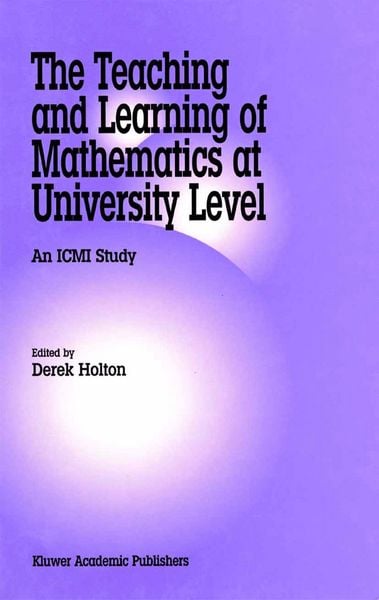
  • Produktbild: The Teaching and Learning of Mathematics at University Level
  • Produktbild: The Teaching and Learning of Mathematics at University Level
Band 7 - 12%

The Teaching and Learning of Mathematics at University Level An ICMI Study

Aus der Reihe New ICMI Study Series
12% sparen

221,99 € UVP 252,99 €

inkl. gesetzl. MwSt., Versandkostenfrei


Beschreibung

Produktdetails

Einband

Taschenbuch

Erscheinungsdatum

30.09.2001

Herausgeber

Derek Holton

Verlag

Springer Netherland

Seitenzahl

562

Maße (L/B/H)

23,5/15,5/3,1 cm

Gewicht

861 g

Auflage

2001

Sprache

Englisch

ISBN

978-1-4020-0072-0

Beschreibung

Produktdetails

Einband

Taschenbuch

Erscheinungsdatum

30.09.2001

Herausgeber

Derek Holton

Verlag

Springer Netherland

Seitenzahl

562

Maße (L/B/H)

23,5/15,5/3,1 cm

Gewicht

861 g

Auflage

2001

Sprache

Englisch

ISBN

978-1-4020-0072-0

Herstelleradresse

Springer-Verlag KG
Sachsenplatz 4-6
1201 Wien
AT

Email: GPSR Kontakt

Noch keine Bewertungen vorhanden

Verfassen Sie die erste Bewertung zu diesem Artikel

Helfen Sie anderen Kundinnen und Kunden durch Ihre Meinung.

Kundinnen und Kunden meinen

Bewertungen (0)

Weitere Artikel finden Sie in

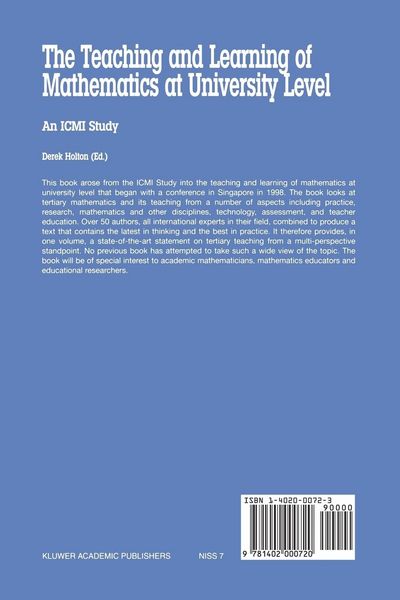
  • Produktbild: The Teaching and Learning of Mathematics at University Level
  • Produktbild: The Teaching and Learning of Mathematics at University Level
  • Preface.
    Section I: Introduction. Why the Professor Must be a Stimulating Teacher: Towards a New Paradigm of Teaching Mathematics at University Level; C. Alsina. Changing Contexts in Tertiary Mathematics: Implications for Diversity and Equity; R. Zevenbergen. Policy Issues; J. Thomas. Policy Case Studies. Policy Issues Concerning Teaching at University Level in France; J.-L. Dorier, V. Durand-Guerrier. Mathematics Education in Chinese Universities; X. Longwan. Policy in Sweden; A. Tengstrand.
    Section 2: Practice. Trends in Curriculum: A Working Group Report; J. Hillel. Mathematical Teaching Practices at Tertiary Level: Working Group Report; J. Mason. The Secondary-Tertiary Interface; L. Wood. The Warwick Analysis Project: Practice and Theory; L. Alcock, A. Simpson. Professional Development for Changing Undergraduate Mathematics Instruction; H. Keynes, A. Olson. Scientific Debate in Mathematics Courses; M. Legrand. Making Large Lectures Effective: An Effort to Increase Student Success; K. Millett. University Mathematics Based on Problem-Oriented Student Projects: 25 Years of Experience with the Roskilde Model; M. Niss. The Active/Interactive Classroom; D. Smith. Departmental Profiles. Concordia University, Montreal, Canada; J. Hillel. Eidgenössische Technische Hochschule, Zurich, Switzerland; U. Kirchgraber. Universidad Nacional Del Literal, Santa Fe, Argentina; N. Aguilera, R. Marcias. Universiti Teknologi Malaysia, Malaysia. University of Joensuu, Finland; M. Pesonen.
    Section 3: Research. What Can We Learn from Educational Research at the University Level? M. Artigue. Purposes and Methods of Research in Mathematics Education; A. Schoenfeld. TertiaryMathematics Education Research and its Future; A. Selden, J. Selden. Research into the Teaching and Learning of Linear Algebra; J.-L. Dorier, A. Sierpinska. APOS: A Constructivist Theory of Learning in Undergraduate Mathematics Education Research; E. Dubinski, M. McDonald. Research on the Teaching and Learning of Calculus/Elementary Analysis; A. Robert, N. Speer.
    Section 4: Mathematics and Other Disciplines. Revolution by Stealth: Redefining University Mathematics; L. Steen. Mathematics and Other Subjects; J.-P. Bourguignon. Trying the Impossible: Teaching Mathematics to Physicists and Engineers; B. Kümmerer. Do Not Ask What Mathematics Can do for Modelling. Ask What Modelling Can do for Mathematics! J. Ottesen.
    Section 5: Technology. Technology: A Working Group Report; K. King, et al. Technology in College Statistics Courses; J. Garfield, et al. Computer Algebra Systems in the Learning and Teaching of Linear Algebra: Some Examples; J. Hillel. Reflections on the Sustained Use of Technology in Undergraduate Mathematics Education; E. Muller. Finding a Role for Technology in Service Mathematics for Engineers and Scientists; P. Kent, R. Noss.
    Section 6: Assessment. Assessing Undergraduate Mathematics Students; K. Houston. Assessing Mathematical Thinking Via FLAG; J. Ridgway, et al. Assessing Student Project Work; C. Haines, K. Houston.
    Section 7: Teacher Education. Preparation of Primary and Secondary Mathematics Teachers: A Working Group Report; H. Williams. Using Research to Inform Pre-Service Teacher Education Programmes; T. Cooney. Mathematicians and the Preparation of Elementary Teachers; C. Kessel, L. Ma. Mathematics Teachers' Education in France: From Academic Training to