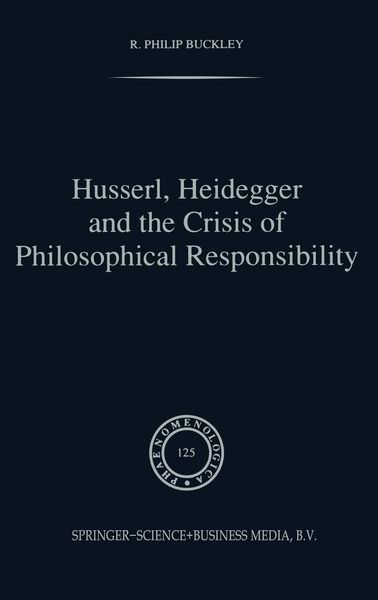
Husserl, Heidegger and the Crisis of Philosophical Responsibility
-
- Hardcover ausgewählt
- Taschenbuch
-
Sprache:Englisch
77,99 €
UVP
88,00 €
inkl. gesetzl. MwSt.,
Beschreibung
Produktdetails
Einband
Gebundene Ausgabe
Erscheinungsdatum
30.06.1992
Verlag
Springer NetherlandsSeitenzahl
298
Maße (L/B/H)
25/17,5/2,4 cm
Gewicht
632 g
Auflage
1. 992
Sprache
Englisch
ISBN
978-0-7923-1633-6
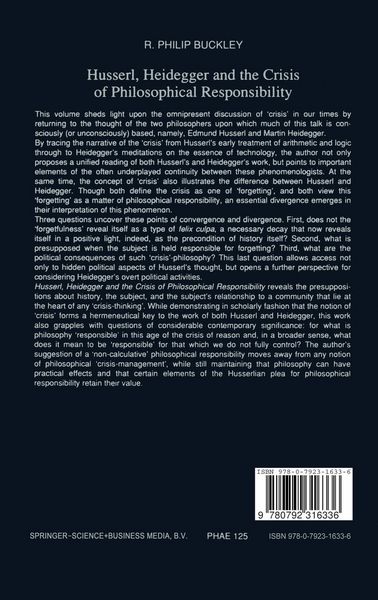
By tracing the narrative of the `crisis' from Husserl's early treatment of arithmetic and logic through to Heidegger's meditations on the essence of technology, the author not only proposes a unified reading of both Husserl's and Heidegger's work, but points to important elements of the often underplayed continuity between these phenomenologists. At the same time, the concept of `crisis' also illustrates the difference between Husserl and Heidegger. Though both define the crisis as one of `forgetting', and both view this `forgetting' as a matter of philosophical responsibility, essential divergence emerges in their interpretation of this phenomenon. Three questions uncover these points of convergence and divergence. First, does not the `forgetfulness' reveal itself as a type of felix culpa, a necessary decay that now reveals itself in a positive light, indeed, as the precondition of history itself? Second, what is presupposed when the subjects is held responsible for forgetting? Third, what are the political consequences of such `crisis'-philosophy? This last question allows access not only to hidden political aspects of Husserl's thought, but opens a further perspective for considering Heidegger's overt political activities.
Husserl, Heidegger and the Crisis of Philosophical Responsibility reveals the presuppositions about history, the subject, and the subject's relationship to a community that lie at the heart of any `crisis-thinking'. While demonstrating in scholarly fashion that the notion of `crisis' forms a hermeneutical key to the work of both Husserl and Heidegger, this work also grapples with questions of considerable contemporary significance: for what is philosophy `responsible' in this age of the crisis of reason, and in a broader sense, what does it mean to be `responsible' for that which we do not fully control? The author's suggestion of a `non-calculative' philosophical responsibility moves away from any notion of philosophical `crisis-management', while still maintaining that philosophy can have practical effects and that certain elements of the Husserlian plea for philosophical responsibility retain their value.
Noch keine Bewertungen vorhanden
Verfassen Sie die erste Bewertung zu diesem Artikel
Helfen Sie anderen Kundinnen und Kunden durch Ihre Meinung.
Kurze Frage zu unserer Seite
Vielen Dank für Ihr Feedback
Wir nutzen Ihr Feedback, um unsere Produktseiten zu verbessern. Bitte haben Sie Verständnis, dass wir Ihnen keine Rückmeldung geben können. Falls Sie Kontakt mit uns aufnehmen möchten, können Sie sich aber gerne an unseren Kund*innenservice wenden.
zum Kundenservice