
Gutscheinbedingungen

**Gültig bis 12.08.2026 auf fremdsprachige Bücher online auf thalia.at und in der Thalia App. Einzelne Artikel können ausgeschlossen sein. Ausgenommen sind preisgebundene Artikel & eBooks. Pro Einkauf einmal einlösbar. Click & Collect nur bei Onlinevorabzahlung möglich. Keine Barauszahlung. Nicht kombinierbar mit anderen Aktionen und Gutscheinen. Gutschein wird auf max. 500€ Bestellwert angerechnet. Nicht gültig für Geschenkkarten, Versandkosten und Services.

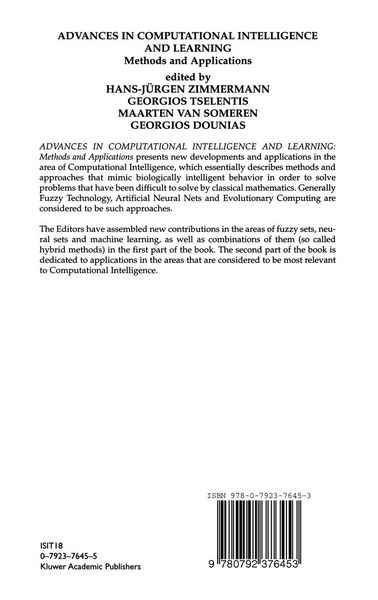
  • Produktbild: Advances in Computational Intelligence and Learning
  • Produktbild: Advances in Computational Intelligence and Learning
Band 18 - 12%

Advances in Computational Intelligence and Learning Methods and Applications

12% sparen

144,99 € UVP 164,99 €

inkl. gesetzl. MwSt., Versandkostenfrei


Beschreibung

Produktdetails

Einband

Gebundene Ausgabe

Erscheinungsdatum

31.01.2002

Herausgeber

Hans-Jürgen Zimmermann + weitere

Verlag

Springer Netherland

Seitenzahl

515

Maße (L/B/H)

24,1/16/3,4 cm

Gewicht

958 g

Auflage

2002

Sprache

Englisch

ISBN

978-0-7923-7645-3

Beschreibung

Produktdetails

Einband

Gebundene Ausgabe

Erscheinungsdatum

31.01.2002

Herausgeber

Verlag

Springer Netherland

Seitenzahl

515

Maße (L/B/H)

24,1/16/3,4 cm

Gewicht

958 g

Auflage

2002

Sprache

Englisch

ISBN

978-0-7923-7645-3

Herstelleradresse

Springer-Verlag KG
Sachsenplatz 4-6
1201 Wien
AT

Email: GPSR Kontakt

Noch keine Bewertungen vorhanden

Verfassen Sie die erste Bewertung zu diesem Artikel

Helfen Sie anderen Kundinnen und Kunden durch Ihre Meinung.

Kundinnen und Kunden meinen

Bewertungen (0)

  • Produktbild: Advances in Computational Intelligence and Learning
  • Produktbild: Advances in Computational Intelligence and Learning
  • Preface.
    Methodologies. Accuracy and Transparency of Fuzzy Systems; R. Babuska. Should Tendency Assessment Precede Rule Extraction by Clustering? (No!); J.C. Bezdek, et al. A Review of Wavelet Networks, Wavenets, Fuzzy Wavenets and their Applications; M. Thuillard. Investigating Neural Network Efficiency and Structure by Weight Investigation; M. Lefley, T. Kinsella. An Evaluation of Confidence Bound Estimation Methods for Neural Networks; L. Yang, et al. Compensation of Periodic Disturbances in Continuous Processing Plants by Means of a Neural Controller; M. Rau, D. Schröder. Predictive Control with Restricted Genetic Optimisation; S. Garrido, et al. Adaptive Parameterization of Evolutionary Algorithms and Chaotic Populations; M. Annunziato, S. Pizzuti. Neuro-Fuzzy Systems for Rule-Based Modelling of Dynamic Processes; M.B. Gorzalczany, A. Gluszek. Hybrid Intelligent Architectures using a Neurofuzzy Approach; L.P. Maguire, et al. Unifying Learning with Evolution Through Baldwinian Evolution and Lamarckism; C. Giraud-Carrier. Using An Evolutionary Strategy to Select Input Features for a Neural Network Classifier; J. Strackeljan, A. Schubert. Advances in Machine Learning; M.W. van Someren. Symbolic and Neural Learning of Named-Entity Recognition and Classification Systems in Two Languages; G. Petasis, et al. Fuzzy Model-Based Reinforcement Learning; M. Appl, W. Brauer. A Cellular Space for Feature Extraction and Classification; C. Kuhn, J. Wernstedt.
    Applications. A Fuzzy Approach to Taming the Bullwhip Effect; C. Carlsson, R. Fullér. Forecast of Short Term Trends in Stock Exchange using Fuzzy Rules and Neural Networks on Multiresolution Processed Signals; A. Tsakonas, et al. Customer Relationship Management: A Combined Approachby Customer Segmentation and Database Marketing; M. Nelke. A New Vendor Evaluation Product for SAP R/3® Systems; U. Grimmer, et al. About Robustness of Fuzzy Logic PD and PID Controller under Changes of Reasoning Methods; B.S. Butkiewicz. Control of MIMO Dead Time Processes Using Fuzzy Relational Models; B.A. Gormandy, et al. Fuzzy Sliding Mode Controllers Synthesis through Genetic Optimization; M. Dotoli, et al. Fuzzy RED: Congestion Control for TCP/IP Diff-Serv; L. Rossides, et al. The Use of Reinforcement Learning Algorithms in Traffic Control of High Speed Networks; A. Atlasis, A. Vasilakos. Fuzzy Reasoning in WCDMA Radio Resource Functions; T. Frantti, P. Mähönen. Odour Classification based on Computational Intelligence Techniques; G. Tselentis, et al. Fuzzy Rule Based Systems for Diagnosis of Stone Construction Cracks of Buildings; S. Shtovba, et al. Automated Design of Multi-Drilling Gear Machines; G. Klene, et al. Optimal Design of Alloy Steels Using Genetic Algorithms; M. Mahfouf. Intelligent Systems in Biomedicine; M.F. Abbod, et al. Diagnosis of Aphasia Using Neural and Fuzzy Techniques; J. Jantzen, et al. Gene Expression Data Mining for Functional Genomics using Fuzzy Technology; R. Guthke, et al. Symbolic, Neural and Neuro-fuzzy Approaches to Pattern Recognition in Cardiotocograms; O. Fontenla-Romero, et al. Perspectives of Computational Intelligence; G. Tselentis, M.W. van Someren.
    Index.