KI-Beratung Beta

Gutscheinbedingungen

**Gültig am 20.11.2026 ab einem Mindestbestellwert von 30€ auf Spielzeug, Schreibwaren, Filme, Geschenke & Trends, Musik, tolino eReader & Zubehör, Hörbücher und Hörbuch-Downloads, nicht preisgebundene Bücher und Kalender online auf thalia.at und in der Thalia App. Einzelne Artikel können ausgeschlossen sein. Aufgrund der Buchpreisbindung sind deutschsprachige Bücher und eBooks ausgenommen. Zusätzlich ausgenommen sind Abos & Flatrates, Games, Geschenkkarten/-boxen, Shelfies, Software, Zeitschriften sowie einzelne Artikel von tonies®. Pro Einkauf einmal einlösbar. Click & Collect nur bei Onlinevorabzahlung möglich. Keine Barauszahlung. Nicht kombinierbar mit anderen Aktionen und Gutscheinen. Gutschein wird auf max. 500€ Bestellwert angerechnet. Nicht gültig für Versandkosten und Services. Preisgebundene Artikel sind vom Mindestbestellwert ausgeschlossen.

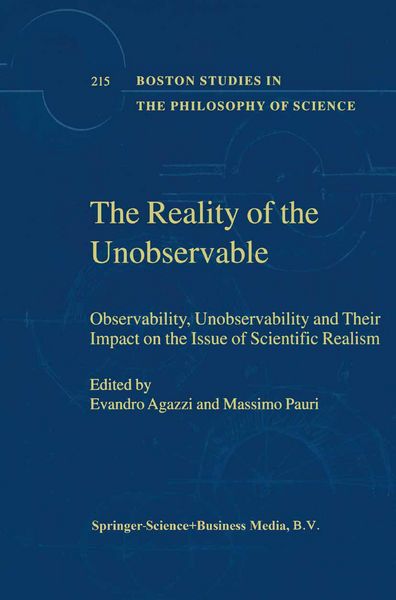
  • Produktbild: The Reality of the Unobservable
  • Produktbild: The Reality of the Unobservable
Band 215

The Reality of the Unobservable Observability, Unobservability and Their Impact on the Issue of Scientific Realism

164,99 €

inkl. gesetzl. MwSt., Versandkostenfrei


Beschreibung

Observability and Scientific Realism It is commonly thought that the birth of modern natural science was made possible by an intellectual shift from a mainly abstract and specuJative conception of the world to a carefully elaborated image based on observations. There is some grain of truth in this claim,...

Beschreibung

Observability and Scientific Realism It is commonly thought that the birth of modern natural science was made possible by an intellectual shift from a mainly abstract and specuJative conception of the world to a carefully elaborated image based on observations. There is some grain of truth in this claim, but this grain depends very much on what one takes observation to be. In the philosophy of science of our century, observation has been practically equated with sense perception. This is understandable if we think of the attitude of radical empiricism that inspired Ernst Mach and the philosophers of the Vienna Circle, who powerfully influenced our century's philosophy of science. However, this was not the atti tude of the f ounders of modern science: Galileo, f or example, expressed in a f amous passage of the Assayer the conviction that perceptual features of the world are merely subjective, and are produced in the 'anima!' by the motion and impacts of unobservable particles that are endowed uniquely with mathematically expressible properties, and which are therefore the real features of the world. Moreover, on other occasions, when defending the Copernican theory, he explicitly remarked that in admitting that the Sun is static and the Earth turns on its own axis, 'reason must do violence to the sense' , and that it is thanks to this violence that one can know the tme constitution of the universe.

Produktdetails

Einband

Gebundene Ausgabe

Erscheinungsdatum

31.07.2000

Abbildungen

VIII, 378 p.

Herausgeber E. Agazzi + weitere

Produktdetails

Einband

Gebundene Ausgabe

Erscheinungsdatum

31.07.2000

Abbildungen

VIII, 378 p.

Herausgeber
Verlag Springer Netherland
Seitenzahl

378

Maße (L/B/H)

24,1/16/2,6 cm

Gewicht

694 g

Auflage

2000

Sprache

Englisch

ISBN

978-0-7923-6311-8

Herstelleradresse

Springer-Verlag GmbH
Europaplatz 3
69115 Heidelberg
DE

Email: ProductSafety@springernature.com

Noch keine Bewertungen vorhanden

Verfassen Sie die erste Bewertung zu diesem Artikel

Helfen Sie anderen Kundinnen und Kunden durch Ihre Meinung.

Kundinnen und Kunden meinen

Bewertungen (0)

  • Produktbild: The Reality of the Unobservable
  • Produktbild: The Reality of the Unobservable
  • Observability and Scientific Realism.- History.- The Origin of Scientific Realism: Boltzman, Planck, Einstein.- General Philosophy, Scientific Realism.- Observability and Referentiality.- A new Approach to Human Cognition and its Significance for the Philosophy of Science.- Abduction and Non-Observability — Some Examples from Language Science and the Cognitive Science.- ‘Scientific Realism’ and Scientific Practice.- Random Philosophy.- Formal Representation and the Subjective Side of Scientific Realism.- Convention and Observability — Poincaré once again.- Scientific Realism, Objectivity, and ‘Technological Realism’.- Philosophy of Observation.- Testability and Empiricism.- Observing the Unobservable.- What does it Mean to Observe Physical Reality?.- Realism, and the Case of Rival Theories without Observable Differences.- Measurability, Computability and the Existence of Theoretical Entities.- Observation, Construction and Speculation in Cosmology.- Where did the Notion that Forces are Unobservable come from?.- Philosophy of Quantum Theory.- Quantum Mechanics without the Observables.- Observation, Contextuality and Realism.- Leibniz, Kant and the Quantum — A Provocative Point of View about Observation, Space-Time, and the Mind-Body Issue.- Efficient and Final Causes as CPT Reciprocals.- Specific Issues of Observability in Quantum Theory.- Observability and Realism in Modern Experiments with Correlated Quantum Systems.- Quantum Mechanics, Realism and the Ultimate Observer.- Individualistic and Statistical Interpretation of Quantum Mechanics.- How to Observe Quarks.- Common Experience and Quantum Theory — Observables and Beables.- On the Relationships between Classical and Quantum Mechanics.