Gutscheinbedingungen

**Gültig bis 06.07.2026 auf fremdsprachige Bücher online auf thalia.at, in der Thalia App ab einem Mindestbestellwert von 30€ und in allen Thalia Buchhandlungen in Österreich. In den Buchhandlungen nur gültig auf lagernde Ware. Einzelne Artikel können ausgeschlossen sein. Ausgenommen sind preisgebundene Artikel & eBooks. Pro Einkauf einmal einlösbar. Nur gültig gegen Vorlage oder im Onlineshop hinterlegter Bonuscard. Infos zur Einlösung in der Buchhandlung sind auf der Bonuscard-Vorteilspreisseite zu finden. Click & Collect nur bei Onlinevorabzahlung möglich. Keine Einlösung bei Scan & Go-Bezahlung. Keine Barauszahlung. Nicht kombinierbar mit anderen Aktionen und Gutscheinen. Gutschein wird auf max. 500€ Bestellwert angerechnet. Nicht gültig für Versandkosten und Services.

  • Produktbild: Environmental Health for All
  • Produktbild: Environmental Health for All
Band 49 - 12%

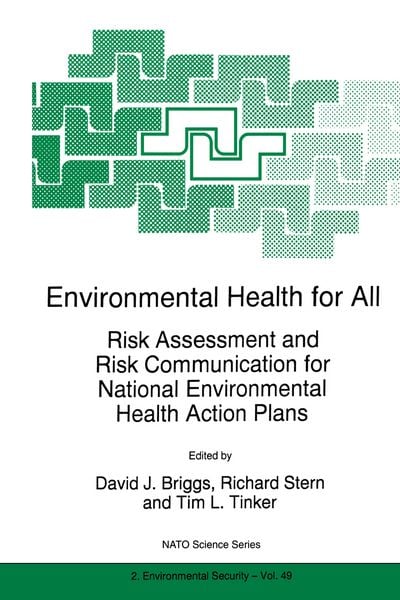
Environmental Health for All Risk Assessment and Risk Communication for National Environmental Health Action Plans

12% sparen

192,99 € UVP 219,99 €

inkl. gesetzl. MwSt., Versandkostenfrei


Beschreibung

Produktdetails

Einband

Taschenbuch

Erscheinungsdatum

31.12.1998

Herausgeber

David J. Briggs + weitere

Verlag

Springer Netherland

Seitenzahl

278

Maße (L/B/H)

23,4/15,6/1,7 cm

Gewicht

417 g

Auflage

Repr. of the original 1st ed. 1998

Sprache

Englisch

ISBN

978-0-7923-5453-6

Beschreibung

Produktdetails

Einband

Taschenbuch

Erscheinungsdatum

31.12.1998

Herausgeber

Verlag

Springer Netherland

Seitenzahl

278

Maße (L/B/H)

23,4/15,6/1,7 cm

Gewicht

417 g

Auflage

Repr. of the original 1st ed. 1998

Sprache

Englisch

ISBN

978-0-7923-5453-6

Herstelleradresse

Springer-Verlag KG
Sachsenplatz 4-6
1201 Wien
AT

Email: GPSR Kontakt

Noch keine Bewertungen vorhanden

Verfassen Sie die erste Bewertung zu diesem Artikel

Helfen Sie anderen Kundinnen und Kunden durch Ihre Meinung.

Kundinnen und Kunden meinen

Bewertungen (0)

  • Produktbild: Environmental Health for All
  • Produktbild: Environmental Health for All
  • Preface. Part One: Developing NEHAPs: Practice and Experience. 1. National Environmental Health Action Plans: Background and Process; D. Kello, et al. 2. The NEHAP Experience in the Czech Republic, Romania and Poland; H. Cizkova, et al. 3. Setting Priorities for Environmental Health Risks in Sweden; K. Victorin, et al. Part Two: Risk Assessment: Exploring Relationships Between Environment and Health. 4. Sources and Consequences of Uncertainty in Risk Estimates; L. Järup. 5. Outbreak of Baldness in Children in Sillamäe, Estonia; R. Silla, T. Trei. 6. Health Effects of Exposure to Metals from Manufacturing Plants; L. Järup. 7. Is Iodide a Confounding or Effect Modifying Factor of Liver Cirrhosis? I. Vincze, et al. 8. Structural-Functional State of the Bone-Muscular System in People Exposed to Low Doses of Ionising Radiation; V.V. Povoroznjuk. Part Three: Risk Assessment: Mapping and Modelling. 9. Tools for Risk Assessment: Statistical and Spatial Methods; I. Vincze, et al. 10. Environmental Modelling in the NEHAP Process; W.D. Henriques, D.J. Briggs. 11. Tools for Risk Assessment: Geographic Information Systems; D.L. Dalbokova, et al. 12. Monte Carlo Simulations in Risk Assessment: Cancer Risk in the Polish Coke Industry; M. Biesiada, et al. Part Four: Risk Communication. 13. Promoting Active Public Participation; C.G. Jardine, S.E. Hrudey. 14. Putting Risk Communication Policy Into Practice: a U.S. Federal Perspective; T.L. Tinker. 15. PrioritySetting of Environmental and Health Policy Options; R. Janikowski. 16. Presenting Decision-Makers with Their Choices: Environment Health Indicators for NEHAPs; D.J. Briggs, J. Wills. Part Five: Issues and Research Needs. 17. What is Risk? C.G. Jardine, S.E. Hrudey. 19. Quantifying the Unquantifiable and Comparing the Non-Commensurate; A. Dumitrescu. 20. Reality Versus Perception, and Values Versus Science in Risk Assessment and Risk Perception; K. Farago. 21. Coping with Complexity in Environmental Health Management and Policy; D.J. Briggs. References. Appendix 1: Workshop Conclusions and Recommendations. Appendix 2: Workshop Participants. Index.