KI-Beratung Beta

  • Produktbild: Carbyne and Carbynoid Structures
  • Produktbild: Carbyne and Carbynoid Structures
Band 21

Carbyne and Carbynoid Structures

198,99 €

inkl. gesetzl. MwSt., Versandkostenfrei


Beschreibung

1.1. THE DISCOVERY OF CARBYNE Yu.P. KUDRYA VTSEV A.N. Nesmeyanov Institute ofOrganoelement Compounds, Russian Academy of Sciences, 117813 Moscow, Russia Abstract - The history of the discovery of carbyne is briefly recalled. The existence of carbyne was first disclosed by Russian researchers in 1960....

Beschreibung

1.1. THE DISCOVERY OF CARBYNE Yu.P. KUDRYA VTSEV A.N. Nesmeyanov Institute ofOrganoelement Compounds, Russian Academy of Sciences, 117813 Moscow, Russia Abstract - The history of the discovery of carbyne is briefly recalled. The existence of carbyne was first disclosed by Russian researchers in 1960. It was obtained for the first time via oxidative dehydropolycondensation of acetylene based on the Glaser coupling of ethynyl compounds. 1. Introduction The polymeric nature of carbon was first pointed out by Mendeleev. He wrote: "The molecules of coal, graphite, and diamond are very complicated, and carbon atoms exhibit the capability of binding one to another to form complex molecules in all compounds of carbon. None of the elements possesses an ability of complicating in such an extent as does carbon. There is still no basis to define the polymerization degree of the coal, graphite, or diamond molecules. One should believe, however that they contain en species, where 'n' is a large value" [IJ. Until the 1960s only two allotropic forms of carbon were known, viz., graphite and diamond, including their polymorphous modifications. For a long time 'amorphous carbon' was also included among the simple forms. Presently, however, the structure of amorphous and quasi-amorphous carbons (such as carbon blacks, soot, cokes, glassy carbon, etc.) is known to approach that of graphite to various degrees [2J.

Portrait

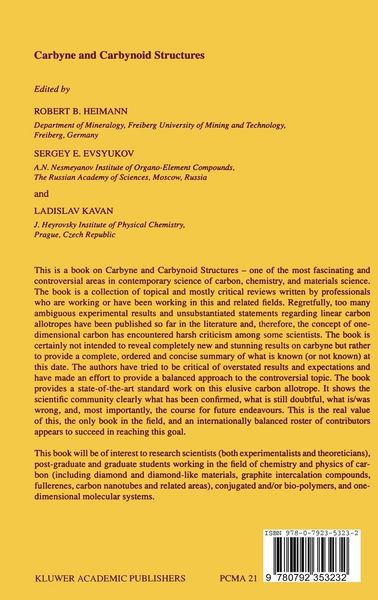
Robert Heimann is professor emeritus of applied mineralogy and materials science. He obtained his academic degrees from Freie Universität (FU) Berlin, and subsequently served as a faculty member at FU Berlin and Universität Karlsruhe. From 1979 on he worked in Canada as a research associate (McMaster University), senior researcher (3M Canada Inc.), staff geochemist (Atomic Energy of Canada Limited), and research manager (Alberta Research Council). From 1993 to 2004 he was a full professor at TU Bergakademie Freiberg. Professor Heimann has authored over 260 scientific publications and in 2001 was awarded the Georg-Agricola-Medal of the German Mineralogical Society (DMG) for his outstanding lifetime achievements in applied mineralogy.

Produktdetails

Einband

Gebundene Ausgabe

Erscheinungsdatum

28.02.1999

Abbildungen

XVII, 446 p.

Herausgeber R.B. Heimann + weitere

Produktdetails

Einband

Gebundene Ausgabe

Erscheinungsdatum

28.02.1999

Abbildungen

XVII, 446 p.

Herausgeber
Verlag Springer Netherland
Seitenzahl

446

Maße (L/B/H)

24,1/16/3 cm

Gewicht

812 g

Auflage

1999

Sprache

Englisch

ISBN

978-0-7923-5323-2

Herstelleradresse

Springer-Verlag GmbH
Europaplatz 3
69115 Heidelberg
DE

Email: ProductSafety@springernature.com

Noch keine Bewertungen vorhanden

Verfassen Sie die erste Bewertung zu diesem Artikel

Helfen Sie anderen Kundinnen und Kunden durch Ihre Meinung.

Kundinnen und Kunden meinen

Bewertungen (0)

  • Produktbild: Carbyne and Carbynoid Structures
  • Produktbild: Carbyne and Carbynoid Structures
  • 1: Introduction.- 1.1. The discovery of carbyne.- 1.2. The nature of carbyne: pros and cons.- 2: Carbyne and carbynoid structures in nature.- 2.1. Carbon-how many allotropes associated with meteorites and impact phenomena?.- 2.2. Other natural carbynoid structures.- 3: Syntheses of carbyne and carbynoid structures.- 3.1. Catalytic and electrochemical polycondensation reactions.- 3.1.1. Dehydropolycondensation of acetylene.- 3.1.2. Polycondensation reaction of halides.- 3.2. Chemical, photo-, and electrochemical transformations of polymers.- 3.2.1. Chemical dehydrohalogenation of polymers.- 3.2.2. Photo-and laser-induced dehydrohalogenation of polymers.- 3.2.3. Dehydrogenation of polyacetylene at high static pressure.- 3.3.1. Decomposition of hydrocarbons.- 3.3.2. Pyrolysis of organic polymers.- 3.4. Phase transformation of carbon materials.- 3.4.1. Condensation of carbon vapour.- 3.4.2. Ion-assisted condensation of carbon.- 3.4.3. Dynamic pressure synthesis.- 3.5. Electrochemical methods.- 4: Structural models of carbyne.- 4.1. Structural and electronic properties of polyyne.- 4.2. Kinked chains and layered structure.- 4.3. Carbyne intercalation compounds.- 4.4. Electron diffraction and microscopy.- 5: Properties of carbyne and carbynoid structures.- 5.1. Chemical properties.- 5.2. Thermophysical properties.- 5.3. Electrical and optical properties.- 6: Molecular and electron spectroscopy of carbyne structures.- 6.1. Raman and infrared spectroscopy.- 6.2. Electron spin resonance spectroscopy.- 6.3. Electron spectroscopy.- 6.4. Electron energy loss spectroscopy studies of carbynoid structures.- 7: Suggested technical applications of carbyne materials.- 7.1. Diamond synthesis from carbyne.- 7.2. Medical applications of carbynoid materials.