Econometric Business Cycle Research
-
- Hardcover ausgewählt
- Taschenbuch
-
Sprache:Englisch
96,99 €
UVP
109,99 €
inkl. gesetzl. MwSt.,
Beschreibung
Produktdetails
Einband
Gebundene Ausgabe
Erscheinungsdatum
30.09.1998
Abbildungen
XIV, 228 p.
Verlag
Springer UsSeitenzahl
228
Maße (L/B/H)
24,1/16/1,9 cm
Gewicht
541 g
Auflage
1998
Sprache
Englisch
ISBN
978-0-7923-8254-6
Econometric Business Cycle Research
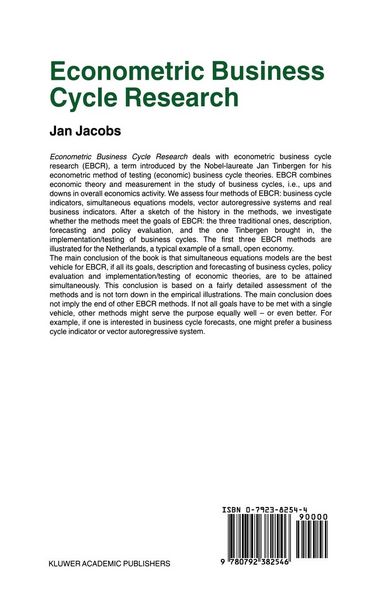
deals with econometric business cycle research (EBCR), a term introduced by the Nobel-laureate Jan Tinbergen for his econometric method of testing (economic) business cycle theories. EBCR combines economic theory and measurement in the study of business cycles, i.e., ups and downs in overall economic activity. We assess four methods of EBCR: business cycle indicators, simultaneous equations models, vector autoregressive systems and real business indicators. After a sketch of the history of the methods, we investigate whether the methods meet the goals of EBCR: the three traditional ones, description, forecasting and policy evaluation, and the one Tinbergen introduced, the implementation|testing of business cycles. The first three EBCR methods are illustrated for the Netherlands, a typical example of a small, open economy.
The main conclusion of the book is that simultaneous equation models are the best vehicle for EBCR, if all its goals are to be attained simultaneously. This conclusion is based on a fairly detailed assessment of the methods and is not over-turned in the empirical illustrations. The main conclusion does not imply the end of other EBCR methods. Not all goals have to be met with a single vehicle, other methods might serve the purpose equally well - or even better. For example, if one is interested in business cycle forecasts, one might prefer a business cycle indicator or vector autoregressive system.
A second conclusion is that many ideas/concepts that play an important role in current discussions about econometric methodology in general and EBCR in particular, were put forward in the 1930s and 1940s.
A third conclusion is that it is difficult, if not impossible, to compare the outcomes of RBC models to outcomes of the other three methods, because RBC modellers are not interested in modelling business cycles on an observation-per-observation basis. A more general conclusion in this respect is that methods should adopt the same concept of business cycles to make them comparable.
Noch keine Bewertungen vorhanden
Verfassen Sie die erste Bewertung zu diesem Artikel
Helfen Sie anderen Kundinnen und Kunden durch Ihre Meinung.
Kurze Frage zu unserer Seite
Vielen Dank für Ihr Feedback
Wir nutzen Ihr Feedback, um unsere Produktseiten zu verbessern. Bitte haben Sie Verständnis, dass wir Ihnen keine Rückmeldung geben können. Falls Sie Kontakt mit uns aufnehmen möchten, können Sie sich aber gerne an unseren Kund*innenservice wenden.
zum Kundenservice