KI-Beratung Beta

Gutscheinbedingungen

**Gültig bis 30.11.2026 auf Spielzeug, Schreibwaren, Filme, Geschenke & Trends, Musik, tolino eReader & Zubehör, Hörbücher und Hörbuch-Downloads, nicht preisgebundene Bücher und Kalender online auf thalia.at und in der Thalia App. Einzelne Artikel können ausgeschlossen sein. Aufgrund der Buchpreisbindung sind deutschsprachige Bücher und eBooks ausgenommen. Zusätzlich ausgenommen sind Abos & Flatrates, Games, Geschenkkarten/-boxen, Shelfies, Software, Zeitschriften sowie einzelne Artikel von tonies®. Pro Einkauf einmal einlösbar. Nur gültig mit im Onlineshop hinterlegter Bonuscard. Click & Collect nur bei Onlinevorabzahlung möglich. Keine Barauszahlung. Nicht kombinierbar mit anderen Aktionen und Gutscheinen. Gutschein wird auf max. 500€ Bestellwert angerechnet. Nicht gültig für Versandkosten und Services.

  • Produktbild: Advances in Lymphoma Research
  • Produktbild: Advances in Lymphoma Research
Band 85

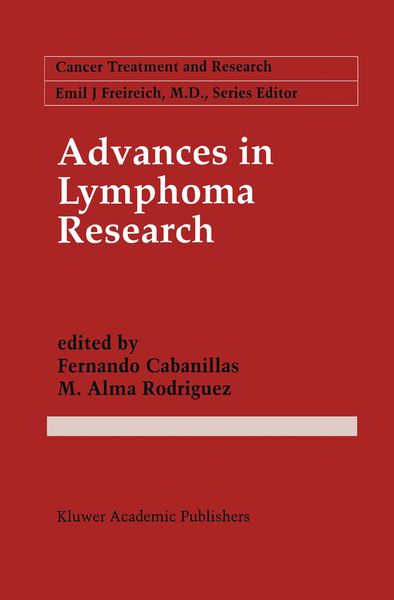
Advances in Lymphoma Research

219,99 €

inkl. gesetzl. MwSt., Versandkostenfrei


Beschreibung

Fernando Cabanillas In 1993, Fisher et al. published the results of a randomized trial comparing three third-generation regimens against the classic CHOP combination. For several years, the oncology community had been convinced that the third generation regimens were clearly superior to CHOP. It came...

Beschreibung

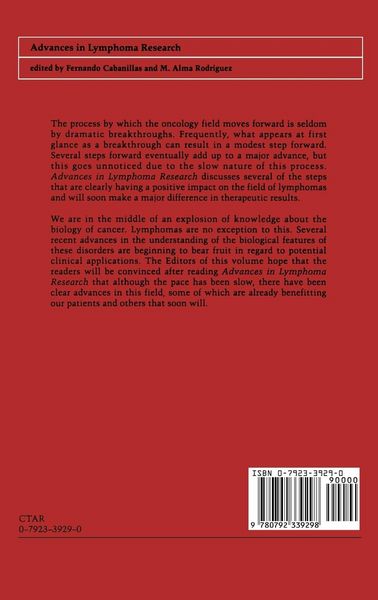
Fernando Cabanillas In 1993, Fisher et al. published the results of a randomized trial comparing three third-generation regimens against the classic CHOP combination. For several years, the oncology community had been convinced that the third generation regimens were clearly superior to CHOP. It came as a shock to many that there was no difference in outcome between the four arms of this clinical trial. The logical conclusion is that CHOP is as good as any of the other regimens tested in that study. Unfortunately, this excellent study has been misinterpreted by many as proving that there has not been any progress in the field of lymphoma during the last 20 years. Furthermore, it has led to a fatalistic attitude in the reasoning of many clinicians who feel that 'nothing works better than CHOP' and therefore that it is not worth testing new drugs or developing novel regimens. However, the process by which we move forward in the oncology field is seldom by dramatic breakthroughs. Frequently, what appears at first glance to be a breakthrough turns out later to be just a modest step forward. Several steps forward eventually add up to a major advance, but this advance goes unnoticed because of the slow nature of the process. In this volume, we have chosen to discuss several of these steps, which we feel are clearly making a positive impact on the field of lymphomas and which soon should make a major difference in therapeutic results.

Produktdetails

Einband

Gebundene Ausgabe

Erscheinungsdatum

28.02.1997

Abbildungen

XI, 169 p.

Herausgeber Fernando Cabanillas + weitere

Produktdetails

Einband

Gebundene Ausgabe

Erscheinungsdatum

28.02.1997

Abbildungen

XI, 169 p.

Herausgeber
Verlag Springer Us
Seitenzahl

169

Maße (L/B/H)

24,1/16/1,5 cm

Gewicht

398 g

Auflage

1996

Sprache

Englisch

ISBN

978-0-7923-3929-8

Herstelleradresse

Springer-Verlag GmbH
Europaplatz 3
69115 Heidelberg
DE

Email: ProductSafety@springernature.com

Noch keine Bewertungen vorhanden

Verfassen Sie die erste Bewertung zu diesem Artikel

Helfen Sie anderen Kundinnen und Kunden durch Ihre Meinung.

Kundinnen und Kunden meinen

Bewertungen (0)

  • Produktbild: Advances in Lymphoma Research
  • Produktbild: Advances in Lymphoma Research
  • I. New Therapeutic Advances 1.- 1. Fludarabine phosphate in lymphoma: an important new therapeutic agent.- 2. 2-Chlorodeoxyadenosine treatment of lymphoma.- II. New Histopathologic Entities.- 3. Histologic grading of nodular sclerosing Hodgkin’s disease: is it an independent prognostic factor?.- 4. Mantle cell lymphomas.- III. New Perspectives on Clinical Prognostic Parameters and Treatment.- 5. Can prognostic factors be applied in treatment selection for aggressive lymphoma patients?.- 6. Factors that influence prognosis of intermediate-grade lymphomas at relapse.- 7. High-dose chemotherapy in non-Hodgkin’s lymphoma.- IV. New Biomolecular Markers/Targets.- 8. The phenomenon of multidrug resistance in non-Hodgkin’s lymphoma.- 9. Adhesion molecules in non-Hodgkin’s lymphoma.- 10. PCR monitoring of response in patients treated with high-dose chemotherapy for low-grade lymphoma.