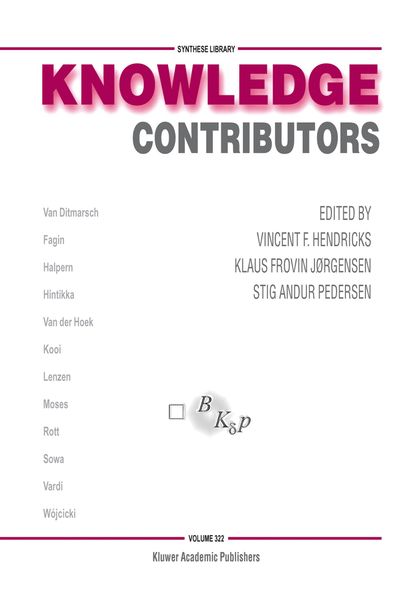
Produktbild: Knowledge Contributors
Band 322 - 12%

Knowledge Contributors

Aus der Reihe Synthese Library
12% sparen

95,99 € UVP 109,99 €

inkl. gesetzl. MwSt., Versandkostenfrei


Beschreibung

Produktdetails

Einband

Gebundene Ausgabe

Erscheinungsdatum

30.11.2003

Herausgeber

Vincent F. Hendricks + weitere

Verlag

Springer Netherland

Seitenzahl

203

Maße (L/B/H)

23,9/16,2/1,2 cm

Gewicht

349 g

Auflage

2003 edition

Sprache

Englisch

ISBN

978-1-4020-1748-3

Beschreibung

Produktdetails

Einband

Gebundene Ausgabe

Erscheinungsdatum

30.11.2003

Herausgeber

Verlag

Springer Netherland

Seitenzahl

203

Maße (L/B/H)

23,9/16,2/1,2 cm

Gewicht

349 g

Auflage

2003 edition

Sprache

Englisch

ISBN

978-1-4020-1748-3

Herstelleradresse

Libri GmbH
Europaallee 1
36244 Bad Hersfeld
DE

Email: gpsr@libri.de

Kundinnen und Kunden meinen

0 Bewertungen

Informationen zu Bewertungen

Zur Abgabe einer Bewertung ist eine Anmeldung im Konto notwendig. Die Authentizität der Bewertungen wird von uns nicht überprüft. Wir behalten uns vor, Bewertungstexte, die unseren Richtlinien widersprechen, entsprechend zu kürzen oder zu löschen.

Die Bewertungen sind nach Format, Anzahl Sterne und Datum sortiert.

Verfassen Sie die erste Bewertung zu diesem Artikel

Helfen Sie anderen Kund*innen durch Ihre Meinung

Kundinnen und Kunden meinen

0 Bewertungen filtern

  • Produktbild: Knowledge Contributors
  • Preface.
    Introduction; V.F. Hendricks, K.F. Jørgensen, S.A. Pedersen. 1. Agent and System. 2. Active Agenthood. 3. Multiple Active Agents. 4. Multi-Modalities. 5. Conclusion. Notes. References.
    Knowledge, Belief, and Subjective Probability: Outlines of a Unified System of Epistemic/Doxastic Logic; W. Lenzen. 1. The Logic of Conviction. 2. The Logic of Knowledge. 3. The Logic of ('Weak') Belief. 4. The Pragmatics of Epistemic Sentences. Notes. References.
    A Second Generation Epistemic Logic and Its General Significance. J. Hintikka. 1. The Prima Facie Conundrum of Epistemic Logic. 2. The Promises. 3. Promises Fulfilled by Means of the Notion of Independence. References.
    Economics and Economy in the Theory of Belief Revision; H. Rott. 1. Introduction. 2. What is Economics? 3. Acting Economically, a Second View: 'Informational Economy'. 4. Economic and Economical Considerations in Belief Revision Theory. 5. Informational Economy with Respect to Beliefs: What has been done? 6. Informational Economy with Respect to Beliefs: What should be done? 7. Conservatism with Respect to Belief-Revision Guiding Structures: What has been done? 8. Conservatism with Respect to Belief-Revision Guiding Structures: What should be done? 9. Rational Choices and Logical Properties: What has been done? 10. Rational Choices and Logical Properties: What should be done? 11. Conclusion. Notes. References.
    Common Knowledge Revisited; R. Fagin, J.Y. Halpern, Y. Moses, M.Y. Vardi. 1. Introduction. 2. TwoPuzzles. 3. Common Knowledge and Uncertainty. 4. Simultaneous Events. 5. Temporal Imprecision. 6. The Granularity of Time. 7. Approximations of Common Knowledge. 8. Summary. Notes. References.
    Concurrent Dynamic Epistemic Logic; H.P. van Ditmarsch, W. van der Hoek, B.P. Kooi. 1. Introduction. 2. Language and Semantics. 3. Proof System. 4. Completeness. 5. Applications. 6. Conclusions. References.
    Laws, Facts, and Contexts: Foundations of Multimodal Reasoning; J.F. Sowa. 1. Replacing Possible Worlds with Contexts. 2. Dunn's Laws and Facts. 3. Contexts by Pierce and McCarthy. 4. Tarski's Metalevels. 5. Nested Graph Models. 6. Beyond Kripke Semantics. 7. The Intended Interpretation. References.
    Referential Semantics; R. Wójcicki. 1. The General Idea of Referential Semantics. 2. Language. 3. Components of Referential Semantics. 4. Substitutions. 5. Some Notation. 6. The Definition Completed. 7. A Few Examples. 8. Four Principles of Logical Analysis. 9. Logical Consequences. 10. A Few Comments on the Peculiar Status of the Identity Predicate. 11. General Properties of Consequence Operations. 12. The Truth Preserving Consequence Operations. 13. The Problem of Adequacy. 14. Self-Extensional Consequence Operations. 15. Adequacy Theorem. 16. The Need for Referential Semantics. 17. Notes and References. References.
    Index.