
KI-Beratung Beta

Gutscheinbedingungen

**Gültig am 27.11.2026 auf Spielzeug, Schreibwaren, Filme, Geschenke & Trends, Musik, tolino eReader & Zubehör, Hörbücher und Hörbuch-Downloads, nicht preisgebundene Bücher und Kalender online auf thalia.at und in der Thalia App. Einzelne Artikel können ausgeschlossen sein. Aufgrund der Buchpreisbindung sind deutschsprachige Bücher und eBooks ausgenommen. Zusätzlich ausgenommen sind Abos & Flatrates, Games, Geschenkkarten/-boxen, Shelfies, Software, Zeitschriften sowie einzelne Artikel von tonies®. Pro Einkauf einmal einlösbar. Click & Collect nur bei Onlinevorabzahlung möglich. Keine Barauszahlung. Nicht kombinierbar mit anderen Aktionen und Gutscheinen. Gutschein wird auf max. 500€ Bestellwert angerechnet. Nicht gültig für Versandkosten und Services.

  • Produktbild: Advanced Chemical Methods for Soil and Clay Minerals Research
  • Produktbild: Advanced Chemical Methods for Soil and Clay Minerals Research
Band 63

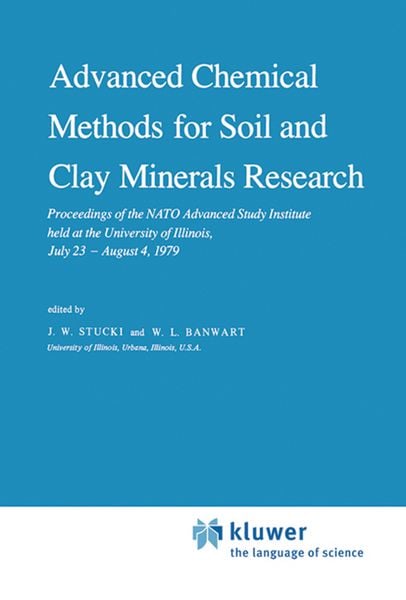
Advanced Chemical Methods for Soil and Clay Minerals Research Proceedings of the NATO Advanced Study Institute held at the University of Illinois, July 23 – August 4, 1979

Aus der Reihe Nato Science Series C:

219,99 €

inkl. gesetzl. MwSt., Versandkostenfrei


Beschreibung

During the past few years there has been a marked increase in the use of advanced chemical methods in studies of soil and clay mineral systems, but only a relatively small number of soil and clay scientists have become intimately associ ated and acquainted with these new techniques. Perhaps the most...

Beschreibung

During the past few years there has been a marked increase in the use of advanced chemical methods in studies of soil and clay mineral systems, but only a relatively small number of soil and clay scientists have become intimately associ ated and acquainted with these new techniques. Perhaps the most important obstacles to technology transfer in this area are: 1) many soil and clay chemists have had insufficient opportunities to explore in depth the working principles of more recent spectroscopic developments, and therefore are unable to exploit the vast wealth of information that is available through the application of such ad vanced technology to soil chemical research; and 2) the necessary equipment gen erally is unavailable unless collaborative projects are undertaken with chemists and physicists who already have the instruments. The objective of the NATO Advanced Study Institute held at the University of Illinois from July 23 to August 4, 1979, was to partially alleviate these obstacles. This volume, which is an extensively edited and reviewed version of the proceedings of that Advanced Study Institute, is an essential aspect of that purpose. Herein are summarized the theory and most current applications of six different spectroscopic methods to soil and/or clay mineral systems. The instrumental methods examined are Mossbauer, neutron scattering, x-ray photoelectron (XPS, ESCA), nuclear magnetic resonance (NMR), electron spin resonance (ESR, EPR), and photoacoustic spectroscopy. Contributing authors were also lecturers at the Advanced Study Institute, and are each well known and respected authorities in their respective disciplines.

Produktdetails

Einband

Gebundene Ausgabe

Erscheinungsdatum

30.11.1980

Abbildungen

X, 477 p.

Herausgeber J.W. Stucki + weitere

Produktdetails

Einband

Gebundene Ausgabe

Erscheinungsdatum

30.11.1980

Abbildungen

X, 477 p.

Herausgeber
Verlag Springer Netherland
Seitenzahl

477

Maße (L/B/H)

24,1/16/3,1 cm

Gewicht

847 g

Auflage

1980

Sprache

Englisch

ISBN

978-90-277-1158-8

Herstelleradresse

Springer-Verlag GmbH
Europaplatz 3
69115 Heidelberg
DE

Email: ProductSafety@springernature.com

Noch keine Bewertungen vorhanden

Verfassen Sie die erste Bewertung zu diesem Artikel

Helfen Sie anderen Kundinnen und Kunden durch Ihre Meinung.

Kundinnen und Kunden meinen

Bewertungen (0)

  • Produktbild: Advanced Chemical Methods for Soil and Clay Minerals Research
  • Produktbild: Advanced Chemical Methods for Soil and Clay Minerals Research
  • 1. Mössbauer Spectroscopy.- 1-1. Introduction to the Mössbauer Effect.- 1-2. Basic Principles of Mössbauer Spectroscopy.- 1-3. Instrumentation and Experimental Procedures.- 1-4. Application of Mössbauer Spectroscopy to the Study of Silicate Minerals.- 1-5. The Study of Mineral Alteration Reactions.- 1-6. Iron Oxides and their Characterization in Soils.- 1-7. Critical Assessment of the Potential of Mössbauer Spectroscopy, and its Application to Nuclei Other than Iron.- References.- 2. Neutron Scattering Methods of Investigating Clay Systems.- 2-1. Introduction.- 2-2. Elementary Neutron Scattering Theory.- 2-3. Neutron Scattering Instrumentation and Methods.- 2-4. Applications of Neutron Spectroscopy to Studies of Clay Minerals.- Appendix 2-1. Macroscopic Cross Section for a Montmorillonite-Water System.- Appendix 2-2. Calculation of Incoherent Scattering Intensity Ratios for a Clay-Water System.- References.- 3. Introduction to X-ray Photoelectron Spectroscopy.- 3-1. Introduction.- 3-2. Trend of XPS Spectra.- 3-3. Instrumentation.- 3-4. Peak Position.- 3-5. Explored Depth.- 3-6. Peak Intensity.- 3-7. Overview of Methods of Characterization of Solids Based on X-ray, Electron and Ion Beams.- References.- 4. Application of X-ray Photoelectron Spectroscopy to the Study of Mineral Surface Chemistry.- 4-1. Uniqueness of XPS for the Investigation of Mineral Surface Phenomena — Probing Depth.- 4-2. Sample Handling Techniques.- 4-3. Analytical Applications.- 4-4. Electron Take-Off (Grazing) Angle Analysis Applications.- 4-5. Qualitative Bonding Investigations.- 4-6. Summary.- References.- 5. The Application of NMR to the Study of Clay Minerals.- 5-1. Introduction: Fundamentals of NMR.- 5-2. The Bloch Equations.- 5-3. Line Shape.- 5-4. Relaxation Mechanisms.- 5-5. Review ofSome Problems: Order and Disorder in Adsorbed Water Molecules.- References.- 6. Distribution of Ions in the Octahedral Sheet of Micas.- 6-1. Introduction.- 6-2. Influence of the Fe2+ Ions.- 6-3. H+ Spectra of Phlogopites.- 6-4. H+ Spectra of Biotites.- 6-5. F? Spectra.- 6-6. Correlation with I.R. Results.- References.- 7. General Theory and Experimental Aspects of Electron Spin Resonance.- 7-1. Introduction.- 7-2. G-Factor Tensor.- 7-3. Hyperfine Interaction.- 7-4. Analysis of ESR Spectra.- 7-5. Fine Structure.- 7-6. Summary.- Appendix 7-1.- Appendix 7-2.- Appendix 7-3.- References.- 8. Applications of ESR Spectroscopy to Inorganic-Clay Systems.- 8-1. Introduction.- 8-2. Surface-Bound Metal Ions.- 8- 3. Framework Paramagnetic Centers.- References.- 9. Application of Spin Probes to ESR Studies of Organic-Clay Systems.- 9- 1. Nitroxide Spin Probes — Origin of the ESR Spectrum.- 9-2. Nitroxides in Low-Viscosity Media — Rapid Isotropic Motion.- 9-3. Nitroxides in High-Viscosity Media.- 9-4. Nitroxides Adsorbed on Clay Surfaces.- 9-5. Experimental Considerations in Using Nitroxide Spin Probes.- References.- 10. Applications of Photoacoustic Spectroscopy to the Study of Soils and Clay Minerals.- 10-1. Introduction.- 10-2. Instrumentation.- 10-3. Results.- 10-4. Conclusions.- References.