
Gutscheinbedingungen

**Gültig bis 24.09.2026 ab einem Mindestbestellwert von 30€ auf Spielzeug, Schreibwaren, Filme, Geschenke & Trends, Musik, tolino eReader & Zubehör, Hörbücher und Hörbuch-Downloads, nicht preisgebundene Bücher und Kalender online auf thalia.at und in der Thalia App. Einzelne Artikel können ausgeschlossen sein. Aufgrund der Buchpreisbindung sind deutschsprachige Bücher und eBooks ausgenommen. Zusätzlich ausgenommen sind Abos & Flatrates, Games, Geschenkkarten/-boxen, Shelfies, Software, Zeitschriften sowie einzelne Artikel von tonies®. Pro Einkauf einmal einlösbar. Click & Collect nur bei Onlinevorabzahlung möglich. Keine Barauszahlung. Nicht kombinierbar mit anderen Aktionen und Gutscheinen. Gutschein wird auf max. 500€ Bestellwert angerechnet. Nicht gültig für Versandkosten und Services. Preisgebundene Artikel sind vom Mindestbestellwert ausgeschlossen.

  • Produktbild: Switching Machines
  • Produktbild: Switching Machines

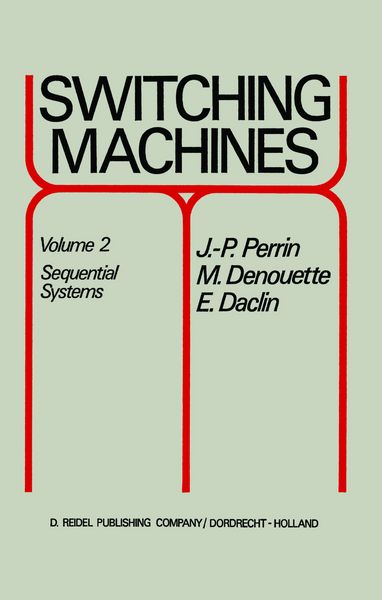
Switching Machines Volume 2 Sequential Systems

189,99 €

inkl. gesetzl. MwSt., Versandkostenfrei


Beschreibung

Produktdetails

Einband

Gebundene Ausgabe

Erscheinungsdatum

30.06.1972

Abbildungen

XIV, 421 p.

Verlag

Springer Netherland

Seitenzahl

421

Maße (L/B/H)

24,1/16/2,9 cm

Gewicht

822 g

Auflage

1972 edition

Sprache

Englisch

ISBN

978-90-277-0197-8

Beschreibung

Produktdetails

Einband

Gebundene Ausgabe

Erscheinungsdatum

30.06.1972

Abbildungen

XIV, 421 p.

Verlag

Springer Netherland

Seitenzahl

421

Maße (L/B/H)

24,1/16/2,9 cm

Gewicht

822 g

Auflage

1972 edition

Sprache

Englisch

ISBN

978-90-277-0197-8

Herstelleradresse

Libri GmbH
Europaallee 1
36244 Bad Hersfeld
DE

Email: gpsr@libri.de

Noch keine Bewertungen vorhanden

Verfassen Sie die erste Bewertung zu diesem Artikel

Helfen Sie anderen Kundinnen und Kunden durch Ihre Meinung.

Kundinnen und Kunden meinen

Bewertungen (0)

  • Produktbild: Switching Machines
  • Produktbild: Switching Machines
  • 7/Synthesis of the Tables.- 7.1. Generalizations.- 7.2. Natural methods.- 7.3. Algebraic methods-Notion of a regular expression.- 7.4. Gloushkov method.- 7.5. Conclusion.- 7.A. Brzozowski method.- Exercises.- 8/Reduction of the Number of States in a Table.- 8.1. Introduction-Statement of the problem.- 8.2. Equivalence of states.- 8.3. Reduction of complete tables.- 8.4. Reduction of incomplete tables.- 8.5. Programming of flow table reduction on digital computers.- 8.6. Reduction of a phase table.- 8.7. Application of the method of compatible pairs to asynchronous systems.- 8.8. Conclusion.- Exercises.- 9/Assignment of the Internal States (Asynchronous Sequential Systems).- 9.1. Introduction.- 9.2. Connected sets.- 9.3. Huffman numbers.- 9.4. The influence of essential connections on the density of the assignment table.- 9.5. Reduction of the system’s number of connections.- 9.6. Creation of supplementary unstable states.- 9.7. Incomplete merging of the primitive phase table.- 9.8. General remarks about assignment.- 9.9. Assignments and universal circuits.- Exercises.- 10/Assignment of Internal States (Synchronous Systems).- 10.1. Introduction.- 10.2. Distinct assignments-valid assignments.- 10.3. Example of the different assignments of a same table.- 10.4. Assignment from adjacency study.- 10.5. General concepts concerning partitions.- 10.6. Search for the p.s.p..- 10.7. Properties connected with partitions p.s.p..- 10.8. Use of the p.s.p. in assignment.- 10.9. Decomposition of sequential machines.- 10.10. Partition pairs.- 10.11. Assignment of the uncompletely specified tables.- 10.12. Extension methods.- 10.13. Assignment of internal states by taking into account the output.- 10.14. Conclusion.- Exercises.- 11/Examples of Applications.- 11.1. Introduction.- 11.2.Applications on computers.- 11.3. Sequentially controlled machines.- 11.4. Analysis of a system of electrical airplane generation.- Exercises.- 12/Linear Sequential Systems.- 12.1. Introduction.- 12.2. Review of algebra.- 12.3. Transition of linear sequential systems.- 12.4. General configurations of linear machines.- 12.5. Discrete Laplace transform.- 12.6. Study of linear systems by the discrete Laplace transform.- 12.7. Application.- 12.8. Conclusion.- Exercises.- 13/Theoretical Study of the Real Functioning of Binary Switching Elements-Non-Binary Switching Elements.- 13.1. Many-valued algebra.- 13.2. Ternary algebra and relay systems.- 13.3. Expression for a function defined in a set of p values.- 13.4. Characteristic equation of a relay.- 13.5. Analysis of relay systems.- 13.7. Multipositional contactors.- 13.8. Analysis of a multipositional contactor circuit ideal functioning.- 13.9. Minimization of the conductibility function of the commutators’ circuits.- 13.10. Synthesis of relay circuits with ordinary contacts 400 13.10.1. Action of a switch A on a relay X.- 13.11. Lukasiewicz algebras and their applications.- 13.12. Conclusion.- Exercises.