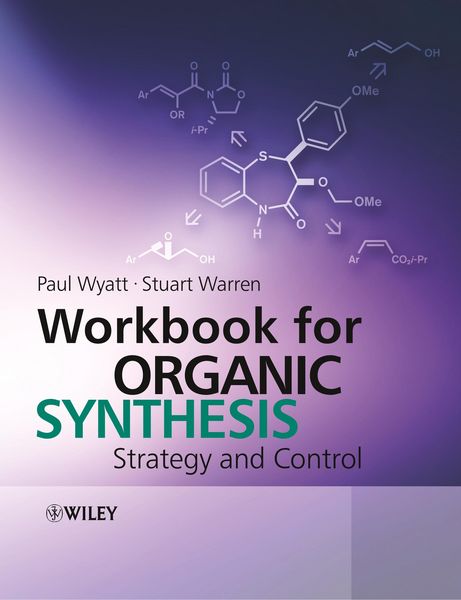
Workbook for Organic Synthesis Strategy and Control
-
- Englisch ausgewählt
65,99 €
inkl. gesetzl. MwSt.,
Beschreibung
Produktdetails
Einband
Taschenbuch
Erscheinungsdatum
21.04.2008
Verlag
John Wiley & Sons IncSeitenzahl
502
Maße (L/B/H)
24,6/18,9/2,7 cm
Gewicht
907 g
Auflage
1. Auflage
Sprache
Englisch
ISBN
978-0-471-92964-2
Workbook for Organic Synthesis: Strategy and Control
Paul Wyatt
Senior Lecturer and Director of Undergraduate Studies, School of Chemistry, University of Bristol, UK
Stuart Warren
Reader in Organic Chemistry, Department of Chemistry, University of Cambridge, UK.
Workbook for Organic Synthesis: Strategy and Control
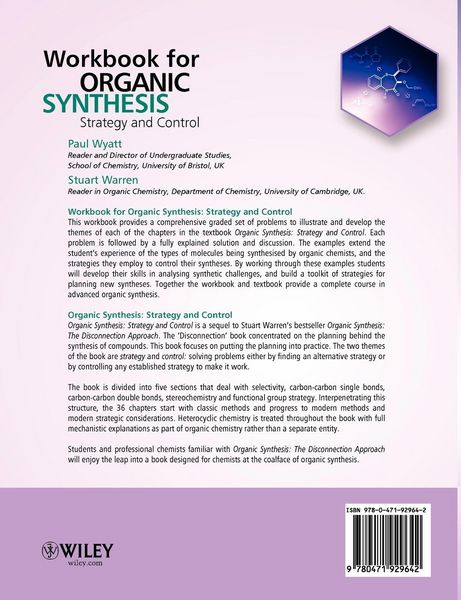
This workbook provides a comprehensive graded set of problems to illustrate and develop the themes of each of the chapters in the textbook Organic Synthesis: Strategy and Control. Each problem is followed by a fully explained solution and discussion. The examples extend the student's experience of the types of molecules being synthesised by organic chemists, and the strategies they employ to control their syntheses. By working through these examples students will develop their skills in analysing synthetic challenges, and build a toolkit of strategies for planning new syntheses. Together the workbook and textbook provide a complete course in advanced organic synthesis.
Organic Synthesis: Strategy and Control
Organic Synthesis: Strategy and Control is a sequel to Stuart Warren's bestseller Organic Synthesis: The Disconnection Approach. The 'Disconnection' book concentrated on the planning behind the synthesis of compounds. This book focuses on putting the planning into practice. The two themes of the book are strategy and control: solving problems either by finding an alternative strategy or by controlling any established strategy to make it work.
The book is divided into five sections that deal with selectivity, carbon-carbon single bonds, carbon-carbon double bonds, stereochemistry and functional group strategy. Interpenetrating this structure, the 36 chapters start with classic methods and progress to modern methods and modern strategic considerations. Heterocyclic chemistry is treated throughout the book with full mechanistic explanations as part of organic chemistry rather than a separate entity.
Students and professional chemists familiar with Organic Synthesis: The Disconnection Approach will enjoy the leap into a book designed for chemists at the coalface of organic synthesis.
Paul Wyatt
Senior Lecturer and Director of Undergraduate Studies, School of Chemistry, University of Bristol, UK
Stuart Warren
Reader in Organic Chemistry, Department of Chemistry, University of Cambridge, UK.
Workbook for Organic Synthesis: Strategy and Control
This workbook provides a comprehensive graded set of problems to illustrate and develop the themes of each of the chapters in the textbook Organic Synthesis: Strategy and Control. Each problem is followed by a fully explained solution and discussion. The examples extend the student's experience of the types of molecules being synthesised by organic chemists, and the strategies they employ to control their syntheses. By working through these examples students will develop their skills in analysing synthetic challenges, and build a toolkit of strategies for planning new syntheses. Together the workbook and textbook provide a complete course in advanced organic synthesis.
Organic Synthesis: Strategy and Control
Organic Synthesis: Strategy and Control is a sequel to Stuart Warren's bestseller Organic Synthesis: The Disconnection Approach. The 'Disconnection' book concentrated on the planning behind the synthesis of compounds. This book focuses on putting the planning into practice. The two themes of the book are strategy and control: solving problems either by finding an alternative strategy or by controlling any established strategy to make it work.
The book is divided into five sections that deal with selectivity, carbon-carbon single bonds, carbon-carbon double bonds, stereochemistry and functional group strategy. Interpenetrating this structure, the 36 chapters start with classic methods and progress to modern methods and modern strategic considerations. Heterocyclic chemistry is treated throughout the book with full mechanistic explanations as part of organic chemistry rather than a separate entity.
Students and professional chemists familiar with Organic Synthesis: The Disconnection Approach will enjoy the leap into a book designed for chemists at the coalface of organic synthesis.
Kundinnen und Kunden meinen
Verfassen Sie die erste Bewertung zu diesem Artikel
Helfen Sie anderen Kund*innen durch Ihre Meinung
Kurze Frage zu unserer Seite
Vielen Dank für Ihr Feedback
Wir nutzen Ihr Feedback, um unsere Produktseiten zu verbessern. Bitte haben Sie Verständnis, dass wir Ihnen keine Rückmeldung geben können. Falls Sie Kontakt mit uns aufnehmen möchten, können Sie sich aber gerne an unseren Kund*innenservice wenden.
zum Kundenservice