KI-Beratung Beta

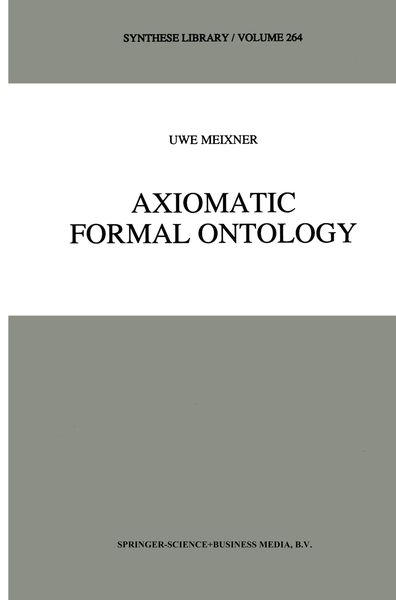
  • Produktbild: Axiomatic Formal Ontology
  • Produktbild: Axiomatic Formal Ontology
Band 264

Axiomatic Formal Ontology

Aus der Reihe Synthese Library

189,99 €

inkl. gesetzl. MwSt., Versandkostenfrei


Beschreibung

Produktdetails

Einband

Gebundene Ausgabe

Erscheinungsdatum

31.08.1997

Abbildungen

X, 398 p.

Verlag

Springer Netherland

Seitenzahl

398

Maße (L/B/H)

24,1/16/2,7 cm

Gewicht

781 g

Auflage

1997 edition

Sprache

Englisch

ISBN

978-0-7923-4717-0

Beschreibung

Produktdetails

Einband

Gebundene Ausgabe

Erscheinungsdatum

31.08.1997

Abbildungen

X, 398 p.

Verlag

Springer Netherland

Seitenzahl

398

Maße (L/B/H)

24,1/16/2,7 cm

Gewicht

781 g

Auflage

1997 edition

Sprache

Englisch

ISBN

978-0-7923-4717-0

Herstelleradresse

Libri GmbH
Europaallee 1
36244 Bad Hersfeld
DE

Email: gpsr@libri.de

Noch keine Bewertungen vorhanden

Verfassen Sie die erste Bewertung zu diesem Artikel

Helfen Sie anderen Kundinnen und Kunden durch Ihre Meinung.

Kundinnen und Kunden meinen

Bewertungen (0)

  • Produktbild: Axiomatic Formal Ontology
  • Produktbild: Axiomatic Formal Ontology
  • I.1 The Central Axioms for the Part-Concept “P”.- I.2 Concepts based on “P” and Elementary Theorems.- I.3 The Concept of State of Affairs.- I.4 Functional Terms Definable by “P”.- I.5 The Conjunction Axiom.- I.6 The Exhaustion Axiom.- I.7 The Connection Axiom.- I.8 Theorems for Negation, Conjunction and Disjunction.- I.9 The Big Disjunction.- I.10 Possible Worlds and Elementary States of Affairs.- I.11 Possibility and Necessity.- I.12 The World and the Truth.- I.13 The Law of Non-Contradiction.- I.14 The Law of Excluded Middle.- I.15 Laws of Truth and Falsity.- I.16 Contingency.- I.17 A Further Examination of Axioms AP7 – AP9.- I.18 The Hierarchies of States of Affairs.- I.19 The Discreteness of “P*”.- I.20 The Cardinality of the Universe of States of Affairs.- II.1 Intensional Parthood between Properties.- II.2 New Readings of Predicates and Functional Terms, and Inherence.- II.3 Actual Existence for Accidents and Substances.- II.4 Real Subsistence as a Property?.- II.5 Laws of Actual Existence.- II.6 Laws of Inherence, and Superessentialism.- II.7 Leibniz’s Principium.- II.8 Once More: Real Subsistence as a Property?.- II.9 The Philosophy of Leibniz and the Ontology of Properties.- II.10 Meinongian Objects in the Ontology of Properties.- II.11 Time-Free and Momentary Material Individuals.- II.12 The Mereology of Gorups.- III.1 Categorial Predicates, Language LPT1, System PT1.- III.2 Saturation and Extraction.- III.3 Parthood and Identity for Properties.- III.4 Important Singular Terms for Properties.- III.5 The Principle of Property-Quanta and the Exhaustion- and Connection-Principle for Properties.- III.6 Properties by Conjunction and Properties by Extraction.- III.7 Essential and Accidental Properties.- III.8 Maximally Consistent Properties andthe Property Specific to an Individual.- III.9 -Exemplification.- III.10 The Relationship between Maximally Consistent Properties, Individuals and Possible Worlds.- III.11 Individuals and Leibniz-Individuals.- III.12 Counterpart Theory.- III.13 Actual Existence for Individuals and Leibniz-Individuals.- III.14 The Modelling of Sets and Extensions.- III.15 Predicates and Properties.- III.16 Modalizers and Quantifiers.- III.17 Conceptions of Properties, and their Number.- IV.1 The System IOU: First Stage.- IV.2 The System IOU: Second Stage.- IV.3 The System IOU: Third Stage.- IV.4 Actual Existence, Identity, and the Fundamental Status of States of Affairs.- Epilogue.- Appendix: Principles, Proofs and Definitions.- System P.- A Variant of System P.- The Leibnizian System.- The Mereology of Momentary Material Individuals.- System PT1.- System IOU.- Index of Subjects.- Index of names.- Literature.