Gutscheinbedingungen

**Gültig bis 14.09.2026 auf Spielzeug, Schreibwaren, Filme, Geschenke & Trends, Musik, tolino eReader & Zubehör, Hörbücher, nicht preisgebundene Bücher und Kalender in der Thalia App. Einzelne Artikel können ausgeschlossen sein. Aufgrund der Buchpreisbindung sind deutschsprachige Bücher und eBooks ausgenommen. Zusätzlich ausgenommen sind Abos & Flatrates, Games, Geschenkkarten/-boxen, Shelfies, Software, Zeitschriften sowie einzelne Artikel von tonies®. Pro Einkauf einmal einlösbar. Nur gültig mit im Onlineshop hinterlegter Bonuscard. Click & Collect nur bei Onlinevorabzahlung möglich. Keine Barauszahlung. Nicht kombinierbar mit anderen Aktionen und Gutscheinen. Gutschein wird auf max. 500€ Bestellwert angerechnet. Nicht gültig für Versandkosten und Services.

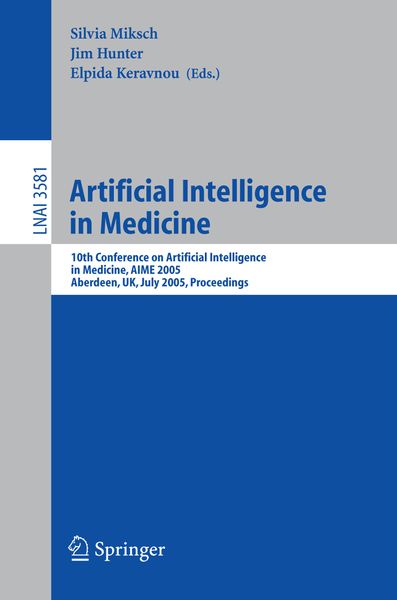
Produktbild: Artificial Intelligence in Medicine
Band 3581

Artificial Intelligence in Medicine 10th Conference on Artificial Intelligence in Medicine, AIME 2005, Aberdeen, UK, July 23-27, 2005, Proceedings

51,99 €

inkl. gesetzl. MwSt., Versandkostenfrei


Beschreibung

Produktdetails

Einband

Taschenbuch

Erscheinungsdatum

14.07.2005

Abbildungen

XVIII, 550 p.

Herausgeber

Silvia Miksch + weitere

Verlag

Springer Berlin

Seitenzahl

550

Maße (L/B/H)

23,5/15,5/3,1 cm

Gewicht

855 g

Auflage

2005

Sprache

Englisch

ISBN

978-3-540-27831-3

Beschreibung

Produktdetails

Einband

Taschenbuch

Erscheinungsdatum

14.07.2005

Abbildungen

XVIII, 550 p.

Herausgeber

Verlag

Springer Berlin

Seitenzahl

550

Maße (L/B/H)

23,5/15,5/3,1 cm

Gewicht

855 g

Auflage

2005

Sprache

Englisch

ISBN

978-3-540-27831-3

Herstelleradresse

Springer-Verlag KG
Sachsenplatz 4-6
1201 Wien
AT

Email: ProductSafety@springernature.com

Noch keine Bewertungen vorhanden

Verfassen Sie die erste Bewertung zu diesem Artikel

Helfen Sie anderen Kundinnen und Kunden durch Ihre Meinung.

Kundinnen und Kunden meinen

Bewertungen (0)

  • Produktbild: Artificial Intelligence in Medicine
  • Invited Talks.- Ontology Mapping: A Way Out of the Medical Tower of Babel?.- Human Computer Interaction in Context Aware Wearable Systems.- Temporal Representation and Reasoning.- A New Approach to the Abstraction of Monitoring Data in Intensive Care.- Learning Rules with Complex Temporal Patterns in Biomedical Domains.- Discriminating Exanthematic Diseases from Temporal Patterns of Patient Symptoms.- Probabilistic Abstraction of Multiple Longitudinal Electronic Medical Records.- Using a Bayesian-Network Model for the Analysis of Clinical Time-Series Data.- Data-Driven Analysis of Blood Glucose Management Effectiveness.- Extending Temporal Databases to Deal with Telic/Atelic Medical Data.- Dichotomization of ICU Length of Stay Based on Model Calibration.- Decision Support Systems.- AtherEx: An Expert System for Atherosclerosis Risk Assessment.- Smooth Integration of Decision Support into an Existing Electronic Patient Record.- REPS: A Rehabilitation Expert System for Post-stroke Patients.- Clinical Guidelines and Protocols.- Testing Asbru Guidelines and Protocols for Neonatal Intensive Care.- EORCA: A Collaborative Activities Representation for Building Guidelines from Field Observations.- Design Patterns for Modelling Guidelines.- Improving Clinical Guideline Implementation Through Prototypical Design Patterns.- Automatic Derivation of a Decision Tree to Represent Guideline-Based Therapeutic Strategies for the Management of Chronic Diseases.- Exploiting Decision Theory for Supporting Therapy Selection in Computerized Clinical Guidelines.- Helping Physicians to Organize Guidelines Within Conceptual Hierarchies.- MHB – A Many-Headed Bridge Between Informal and Formal Guideline Representations.- Clinical Guidelines Adaptation: Managing Authoring and Versioning Issues.-Open-Source Publishing of Medical Knowledge for Creation of Computer-Interpretable Guidelines.- A History-Based Algebra for Quality-Checking Medical Guidelines.- The Spock System: Developing a Runtime Application Engine for Hybrid-Asbru Guidelines.- AI Planning Technology as a Component of Computerised Clinical Practice Guidelines.- Gaining Process Information from Clinical Practice Guidelines Using Information Extraction.- Ontology-Driven Extraction of Linguistic Patterns for Modelling Clinical Guidelines.- Formalising Medical Quality Indicators to Improve Guidelines.- Ontology and Terminology.- Oncology Ontology in the NCI Thesaurus.- Ontology-Mediated Distributed Decision Support for Breast Cancer.- Multimedia Data Management to Assist Tissue Microarrays Design.- Building Medical Ontologies Based on Terminology Extraction from Texts: Methodological Propositions.- Translating Biomedical Terms by Inferring Transducers.- Using Lexical and Logical Methods for the Alignment of Medical Terminologies.- Latent Argumentative Pruning for Compact MEDLINE Indexing.- A Benchmark Evaluation of the French MeSH Indexers.- Populating an Allergens Ontology Using Natural Language Processing and Machine Learning Techniques.- Ontology of Time and Situoids in Medical Conceptual Modeling.- The Use of Verbal Classification for Determining the Course of Medical Treatment by Medicinal Herbs.- Case-Based Reasoning, Signal Interpretation, Visual Mining.- Interactive Knowledge Validation in CBR for Decision Support in Medicine.- Adaptation and Medical Case-Based Reasoning Focusing on Endocrine Therapy Support.- Transcranial Magnetic Stimulation (TMS) to Evaluate and Classify Mental Diseases Using Neural Networks.- Towards Information Visualization and Clustering Techniques for MRI Data Sets.- Computer Vision and Imaging.- Electrocardiographic Imaging: Towards Automated Interpretation of Activation Maps.- Automatic Landmarking of Cephalograms by Cellular Neural Networks.- Anatomical Sketch Understanding: Recognizing Explicit and Implicit Structure.- Morphometry of the Hippocampus Based on a Deformable Model and Support Vector Machines.- Automatic Segmentation of Whole-Body Bone Scintigrams as a Preprocessing Step for Computer Assisted Diagnostics.- Knowledge Management.- Multi-agent Patient Representation in Primary Care.- Clinical Reasoning Learning with Simulated Patients.- Implicit Learning System for Teaching the Art of Acute Cardiac Infarction Diagnosis.- Which Kind of Knowledge Is Suitable for Redesigning Hospital Logistic Processes?.- Machine Learning, Knowledge Discovery and Data Mining.- Web Mining Techniques for Automatic Discovery of Medical Knowledge.- Resource Modeling and Analysis of Regional Public Health Care Data by Means of Knowledge Technologies.- An Evolutionary Divide and Conquer Method for Long-Term Dietary Menu Planning.- Human/Computer Interaction to Learn Scenarios from ICU Multivariate Time Series.- Mining Clinical Data: Selecting Decision Support Algorithm for the MET-AP System.- A Data Pre-processing Method to Increase Efficiency and Accuracy in Data Mining.- Rule Discovery in Epidemiologic Surveillance Data Using EpiXCS: An Evolutionary Computation Approach.- Subgroup Mining for Interactive Knowledge Refinement.- Evidence Accumulation to Identify Discriminatory Signatures in Biomedical Spectra.- On Understanding and Assessing Feature Selection Bias.- A Model-Based Approach to Visualizing Classification Decisions for Patient Diagnosis.- Learning Rules from Multisource Data for Cardiac Monitoring.- Effective Confidence Region Prediction Using Probability Forecasters.- Signature Recognition Methods for Identifying Influenza Sequences.- Conquering the Curse of Dimensionality in Gene Expression Cancer Diagnosis: Tough Problem, Simple Models.- An Algorithm to Learn Causal Relations Between Genes from Steady State Data: Simulation and Its Application to Melanoma Dataset.- Relation Mining over a Corpus of Scientific Literature.