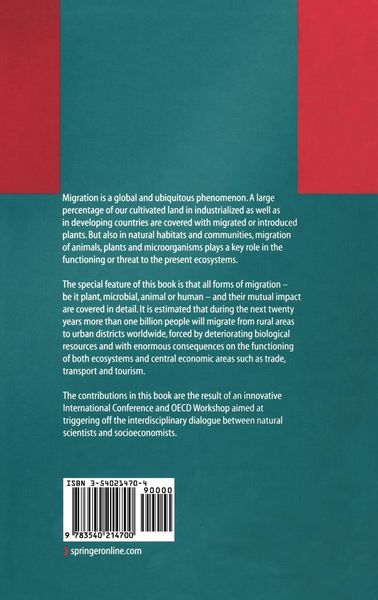
• Produktbild: Biological Resources and Migration
  • Produktbild: Biological Resources and Migration
- 12%

Biological Resources and Migration

12% sparen

192,99 € UVP 219,99 €

inkl. gesetzl. MwSt., Versandkostenfrei


Beschreibung

Produktdetails

Einband

Gebundene Ausgabe

Erscheinungsdatum

09.06.2004

Abbildungen

XXIX, 363 p.

Herausgeber

Dietrich Werner

Verlag

Springer Berlin

Seitenzahl

363

Maße (L/B/H)

24,1/16/2,6 cm

Gewicht

752 g

Auflage

2004

Sprache

Englisch

ISBN

978-3-540-21470-0

Beschreibung

Rezension

From the reviews:


"This volume is the product of a recent … conference and workshop at Phillips University in Marburg, Germany, which brought together more than 100 scientists from 24 nations to discuss the movement of organisms and resources across landscapes and seascapes. Biological Resources and Migration emphasizes the involvement of humans in ecological systems. This characteristic of the book may appeal especially to European landscape ecologists … . landscape ecologists are likely to find something in Biological Resources and Migration pertinent to their research … ." (Kevin M. Potter, Landscape Ecology, Vol. 21, 2006)

Produktdetails

Einband

Gebundene Ausgabe

Erscheinungsdatum

09.06.2004

Abbildungen

XXIX, 363 p.

Herausgeber

Dietrich Werner

Verlag

Springer Berlin

Seitenzahl

363

Maße (L/B/H)

24,1/16/2,6 cm

Gewicht

752 g

Auflage

2004

Sprache

Englisch

ISBN

978-3-540-21470-0

Herstelleradresse

Springer-Verlag KG
Sachsenplatz 4-6
1201 Wien
AT

Email: ProductSafety@springernature.com

Noch keine Bewertungen vorhanden

Verfassen Sie die erste Bewertung zu diesem Artikel

Helfen Sie anderen Kundinnen und Kunden durch Ihre Meinung.

Kundinnen und Kunden meinen

Bewertungen (0)

  • Produktbild: Biological Resources and Migration
  • Produktbild: Biological Resources and Migration
  • 1 The Rice Genepool and Human Migrations.- 2 Movement of Rice Germplasm Around the World.- 3 Potential for Gene Flow from Cultivated Wheat to Weedy Relatives in the Great Plains of North America.- 4 Humans, Climate, and Plants: the Migration of Crested Wheatgrass and Smooth Bromegrass to the Great Plains of North America.- 5 Biogeography, Local Adaptation, Vavilov, and Genetic Diversity in Soybean.- 6 Migration of a Grain Legume, Phaseolus vulgaris, in Europe.- 7 Forest History in Europe.- 8 Forest Biological Resources in the Amazon Basin.- 9 Migration of Knowledge Leads to Floristic Development in Myanmar.- 10 Tracking Parasitoids at the Farmland Field Scale Using Microsatellite Markers.- 11 Interhemispheric Transport of Viable Fungi and Bacteria from Africa to the Caribbean with Soil Dust.- 12 Be a Virus, See the World.- 13 Species Delineation and Biogeography of Symbiotic Bacteria Associated with Cultivated and Wild Legumes.- 14 Micro-spatial Distribution of Bacteria in the Rhizosphere.- 15 Colonization of Some Polish Soils by Azotobacter spp. at the Beginning and at the End of the 20th Century.- 16 Estimation of Biotic and Abiotic Factors That Affect Migration of Rhizobia.- 17 Indigenous Strains of Rhizobia and Their Performance in Specific Regions of India.- 18 Migration of Aquatic Invertebrates.- 19 Migration of Fishery Resources in the World’s Oceans.- 20 Migration of Marine Mammals.- 21 The “Global Register of Migratory Species” — First Results of Global GIS Analysis.- 22 Coupled Dynamics of Lemmings and Long-Distance Migratory Birds.- 23 Israel — an Intercontinental Highway for Migrating Birds.- 24 Contrasting Molecular Markers Reveal: Gene Flow via Pollen Is Much More Effective Than Gene Flow Via Seeds.- 25 Principal Changes of Ecological Migrationand Dispersal: Nature Conservation Consequences.- 26 Agronomical Practices Maximizing Water Use.- 27 Soil Degradation and Land Use.- 28 Migration Towards the Cities: Measuring the Effects of Urban Expansion in Rural-Urban Interface by GIS and RS Technology.- 29 Population Shifts and Migration in the Sahel and Sub-Sudan Zone of West Africa Reviewed from the Aspect of Human Carrying Capacity.- 30 Desertification and Human Migration.- 31 Airborne Migration of Obligate Nomads Demonstrates Gene Flow Across Eurasia.- 32 Discussion Sessions.