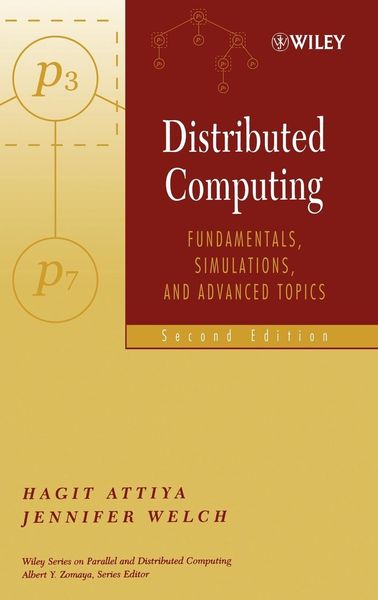
Distributed Computing Fundamentals, Simulations, and Advanced Topics
Aus der Reihe
Wiley Series on Parallel and Distributed Computing
-
- Englisch ausgewählt
196,99 €
inkl. gesetzl. MwSt.,
Beschreibung
Produktdetails
Einband
Gebundene Ausgabe
Erscheinungsdatum
25.03.2004
Verlag
John Wiley & Sons IncSeitenzahl
432
Maße (L/B/H)
24/16,1/2,8 cm
Gewicht
744 g
Auflage
2. Auflage
Sprache
Englisch
ISBN
978-0-471-45324-6
* Comprehensive introduction to the fundamental results in the mathematical foundations of distributed computing
* Accompanied by supporting material, such as lecture notes and solutions for selected exercises
* Each chapter ends with bibliographical notes and a set of exercises
* Covers the fundamental models, issues and techniques, and features some of the more advanced topics
* Accompanied by supporting material, such as lecture notes and solutions for selected exercises
* Each chapter ends with bibliographical notes and a set of exercises
* Covers the fundamental models, issues and techniques, and features some of the more advanced topics
Kundinnen und Kunden meinen
Verfassen Sie die erste Bewertung zu diesem Artikel
Helfen Sie anderen Kund*innen durch Ihre Meinung
Kurze Frage zu unserer Seite
Vielen Dank für Ihr Feedback
Wir nutzen Ihr Feedback, um unsere Produktseiten zu verbessern. Bitte haben Sie Verständnis, dass wir Ihnen keine Rückmeldung geben können. Falls Sie Kontakt mit uns aufnehmen möchten, können Sie sich aber gerne an unseren Kund*innenservice wenden.
zum Kundenservice