KI-Beratung Beta

Gutscheinbedingungen

**Gültig bis 18.11.2026 auf englischsprachige Klassiker (klassiker-32728) online auf thalia.at und in der Thalia App. Einzelne Artikel können ausgeschlossen sein. Ausgenommen sind preisgebundene Artikel & eBooks. Pro Einkauf einmal einlösbar. Click & Collect nur bei Onlinevorabzahlung möglich. Keine Barauszahlung. Nicht kombinierbar mit anderen Aktionen und Gutscheinen. Gutschein wird auf max. 500€ Bestellwert angerechnet. Nicht gültig für Geschenkkarten, Versandkosten und Services.

  • Produktbild: Currency Substitution
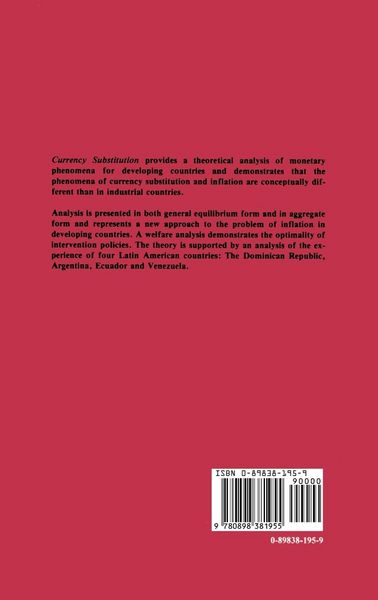
  • Produktbild: Currency Substitution

Currency Substitution Theory and Evidence from Latin America

109,99 €

inkl. gesetzl. MwSt., Versandkostenfrei


Beschreibung

This work grew out of a series of investigations begun by the authors in 1980 and 1981. Specifically the authors pursued two lines of inquiry. First, to advance the state of the theoretical lit erature to better explain the crises of liberalization which seemed to be afflicting the third world in general...

Beschreibung

This work grew out of a series of investigations begun by the authors in 1980 and 1981. Specifically the authors pursued two lines of inquiry. First, to advance the state of the theoretical lit erature to better explain the crises of liberalization which seemed to be afflicting the third world in general and Latin America in particular. To do this, several different kinds of models were in vestigated and adapted. These are presented in Chapters 2, 3 and 5. Secondly an analysis of the empirical evidence was conducted in order to gain insight into the processes that were thought to be occurring and the theoretical models that were being developed. Some of this work appears in Chapters 3, 4, 5 and 6. Other work by the authors on these issues has been published elsewhere and is referenced herein. There are a great many people whose work and whose com ments have influenced this work. We would like to especially thank Guillermo Calvo, Michael Connolly, Sebastian Edwards, Roque Fernandez, Michael Darby, Robert Clower, Neil Wallace, John Kareken, Paul McNelis, Jeffrey Nugent, Jaime Marquez, Lee Ohanian, Leroy Laney, Jorge Braga de Macedo, Dale Henderson, vii Matthew Canzoneiri, Arthur Laffer, Marc Miles, and George Von Furstenberg whose ideas and comments gave rise to much of our work. We would like to thank Suh Lee for his assistance with the computations in Chapter 5.

Produktdetails

Einband

Gebundene Ausgabe

Erscheinungsdatum

31.03.1987

Abbildungen

X, 198 p.

Verlag Springer Netherland

Produktdetails

Einband

Gebundene Ausgabe

Erscheinungsdatum

31.03.1987

Abbildungen

X, 198 p.

Verlag Springer Netherland
Seitenzahl

198

Maße (L/B/H)

24,1/16/1,7 cm

Gewicht

437 g

Auflage

1987

Sprache

Englisch

ISBN

978-0-89838-195-5

Herstelleradresse

Springer-Verlag GmbH
Europaplatz 3
69115 Heidelberg
DE

Email: ProductSafety@springernature.com

Noch keine Bewertungen vorhanden

Verfassen Sie die erste Bewertung zu diesem Artikel

Helfen Sie anderen Kundinnen und Kunden durch Ihre Meinung.

Kundinnen und Kunden meinen

Bewertungen (0)

  • Produktbild: Currency Substitution
  • Produktbild: Currency Substitution
  • 1. Introduction.- References.- 2. A General Equilibrium Theory of Exchange Rates and Managed Floating.- 1. Multiple Stochastic Exchange Rate Equilibria.- 2. Price Uncertainty and Flexible Exchange Rates.- 3. A Welfare Analysis.- References.- 3. Empirical Implementation of the Instability Hypothesis.- 1. Instability and Theoretical Models.- 2. Modelling Considerations.- 3. The Model.- 4. Equilibrium with Government Intervention.- 5. Dominican Currency Crises.- 6. Concluding Remarks.- References.- 4. Currency Substitution and Small Open Economies: The Case of the Dominican Republic.- 1. Stylized Institutional Features of the Dominican Republic Parallel Market.- 2. The Empirical Model.- 3. Empirical Analysis.- 4. Summary and Conclusions.- Notes.- References.- 5. Dominant Currencies and Monetarism in Argentina.- 1. Introduction.- 2. Basic Dominant Currency Modelling Considerations.- 3. A Summary of Argentina’s Exchange Rate Systems 1956–82.- 4. The Case of Argentina.- 5. Evidence of One Way Currency Substitution.- 6. Money, Exchange Rates, and Prices.- References.- 6. Venezuela and Ecuador—Currency Substitution in Oil Economies.- 1. Stability and Homogeneity.- 2. Frequency Analysis of Money and Prices.- 3. Concluding Remarks.- References.- 7. Conclusion.