
KI-Beratung Beta

Gutscheinbedingungen

**Gültig am 25.11.2026 auf fremdsprachige Bücher online auf thalia.at und in der Thalia App. Einzelne Artikel können ausgeschlossen sein. Ausgenommen sind preisgebundene Artikel & eBooks. Pro Einkauf einmal einlösbar. Click & Collect nur bei Onlinevorabzahlung möglich. Keine Barauszahlung. Nicht kombinierbar mit anderen Aktionen und Gutscheinen. Gutschein wird auf max. 500€ Bestellwert angerechnet. Nicht gültig für Geschenkkarten, Versandkosten und Services.

  • Produktbild: Race, Markets, and Social Outcomes
  • Produktbild: Race, Markets, and Social Outcomes
Band 54 - 11%

Race, Markets, and Social Outcomes

Aus der Reihe Recent Economic Thought
11% sparen

96,99 € UVP 109,99 €

inkl. gesetzl. MwSt., Versandkostenfrei


Beschreibung

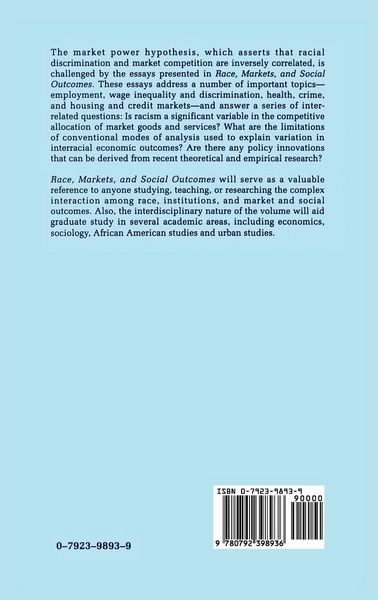
THE JANUS-FACE OF RACE: REFLEC- TIONS ON ECONOMIC THEORY Patrick L. Mason and Rhonda Williams Many economists are willing to accept that race is a significant factor in US eco nomic and social affairs. Yet the professional literature displays a peculiar schizo phrenia when faced with the task of actually...

Beschreibung

THE JANUS-FACE OF RACE: REFLEC- TIONS ON ECONOMIC THEORY Patrick L. Mason and Rhonda Williams Many economists are willing to accept that race is a significant factor in US eco nomic and social affairs. Yet the professional literature displays a peculiar schizo phrenia when faced with the task of actually formulating what race means and how race works in our political economy. On the one hand, race matters when the dis cussion is focused on anti-social behavior, social choices, and undesired market outcomes. Inexplicably, African Americans are more likely to prefer welfare, lower labor force participation, and unemployment. On the other hand, race does not matter when the subject of discussion is economically productive or socially accept able activities and legal market choices (for example, wages and employment). This Janus-faced construction of race is maintained by economists' stubborn ad herence to the market power hypothesis. The market power hypothesis asserts that racial discrimination and market competition are inversely correlated. Discrimina tory behavior will persist only in those sectors of society where the competitive forces of the market are least operative. When applied to the labor market, the mar ket power hypothesis suggests that pre- and post-labor market decisions represent disjoint sets. On average, members of a disadvantaged social group may accumulate a lower amount of or a lower quality of productive attributes because of discrimina tion in marital, residential, or school choice, or because of substantial animosity in day-to-day interpersonal relations with members of a privileged group.

Produktdetails

Einband

Gebundene Ausgabe

Erscheinungsdatum

31.05.1997

Abbildungen

X, 194 p.

Herausgeber Patrick L. Mason + weitere

Produktdetails

Einband

Gebundene Ausgabe

Erscheinungsdatum

31.05.1997

Abbildungen

X, 194 p.

Herausgeber
Verlag Springer Us
Seitenzahl

194

Maße (L/B/H)

24,1/16/1,6 cm

Gewicht

431 g

Auflage

1997

Sprache

Englisch

ISBN

978-0-7923-9893-6

Herstelleradresse

Springer-Verlag GmbH
Europaplatz 3
69115 Heidelberg
DE

Email: ProductSafety@springernature.com

Noch keine Bewertungen vorhanden

Verfassen Sie die erste Bewertung zu diesem Artikel

Helfen Sie anderen Kundinnen und Kunden durch Ihre Meinung.

Kundinnen und Kunden meinen

Bewertungen (0)

  • Produktbild: Race, Markets, and Social Outcomes
  • Produktbild: Race, Markets, and Social Outcomes
  • I. Self-Employment: Escape From Racism?.- 1 The Status of Self-Employed and Employee African Americans in the New York City Construction Industry.- 2 Black Employment Criminal Activity and entrepreneurship: A Case Study of New Jersey.- II. Racial Wage Inequality and Discrimination 65.- 3 Measuring Wage Discrimination During Periods of Growing Overall Wage Inequality.- III. Health 91.- 4 Will Greater Competition Improve the Markets for Health Care Services and the Health Outcomes for Black Americans?.- 5 The Continuing Significance of Race in Meeting the Health Care Needs of Black Elderly.- IV. Race, Crime, and the Neighborhood.- 6 Race and Crime: What is the Connection?.- 7 Why Does Race Matter in Housing and Credit Markets?.