Gutscheinbedingungen

**Gültig am 28.06.2026 auf Spielzeug, Schreibwaren, Filme, Geschenke & Trends, Musik, tolino eReader & Zubehör, Hörbücher und Hörbuch-Downloads (außer Abo), nicht preisgebundene Bücher und Kalender online auf thalia.at und in der Thalia App. Einzelne Artikel können ausgeschlossen sein. Aufgrund der Buchpreisbindung sind deutschsprachige Bücher und eBooks ausgenommen. Zusätzlich ausgenommen sind preisgebundene Artikel, Abos & Flatrates, eBooks, Games, Geschenkkarten/-boxen, Shelfies, Software, Zeitschriften sowie einzelne Artikel von tonies®. Pro Einkauf einmal einlösbar. Click & Collect nur bei Onlinevorabzahlung möglich. Keine Barauszahlung. Nicht kombinierbar mit anderen Aktionen und Gutscheinen. Gutschein wird auf max. 500€ Bestellwert angerechnet. Nicht gültig für Versandkosten und Services.

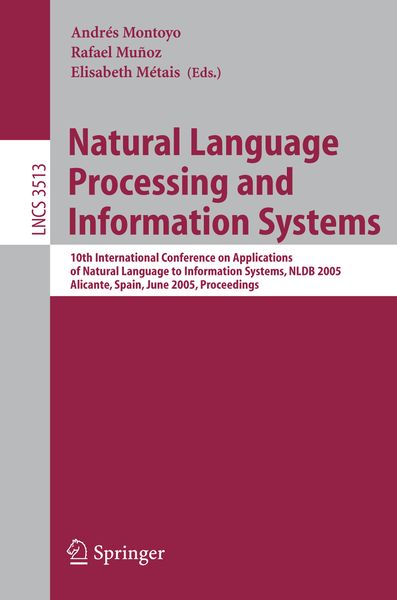
  • Produktbild: Natural Language Processing and Information Systems
  • Produktbild: Natural Language Processing and Information Systems

Natural Language Processing and Information Systems 10th International Conference on Applications of Natural Language to Information Systems, NLDB 2005, Alicante, Spain, June 15-17, Proceedings

51,99 €

inkl. gesetzl. MwSt., Versandkostenfrei


Beschreibung

Produktdetails

Einband

Taschenbuch

Erscheinungsdatum

01.06.2005

Herausgeber

Andrés Montoyo + weitere

Verlag

Springer Berlin

Seitenzahl

408

Maße (L/B/H)

23,5/15,5/2,3 cm

Gewicht

639 g

Auflage

2005

Sprache

Englisch

ISBN

978-3-540-26031-8

Beschreibung

Produktdetails

Einband

Taschenbuch

Erscheinungsdatum

01.06.2005

Herausgeber

Verlag

Springer Berlin

Seitenzahl

408

Maße (L/B/H)

23,5/15,5/2,3 cm

Gewicht

639 g

Auflage

2005

Sprache

Englisch

ISBN

978-3-540-26031-8

Herstelleradresse

Springer-Verlag KG
Sachsenplatz 4-6
1201 Wien
AT

Email: ProductSafety@springernature.com

Kundinnen und Kunden meinen

0 Bewertungen

Informationen zu Bewertungen

Zur Abgabe einer Bewertung ist eine Anmeldung im Konto notwendig. Die Authentizität der Bewertungen wird von uns nicht überprüft. Wir behalten uns vor, Bewertungstexte, die unseren Richtlinien widersprechen, entsprechend zu kürzen oder zu löschen.

Die Bewertungen sind nach Format, Anzahl Sterne und Datum sortiert.

Verfassen Sie die erste Bewertung zu diesem Artikel

Helfen Sie anderen Kund*innen durch Ihre Meinung

Kundinnen und Kunden meinen

0 Bewertungen filtern

  • Produktbild: Natural Language Processing and Information Systems
  • Produktbild: Natural Language Processing and Information Systems
  • Regular Papers.- Extracting Semantic Taxonomies of Nouns from a Korean MRD Using a Small Bootstrapping Thesaurus and a Machine Learning Approach.- On the Transformation of Sentences with Genitive Relations to SQL Queries.- Binary Lexical Relations for Text Representation in Information Retrieval.- Application of Text Categorization to Astronomy Field.- Towards an XML Representation of Proper Names and Their Relationships.- Empirical Textual Mining to Protein Entities Recognition from PubMed Corpus.- Automatic Extraction of Semantic Relationships for WordNet by Means of Pattern Learning from Wikipedia.- Combining Data-Driven Systems for Improving Named Entity Recognition.- Natural Language Processing: Mature Enough for Requirements Documents Analysis?.- Improving Text Categorization Using Domain Knowledge.- A Process and Tool Support for Managing Activity and Resource Conflicts Based on Requirements Classification.- Web-Assisted Detection and Correction of Joint and Disjoint Malapropos Word Combinations.- Web Directory Construction Using Lexical Chains.- Email Categorization with Tournament Methods.- Knowledge-Based Information Extraction: A Case Study of Recognizing Emails of Nigerian Frauds.- Extended Tagging and Interpretation Tools for Mapping Requirements Texts to Conceptual (Predesign) Models.- Improving Question Answering Using Named Entity Recognition.- Using Semantic Roles in Information Retrieval Systems.- Text Categorization Based on Subtopic Clusters.- Interpretation of Implicit Parallel Structures. A Case Study with “vice-versa”.- Text2Onto.- Interaction Transformation Patterns Based on Semantic Roles.- Query Refinement Through Lexical Clustering of Scientific Textual Databases.- Automatic Filtering of Bilingual Corpora for Statistical Machine Translation.- An Approach to Clustering Abstracts.- Named Entity Recognition for Web Content Filtering.- The Role of Word Sense Disambiguation in Automated Text Categorization.- Combining Biological Databases and Text Mining to Support New Bioinformatics Applications.- A Semi-automatic Approach to Extracting Common Sense Knowledge from Knowledge Sources.- A Phrasal Approach to Natural Language Interfaces over Databases.- Information Extraction for User’s Utterance Processing on Ubiquitous Robot Companion.- Investigating the Best Configuration of HMM Spanish PoS Tagger when Minimum Amount of Training Data Is Available.- An Approach to Automatic Construction of Lexical Relations Between Chinese Nouns from Machine Readable Dictionary.- Automatic Acquisition of Adjacent Information and Its Effectiveness in Extraction of Bilingual Word Pairs from Parallel Corpora.- Text Mining from Categorized Stem Cell Documents to Infer Developmental Stage-Specific Expression and Regulation Patterns of Stem Cells.- Simple But Useful Algorithms for Identifying Noun Phrase Complements of Embedded Clauses in a Partial Parse.- An Add-On to Rule-Based Sifters for Multi-recipient Spam Emails.- Semantic Annotation of a Natural Language Corpus for Knowledge Extraction.- mySENSEVAL: Explaining WSD System Performance Using Target Word Features.- Information Extraction from Email Announcements.- An Application of NLP Rules to Spoken Document Segmentation Task.- A Generalised Similarity Measure for Question Answering.- Multi-lingual Database Querying and the Atoms of Language.- Extracting Information from Short Messages.- Automatic Transition of Natural Language Software Requirements Specification into Formal Presentation.- Automatic Description of Static Images in Natural Language.- On Some Optimization Heuristics for Lesk-Like WSD Algorithms.