Gutscheinbedingungen

**Gültig bis 25.06.2026 auf fremdsprachige Bücher online auf thalia.at und in der Thalia App. Einzelne Artikel können ausgeschlossen sein. Ausgenommen sind preisgebundene Artikel & eBooks. Pro Einkauf einmal einlösbar. Click & Collect nur bei Onlinevorabzahlung möglich. Keine Barauszahlung. Nicht kombinierbar mit anderen Aktionen und Gutscheinen. Gutschein wird auf max. 500€ Bestellwert angerechnet. Nicht gültig für Geschenkkarten, Versandkosten und Services.

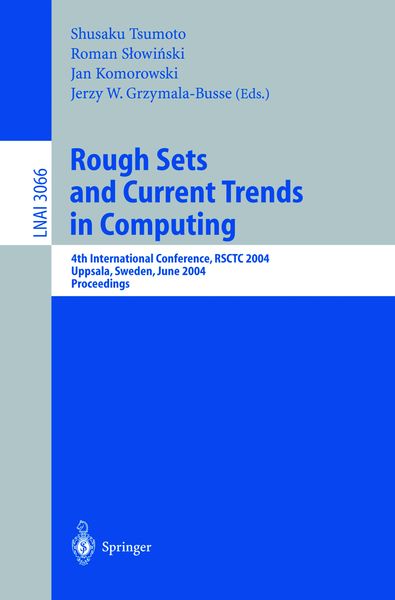
Produktbild: Rough Sets and Current Trends in Computing
Band 3066 - 11%

Rough Sets and Current Trends in Computing 4th International Conference, RSCTC 2004, Uppsala, Sweden, June 1-5, 2004, Proceedings

11% sparen

96,99 € UVP 109,99 €

inkl. gesetzl. MwSt., Versandkostenfrei


Beschreibung

Produktdetails

Einband

Taschenbuch

Erscheinungsdatum

21.05.2004

Herausgeber

Shusaku Tsumoto + weitere

Verlag

Springer Berlin

Seitenzahl

860

Maße (L/B/H)

23,3/15,4/4,8 cm

Gewicht

1294 g

Auflage

2004. 2004

Sprache

Englisch

ISBN

978-3-540-22117-3

Beschreibung

Produktdetails

Einband

Taschenbuch

Erscheinungsdatum

21.05.2004

Herausgeber

Verlag

Springer Berlin

Seitenzahl

860

Maße (L/B/H)

23,3/15,4/4,8 cm

Gewicht

1294 g

Auflage

2004. 2004

Sprache

Englisch

ISBN

978-3-540-22117-3

Herstelleradresse

Springer-Verlag GmbH
Heidelberger Platz 3
14197 Berlin
Deutschland
Email: sdc-bookservice@springer.com
Url: www.springer.com
Telephone: +49 30 827870
Fax: +49 30 8214091

Kundinnen und Kunden meinen

0 Bewertungen

Informationen zu Bewertungen

Zur Abgabe einer Bewertung ist eine Anmeldung im Konto notwendig. Die Authentizität der Bewertungen wird von uns nicht überprüft. Wir behalten uns vor, Bewertungstexte, die unseren Richtlinien widersprechen, entsprechend zu kürzen oder zu löschen.

Die Bewertungen sind nach Format, Anzahl Sterne und Datum sortiert.

Verfassen Sie die erste Bewertung zu diesem Artikel

Helfen Sie anderen Kund*innen durch Ihre Meinung

Kundinnen und Kunden meinen

0 Bewertungen filtern

  • Produktbild: Rough Sets and Current Trends in Computing
  • Plenary Papers.- Decision Networks.- Toward Rough Set Foundations. Mereological Approach.- Generalizations of Rough Sets: From Crisp to Fuzzy Cases.- Theory.- Investigation about Time Monotonicity of Similarity and Preclusive Rough Approximations in Incomplete Information Systems.- The Ordered Set of Rough Sets.- A Comparative Study of Formal Concept Analysis and Rough Set Theory in Data Analysis.- Structure of Rough Approximations Based on Molecular Lattices.- Rough Approximations under Level Fuzzy Sets.- Fuzzy-Rough Modus Ponens and Modus Tollens as a Basis for Approximate Reasoning.- Logic and Rough Sets.- Rough Truth, Consequence, Consistency and Belief Revision.- A Note on Ziarko’s Variable Precision Rough Set Model and Nonmonotonic Reasoning.- Fuzzy Reasoning Based on Propositional Modal Logic.- Granular Computing.- Approximation Spaces and Information Granulation.- Granular Language and Its Applications in Problem Solving.- Belief Reasoning, Revision and Fusion by Matrix Algebra.- Rough and Fuzzy Relations.- On the Correspondence between Approximations and Similarity.- Toward Rough Knowledge Bases with Quantitative Measures.- Considering Semantic Ambiguity and Indistinguishability for Values of Membership Attribute in Possibility-Based Fuzzy Relational Models.- Foundations of Data Mining.- Research on Integrating Ordbms and Rough Set Theory.- Feature Subset Selection Based on Relative Dependency between Attributes.- Granular Computing on Extensional Functional Dependencies for Information System.- Greedy Algorithm for Decision Tree Construction in Context of Knowledge Discovery Problems.- GAMInG – A Framework for Generalization of Association Mining via Information Granulation.- Mining Un-interpreted Generalized Association Rules by Linear Inequalities.- A Graded Applicability of Rules.- On the Degree of Independence of a Contingency Matrix.- K Nearest Neighbor Classification with Local Induction of the Simple Value Difference Metric.- A Note on the Regularization Algorithm.- Incomplete Information Systems.- Characteristic Relations for Incomplete Data: A Generalization of the Indiscernibility Relation.- Data Decomposition and Decision Rule Joining for Classification of Data with Missing Values.- Interestingness.- Bayesian Confirmation Measures within Rough Set Approach.- Discovering Maximal Potentially Useful Association Rules Based on Probability Logic.- Semantics and Syntactic Patterns in Data.- Multiagents and Information Systems.- Dialogue in Rough Context.- Constrained Sums of Information Systems.- Defeasible Deontic Control for Discrete Events Based on EVALPSN.- Fuzzy Logic and Modeling.- Rough Set Based Fuzzy Modeling by Occupancy Degree and Optimal Partition of Projection.- A Novel High Performance Fuzzy Controller Applied to Traffic Control of ATM Networks.- Design of a Speed Drive Based on Fuzzy Logic for a Dual Three-Phase Induction Motor.- Rough Classification.- Rough Set Theory Analysis on Decision Subdivision.- Rough Set Methods in Approximation of Hierarchical Concepts.- Classifiers Based on Two-Layered Learning.- Rough Fuzzy Integrals for Information Fusion and Classification.- Rough Sets and Probabilities.- Towards Jointree Propagation with Conditional Probability Distributions.- Condition Class Classification Stability in RST due to Continuous Value Discretisation.- The Rough Bayesian Model for Distributed Decision Systems.- Variable Precision Rough Set Model.- On Learnability of Decision Tables.- Remarks on Approximation Quality in Variable Precision Fuzzy Rough Sets Model.- The Elucidation of an Iterative Procedure to ß-Reduct Selection in the Variable Precision Rough Sets Model.- Spatial Reasoning.- A Logic-Based Framework for Qualitative Spatial Reasoning in Mobile GIS Environment.- Spatial Object Modeling in Intuitionistic Fuzzy Topological Spaces.- Rough Spatial Interpretation.- Reduction.- A Scalable Rough Set Knowledge Reduction Algorithm.- Tree-Like Parallelization of Reduct and Construct Computation.- Heuristically Fast Finding of the Shortest Reducts.- Study on Reduct and Core Computation in Incompatible Information Systems.- The Part Reductions in Information Systems.- Rule Induction.- Rules from Belief Networks: A Rough Set Approach.- The Bagging and n 2-Classifiers Based on Rules Induced by MODLEM.- A Parallel Approximate Rule Extracting Algorithm Based on the Improved Discernibility Matrix.- Decision Rules in Multivalued Decision Systems.- Multicriteria Choice and Ranking Using Decision Rules Induced from Rough Approximation of Graded Preference Relations.- Measuring the Expected Impact of Decision Rule Application.- Detection of Differences between Syntactic and Semantic Similarities.- Rough Sets and Neural Network.- Processing of Musical Data Employing Rough Sets and Artificial Neural Networks.- Integration of Rough Set and Neural Network for Application of Generator Fault Diagnosis.- Harnessing Classifier Networks – Towards Hierarchical Concept Construction.- Associative Historical Knowledge Extraction from the Structured Memory.- Clustering.- Utilizing Rough Sets and Multi-objective Genetic Algorithms for Automated Clustering.- Towards Missing Data Imputation: A Study of Fuzzy K-means Clustering Method.- K-means Indiscernibility Relation over Pixels.- A New Cluster Validity Function Based on the Modified Partition Fuzzy Degree.- Data Mining.- On the Evolution of Rough Set Exploration System.- Discovering Maximal Frequent Patterns in Sequence Groups.- Fuzzy Taxonomic, Quantitative Database and Mining Generalized Association Rules.- Pattern Mining for Time Series Based on Cloud Theory Pan-concept-tree.- Using Rough Set Theory for Detecting the Interaction Terms in a Generalized Logit Model.- Optimization of the ABCD Formula for Melanoma Diagnosis Using C4.5, a Data Mining System.- A Contribution to Decision Tree Construction Based on Rough Set Theory.- Image and Signal Recognition.- Domain Knowledge Approximation in Handwritten Digit Recognition.- An Automatic Analysis System for Firearm Identification Based on Ballistics Projectile.- Granulation Based Image Texture Recognition.- Radar Emitter Signal Recognition Based on Resemblance Coefficient Features.- Vehicle Tracking Using Image Processing Techniques.- Classification of Swallowing Sound Signals: A Rough Set Approach.- Emotional Temporal Difference Learning Based Multi-layer Perceptron Neural Network Application to a Prediction of Solar Activity.- Information Retrieval.- Musical Metadata Retrieval with Flow Graphs.- A Fuzzy-Rough Method for Concept-Based Document Expansion.- Use of Preference Relation for Text Categorization.- Decision Support.- An Expert System for the Utilisation of the Variable Precision Rough Sets Model.- Application of Decision Units in Knowledge Engineering.- Fuzzy Decision Support System with Rough Set Based Rules Generation Method.- Approximate Petri Nets for Rule-Based Decision Making.- Adaptive and Opminization Methods.- Adaptive Linear Market Value Functions for Targeted Marketing.- Using Markov Models to Define Proactive Action Plans for Users at Multi-viewpoint Websites.- A Guaranteed Global Convergence Particle Swarm Optimizer.- Adaptive Dynamic Clone Selection Algorithms.- Multiobjective Optimization Based on Coevolutionary Algorithm.- Bioinformatics.- Extracting Protein-Protein Interaction Sentences by Applying Rough Set Data Analysis.- Feature Synthesis and Extraction for the Construction of Generalized Properties of Amino Acids.- Improvement of the Needleman-Wunsch Algorithm.- The Alignment of the Medical Subject Headings to the Gene Ontology and Its Application in Gene Annotation.- Medical Applications.- Rough Set Methodology in Clinical Practice: Controlled Hospital Trial of the MET System.- An Automated Multi-spectral MRI Segmentation Algorithm Using Approximate Reducts.- Rough Set-Based Classification of EEG-Signals to Detect Intraoperative Awareness: Comparison of Fuzzy and Crisp Discretization of Real Value Attributes.- Fuzzy Logic-Based Modeling of the Biological Regulator of Blood Glucose.- Bibliography Project of International Rough Set Society.- The Rough Set Database System: An Overview.