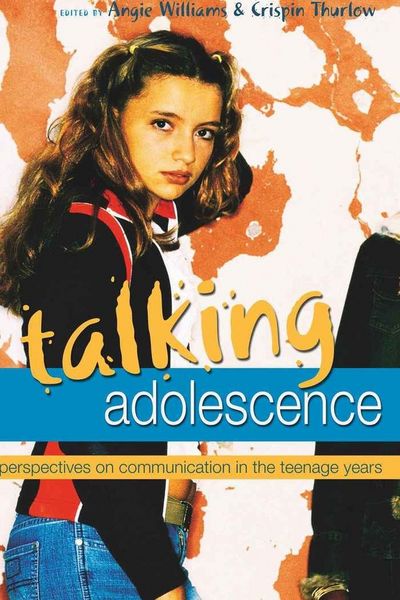
Produktbild: Talking Adolescence
Band 3

Talking Adolescence Perspectives on Communication in the Teenage Years

41,65 €

inkl. gesetzl. MwSt., Versandkostenfrei


Beschreibung

Produktdetails

Einband

Taschenbuch

Erscheinungsdatum

08.09.2005

Herausgeber

Angie Williams + weitere

Verlag

Peter Lang Publishing Inc. New York

Seitenzahl

292

Maße (L/B/H)

22,5/15/1,7 cm

Gewicht

440 g

Auflage

1. Auflage

Sprache

Englisch

ISBN

978-0-8204-7097-9

Beschreibung

Rezension

«With top scholars from numerous disciplines, 'Talking Adolescence' fills an important knowledge gap in our understanding of lifespan communication. It will be required reading for any scholar interested in significant relationships throughout the lifespan, and it will also ignite numerous investigations into the communicative experiences of young people and those of us who interact frequently with them.» (Jon Nussbaum, Professor of Communication Arts and Sciences, Penn State University, U.S.A.)
«It is a pleasure to see this book in print, and to know that academics are taking adolescence seriously. The topics covered here are of great scholarly interest, as well as being of value for anyone working with young people. I recommend this book unreservedly.» (John Coleman, Director of the Trust for the Study of Adolescence, England)

Portrait

The Editors: Angie Williams received her Ph.D. in communication from University of California, Santa Barbara. She is Senior Lecturer in the Centre for Language and Communication Research at Cardiff University in Wales. Her main research interest is in intergroup communication, particularly as it relates to culture, age, lifespan, and health issues. She is co-author of Intergenerational Communication Across the Lifespan (2001).
Crispin Thurlow received his Ph.D. in language and communication from University of Wales. He is Assistant Professor of Social Interaction in the Department of Communication, University of Washington in Seattle. His research on «discourse and difference» examines the ways language and other semiotic modes are used to make sense of boundaries of dissimilarity and inequality. His work on young people’s communication has been published in a wide range of international journals.

Produktdetails

Einband

Taschenbuch

Erscheinungsdatum

08.09.2005

Herausgeber

Verlag

Peter Lang Publishing Inc. New York

Seitenzahl

292

Maße (L/B/H)

22,5/15/1,7 cm

Gewicht

440 g

Auflage

1. Auflage

Sprache

Englisch

ISBN

978-0-8204-7097-9

EU-Ansprechpartner

Zeitfracht Medien GmbH
Ferdinand-Jühlke-Straße 7
99095 Erfurt
DE
produktsicherheit@zeitfracht.de

Herstelleradresse

Peter Lang
Avenue du Théâtre 7
1005 Lausanne
CH
orders@peterlang.com

Noch keine Bewertungen vorhanden

Verfassen Sie die erste Bewertung zu diesem Artikel

Helfen Sie anderen Kundinnen und Kunden durch Ihre Meinung.

Kundinnen und Kunden meinen

Bewertungen (0)

  • Produktbild: Talking Adolescence
  • Contents: Crispin Thurlow: Deconstructing adolescent communication – Johanna Wyn: Youth in the media: Adult stereotypes of young people – Peter Garrett/Angie Williams: Adults’ perceptions of communication with young people – Crispin Thurlow/Alice Marwick: From apprehension to awareness: Toward more critical understandings of young people’s communication experiences – Cynthia Carter/Stuart Allan: Hearing their voices: Young people, citizenship and online news – Penelope Eckert: Stylistic practice and the adolescent social order – Vivian de Klerk: Slang and swearing as markers of inclusion and exclusion in adolescence – Lauren Berger/Dana McMakin/Wyndol Furman: The language of love: Romantic relationships in adolescence – Sarah O’Flynn: Ticket to a Queer planet? Communication issues affecting young lesbian and gay people – Leo Hendry/Marion Kloep: ‘Talkin’, doin’ and bein’ with friends’: Leisure and communication in adolescence – Susan McKay/ Crispin Thurlow/Heather Toomey Zimmerman: Wired whizzes or techno-slaves? Young people and their emergent communication technologies – Patricia Noller: Communication with parents and other family members: The implications of family process for young people’s well-being – John Drury: Young people’s communication with adults in the institutional order – Joseph Chesebro: In the classroom: Instructional communication with young people – Susan McKay: Communication and ‘risky’ behavior in adolescence.