Gutscheinbedingungen

**Gültig bis 06.07.2026 auf fremdsprachige Bücher online auf thalia.at, in der Thalia App ab einem Mindestbestellwert von 30€ und in allen Thalia Buchhandlungen in Österreich. In den Buchhandlungen nur gültig auf lagernde Ware. Einzelne Artikel können ausgeschlossen sein. Ausgenommen sind preisgebundene Artikel & eBooks. Pro Einkauf einmal einlösbar. Nur gültig gegen Vorlage oder im Onlineshop hinterlegter Bonuscard. Infos zur Einlösung in der Buchhandlung sind auf der Bonuscard-Vorteilspreisseite zu finden. Click & Collect nur bei Onlinevorabzahlung möglich. Keine Einlösung bei Scan & Go-Bezahlung. Keine Barauszahlung. Nicht kombinierbar mit anderen Aktionen und Gutscheinen. Gutschein wird auf max. 500€ Bestellwert angerechnet. Nicht gültig für Versandkosten und Services.

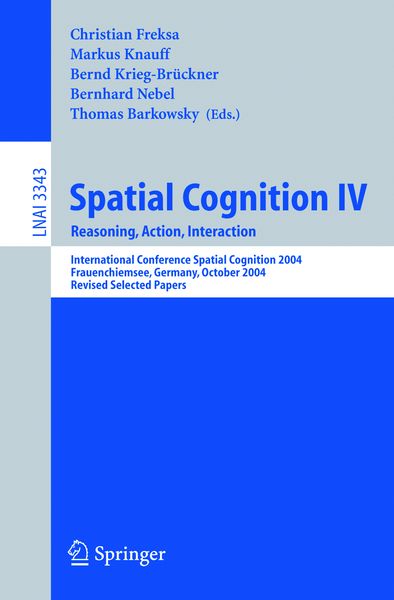
  • Produktbild: Spatial Cognition IV, Reasoning, Action, Interaction
  • Produktbild: Spatial Cognition IV, Reasoning, Action, Interaction

Spatial Cognition IV, Reasoning, Action, Interaction International Spatial Cognition 2004, Frauenchiemsee, Germany, October 11-13, 2004, Revised Selected Papers

99,99 €

inkl. gesetzl. MwSt., Versandkostenfrei


Beschreibung

Produktdetails

Einband

Taschenbuch

Erscheinungsdatum

01.03.2005

Herausgeber

Christian Freksa + weitere

Verlag

Springer Berlin

Seitenzahl

519

Maße (L/B/H)

23,5/15,5/2,9 cm

Gewicht

1650 g

Auflage

2005

Sprache

Englisch

ISBN

978-3-540-25048-7

Beschreibung

Produktdetails

Einband

Taschenbuch

Erscheinungsdatum

01.03.2005

Herausgeber

Verlag

Springer Berlin

Seitenzahl

519

Maße (L/B/H)

23,5/15,5/2,9 cm

Gewicht

1650 g

Auflage

2005

Sprache

Englisch

ISBN

978-3-540-25048-7

Herstelleradresse

Springer-Verlag KG
Sachsenplatz 4-6
1201 Wien
AT

Email: GPSR Kontakt

Noch keine Bewertungen vorhanden

Verfassen Sie die erste Bewertung zu diesem Artikel

Helfen Sie anderen Kundinnen und Kunden durch Ihre Meinung.

Kundinnen und Kunden meinen

Bewertungen (0)

  • Produktbild: Spatial Cognition IV, Reasoning, Action, Interaction
  • Produktbild: Spatial Cognition IV, Reasoning, Action, Interaction
  • Route Directions, Wayfinding, and Spatial Behavior.- Finding the Way Inside: Linking Architectural Design Analysis and Cognitive Processes.- Modelling Wayfinding in Public Transport: Network Space and Scene Space.- Isovists as a Means to Predict Spatial Experience and Behavior.- A Model for Context-Specific Route Directions.- Investigation of Preference Between the Least-Angle Strategy and the Initial Segment Strategy for Route Selection in Unknown Environments.- Descriptions of Space – Prepositions and Reference.- Spatial Prepositions and Vague Quantifiers: Implementing the Functional Geometric Framework.- Reference Frame Conflict in Assigning Direction to Space.- Identifying Objects on the Basis of Spatial Contrast: An Empirical Study.- Cultural Differences of Spatial Descriptions in Tourist Guidebooks.- Mental Models, Diagrams, and Maps.- Reasoning About Consistency with Spatial Mental Models: Hidden and Obvious Indeterminacy in Spatial Descriptions.- Spatial Principles in Control of Focus in Reasoning with Mental Representations, Images, and Diagrams.- Perceptually Induced Distortions in Cognitive Maps.- Characterizing Diagrams Produced by Individuals and Dyads.- Sketch Map Analysis Using GIS Buffer Operation.- Imagined Perspective–Changing Within and Across Novel Environments.- Thinking Through Diagrams: Discovery in Game Playing.- Spatio-Temporal Representation and Reasoning.- The Finest of its Class: The Natural Point-Based Ternary Calculus for Qualitative Spatial Reasoning.- Exploiting Qualitative Spatial Neighborhoods in the Situation Calculus.- Branching Allen.- SNAPVis and SPANVis: Ontologies for Recognizing Variable Vista Spatial Environments.- Modelling Models of Robot Navigation Using Formal Spatial Ontology.- Specification of an Ontology for Route Graphs.- Robot Mapping and Piloting.- Autonomous Construction of Hierarchical Voronoi-Based Route Graph Representations.- Using 2D and 3D Landmarks to Solve the Correspondence Problem in Cognitive Robot Mapping.- Treemap: An O(log n) Algorithm for Simultaneous Localization and Mapping.- Towards Dialogue Based Shared Control of Navigating Robots.- Perception and Tracking of Dynamic Objects for Optimization of Avoidance Strategies in Autonomous Piloting of Vehicles.