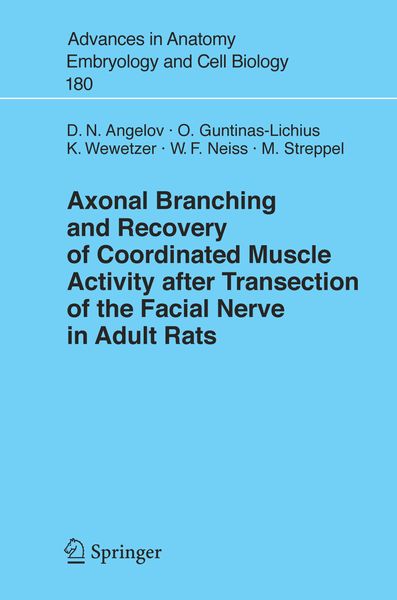
Axonal Branching and Recovery of Coordinated Muscle Activity after Transsection of the Facial Nerve in Adult Rats
-
- Taschenbuch ausgewählt
- eBook
-
Sprache:Englisch
99,99 €
inkl. gesetzl. MwSt.,
Beschreibung
Produktdetails
Einband
Taschenbuch
Erscheinungsdatum
27.09.2005
Abbildungen
X, 132 p. 23 illus., 4 illus. in color.
Verlag
Springer BerlinSeitenzahl
132
Maße (L/B/H)
23,5/15,5/1 cm
Gewicht
257 g
Auflage
2005
Sprache
Englisch
ISBN
978-3-540-25654-0
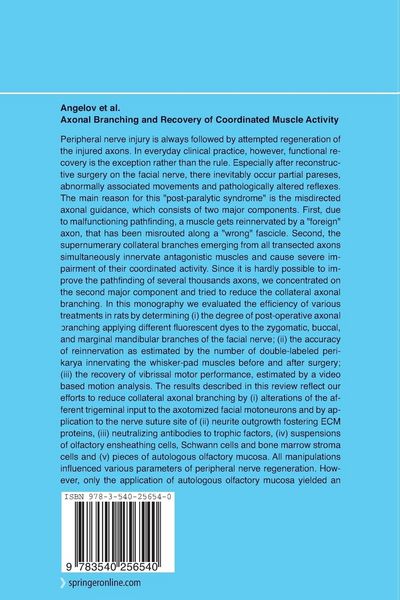
Facial nerve surgery inevitably leads to partial pareses, abnormally associated movements and pathologically altered reflexes. The reason for this "post-paralytic syndrome" is the misdirected reinnervation of targets, which consists of two major components. First, due to malfunctioning axonal guidance, a muscle gets reinnervated by a "foreign" axon, that has been misrouted along a "wrong" fascicle. Second, the supernumerary collateral branches emerging from all transected axons simultaneously innervate antagonistic muscles and cause severe impairment of their coordinated activity. Since it is hardly possible to influence the first major component and improve the guidance of several thousands axons, the authors concentrated on the second major component and tried to reduce the collateral axonal branching.
Noch keine Bewertungen vorhanden
Verfassen Sie die erste Bewertung zu diesem Artikel
Helfen Sie anderen Kundinnen und Kunden durch Ihre Meinung.
Kurze Frage zu unserer Seite
Vielen Dank für Ihr Feedback
Wir nutzen Ihr Feedback, um unsere Produktseiten zu verbessern. Bitte haben Sie Verständnis, dass wir Ihnen keine Rückmeldung geben können. Falls Sie Kontakt mit uns aufnehmen möchten, können Sie sich aber gerne an unseren Kund*innenservice wenden.
zum Kundenservice