• Produktbild: Advances in Cryptology – EUROCRYPT 2003
  • Produktbild: Advances in Cryptology – EUROCRYPT 2003
Band 2656

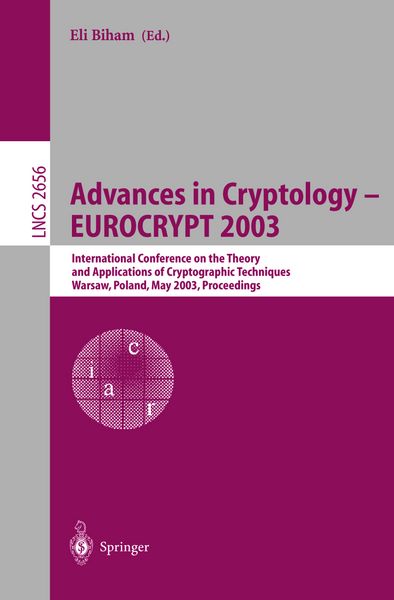
Advances in Cryptology – EUROCRYPT 2003 International Conference on the Theory and Applications of Cryptographic Techniques, Warsaw, Poland, May 4-8, 2003, Proceedings

99,99 €

inkl. gesetzl. MwSt., Versandkostenfrei


Beschreibung

Produktdetails

Einband

Taschenbuch

Erscheinungsdatum

22.04.2003

Abbildungen

XIV, 654 p.

Herausgeber

Eli Biham

Verlag

Springer Berlin

Seitenzahl

654

Maße (L/B/H)

23,5/15,5/3,6 cm

Gewicht

996 g

Auflage

2003

Sprache

Englisch

ISBN

978-3-540-14039-9

Beschreibung

Produktdetails

Einband

Taschenbuch

Erscheinungsdatum

22.04.2003

Abbildungen

XIV, 654 p.

Herausgeber

Eli Biham

Verlag

Springer Berlin

Seitenzahl

654

Maße (L/B/H)

23,5/15,5/3,6 cm

Gewicht

996 g

Auflage

2003

Sprache

Englisch

ISBN

978-3-540-14039-9

Herstelleradresse

Springer-Verlag GmbH
Tiergartenstr. 17
69121 Heidelberg
DE

Email: ProductSafety@springernature.com

Noch keine Bewertungen vorhanden

Verfassen Sie die erste Bewertung zu diesem Artikel

Helfen Sie anderen Kundinnen und Kunden durch Ihre Meinung.

Kundinnen und Kunden meinen

Bewertungen (0)

  • Produktbild: Advances in Cryptology – EUROCRYPT 2003
  • Produktbild: Advances in Cryptology – EUROCRYPT 2003
  • Cryptanalysis I.- Cryptanalysis of the EMD Mode of Operation.- On the Optimality of Linear, Differential, and Sequential Distinguishers.- A Toolbox for Cryptanalysis: Linear and Affine Equivalence Algorithms.- Secure Multi-party Computation I.- Two-Threshold Broadcast and Detectable Multi-party Computation.- On the Limitations of Universally Composable Two-Party Computation without Set-up Assumptions.- Fair Secure Two-Party Computation.- Invited Talk I.- Facts and Myths of Enigma: Breaking Stereotypes.- Zero-Knowledge Protocols.- Resettable Zero-Knowledge in the Weak Public-Key Model.- Simulatable Commitments and Efficient Concurrent Zero-Knowledge.- Simulation in Quasi-Polynomial Time, and Its Application to Protocol Composition.- Strengthening Zero-Knowledge Protocols Using Signatures.- Foundations and Complexity Theoretic Security.- Nearly One-Sided Tests and the Goldreich-Levin Predicate.- Efficient and Non-malleable Proofs of Plaintext Knowledge and Applications.- Public Key Encryption.- A Public Key Encryption Scheme Based on the Polynomial Reconstruction Problem.- A Simpler Construction of CCA2-Secure Public-Key Encryption under General Assumptions.- A Forward-Secure Public-Key Encryption Scheme.- Certificate-Based Encryption and the Certificate Revocation Problem.- New Primitives.- CAPTCHA: Using Hard AI Problems for Security.- Concealment and Its Applications to Authenticated Encryption.- Cryptanalysis II.- Predicting the Shrinking Generator with Fixed Connections.- Algebraic Attacks on Stream Ciphers with Linear Feedback.- Elliptic Curves Cryptography.- Counting Points on Elliptic Curves over Finite Fields of Small Characteristic in Quasi Quadratic Time.- The GHS Attack Revisited.- Improved Algorithms for Efficient Arithmetic on Elliptic Curves Using Fast Endomorphisms.- Digital Signatures.- A Signature Scheme as Secure as the Diffie-Hellman Problem.- Aggregate and Verifiably Encrypted Signatures from Bilinear Maps.- Hypercubic Lattice Reduction and Analysis of GGH and NTRU Signatures.- Invited Talk II.- Why Provable Security Matters?.- Cryptanalysis III.- On the Security of RDSA.- Cryptanalysis of the Public-Key Encryption Based on Braid Groups.- A Theoretical Treatment of Related-Key Attacks: RKA-PRPs, RKA-PRFs, and Applications.- Key Exchange.- Provably Secure Threshold Password-Authenticated Key Exchange.- A Framework for Password-Based Authenticated Key Exchange.- Information Theoretic Cryptography.- The Security of Many-Round Luby-Rackoff Pseudo-Random Permutations.- New Bounds in Secret-Key Agreement: The Gap between Formation and Secrecy Extraction.- Secure Multi-party Computation II.- Round Efficiency of Multi-party Computation with a Dishonest Majority.- Efficient Multi-party Computation over Rings.- Group Signatures.- Foundations of Group Signatures: Formal Definitions, Simplified Requirements, and a Construction Based on General Assumptions.- Extracting Group Signatures from Traitor Tracing Schemes.