• Produktbild: Multivariable Control Systems
  • Produktbild: Multivariable Control Systems
- 11%

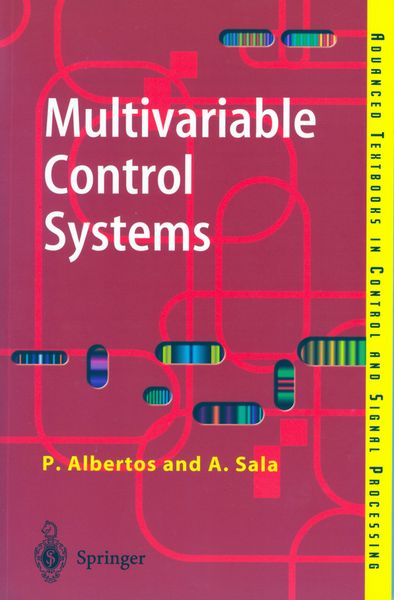
Multivariable Control Systems An Engineering Approach

11% sparen

72,99 € UVP 82,49 €

inkl. gesetzl. MwSt., Versandkostenfrei


Beschreibung

Produktdetails

Einband

Taschenbuch

Erscheinungsdatum

14.11.2003

Verlag

Springer London

Seitenzahl

342

Maße (L/B/H)

23,5/15,5/2 cm

Gewicht

1120 g

Auflage

2004

Sprache

Englisch

ISBN

978-1-85233-738-4

Beschreibung

Rezension

This book is well written and suitable for teaching courses. I was pleased to find that the book devoted so much attention to applications. Many industrial applications are given, which can help teachers to prepare practical works and are equally valuable to students and practising engineers. In particular, there are many case studies implemented with MATLAB.


Automatica
41 (2005) 1665 – 1666 (Reviewer: Mohammed Chadli)

Produktdetails

Einband

Taschenbuch

Erscheinungsdatum

14.11.2003

Verlag

Springer London

Seitenzahl

342

Maße (L/B/H)

23,5/15,5/2 cm

Gewicht

1120 g

Auflage

2004

Sprache

Englisch

ISBN

978-1-85233-738-4

Herstelleradresse

Springer-Verlag KG
Sachsenplatz 4-6
1201 Wien
AT

Email: GPSR Kontakt

Noch keine Bewertungen vorhanden

Verfassen Sie die erste Bewertung zu diesem Artikel

Helfen Sie anderen Kundinnen und Kunden durch Ihre Meinung.

Kundinnen und Kunden meinen

Bewertungen (0)

  • Produktbild: Multivariable Control Systems
  • Produktbild: Multivariable Control Systems
  • 1 Introduction to Multivariable Control
    1.1 Introduction
    1.2 Process and Instrumentation
    1.3 Process Variables
    1.4 The Process Behaviour
    1.5 Control Aims
    1.6 Modes of Operation
    1.7 The Need for Feedback
    1.8 Model-free vs. Model-based Control
    1.9 The Importance of Considering Modelling Errors
    1.10 Multivariable Systems
    1.11 Implementation and Structural Issues
    1.12 Summary of the Chapters
    2 Linear System Representation: Models and Equivalence
    2.1 Introduction: Objectives of Modelling
    2.2 Types of Models.
    2.3 First-principle Models: Components
    2.4 Internal Representation: State Variables
    2.5 Linear Models and Linearisation
    2.6 Input/Output Representations
    2.6.1 Polynomial Representation
    2.6.2 Transfer Matrix
    2.7 Systems and Subsystems: Interconnection
    2.7.1 Series, Parallel and Feedback Connection
    2.7.2 Generalised Interconnection
    2.8 Discretised Models.
    2.9 Equivalence of Representations
    2.10 Disturbance Models
    2.10.1 Deterministic Signals
    2.10.2 Randomness in the Signals
    2.10.3 Discrete Stochastic Processes
    2.11 Key Issues in Modelling
    2.12 Case Study: The Paper Machine Headbox
    2.12.1 Simpli.ed Models
    2.12.2 Elaborated Models
    3 Linear Systems Analysis
    3.1 Introduction
    3.2 Linear System Time-response
    3.3 Stability Conditions
    3.3.1 Relative Degree of Stability
    3.4 Discretisation
    3.5 Gain
    3.5.1 Static Gain
    3.5.2 Instantaneous Gain
    3.5.3 Directional Gain
    3.6 Frequency response
    3.7 System Internal Structure
    3.7.1 Reachability (State Controllability)
    3.7.2 Observability
    3.7.3 Output Reachability
    3.7.4 Remarks on Reachability and Observability
    3.7.5 Canonical Forms
    3.8 Block System Structure (Kalman Form)
    3.8.1 Minimal Realisation
    3.8.2 Balanced Realisation.
    3.8.3 Poles and Zeros
    3.9 Input/Output Properties
    3.9.1 Input/Output Controllability
    3.10 Model Reduction
    3.10.1 Time Scale Decomposition
    3.10.2 Balanced Reduction
    3.11 Key Issues in MIMO Systems Analysis
    3.12 Case Study: Simple Distillation Column
    4 Solutions to the Control Problem
    4.1 The Control Design Problem
    4.2 Control Goals
    4.3 Variables Selection
    4.4 Control Structures
    4.5 Feedback Control
    4.5.1 Closed-loop Stability Analysis
    4.5.2 Interactions
    4.5.3 Generalised Plant
    4.5.4 Performance Analysis
    Contents xv
    4.6 Feedforward Control
    4.6.1 Manual Control
    4.6.2 Open-loop Inversion and Trajectory Tracking
    4.6.3 Feedforward Rejection of Measurable Disturbances
    4.7 Two Degree of Freedom Controller
    4.8 Hierarchical Control
    4.9 Key Issues in Control Design.
    4.10 Case Study: Ceramic Kiln
    5 Decentralised and Decoupled Control
    5.1 Introduction
    5.1.1 Plant Decomposition, Grouping of Variables
    5.2 Multi-loop Control, Pairing Selection
    5.2.1 The Relative Gain Array Methodology
    5.2.2 Integrity (Fault Tolerance)
    5.2.3 Diagonal Dominance (Stability Analysis)
    5.3 Decoupling
    5.3.1 Feedforward Decoupling
    5.3.2 Feedback Decoupling
    5.3.3 SVD Decoupling
    5.4 Enhancing SISO Loops with MIMO Techniques: Cascade Control
    5.4.1 Case I: Extra Measurements
    5.4.2 Case II: Extra Actuators
    5.5 Other Possibilities
    5.5.1 Indirect and Inferential Control
    5.5.2 Override, Selectors
    5.5.3 Split-range Control
    5.5.4 Gradual Control, Local Feedback
    5.6 Sequential-Hierarchical Design and Tuning
    5.6.1 Combined Strategies for Complex Plants
    5.7 Key Conclusions
    5.8 Case Studies
    5.8.1 Steam Boiler
    5.8.2 Mixing Process
    6 Fundamentals of Centralised Closed-loop Control
    6.1 State Feedback
    6.1.1 Stabilisation and Pole-placement
    6.1.2 State Feedback PI Control
    6.2 Output Feedback
    6.2.1 Model-based Recurrent Observer
    6.2.2 Current Observer
    6.2.3 Reduced-order Observer
    6.2.4 Separation Principle
    6.3 Rejection of Deterministic Unmeasurable Disturbances
    6.3.1 Augmented Plan