Gutscheinbedingungen

**Gültig am 28.09.2026 auf fremdsprachige Bücher online auf thalia.at und in der Thalia App. Einzelne Artikel können ausgeschlossen sein. Ausgenommen sind preisgebundene Artikel & eBooks. Pro Einkauf einmal einlösbar. Click & Collect nur bei Onlinevorabzahlung möglich. Keine Barauszahlung. Nicht kombinierbar mit anderen Aktionen und Gutscheinen. Gutschein wird auf max. 500€ Bestellwert angerechnet. Nicht gültig für Geschenkkarten, Versandkosten und Services.

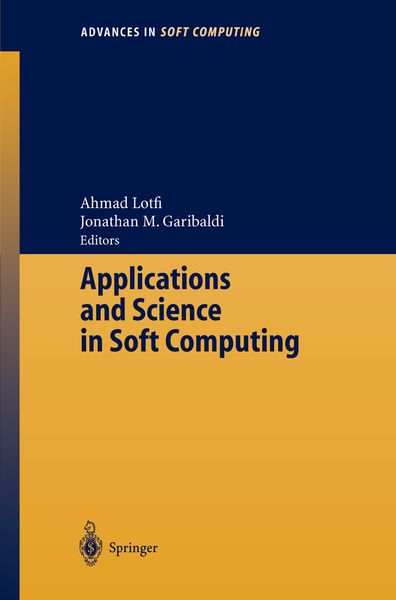
  • Produktbild: Applications and Science in Soft Computing
  • Produktbild: Applications and Science in Soft Computing
Band 24

Applications and Science in Soft Computing

198,99 €

inkl. gesetzl. MwSt., Versandkostenfrei


Beschreibung

Produktdetails

Einband

Taschenbuch

Erscheinungsdatum

18.11.2003

Abbildungen

X, 346 p. 105 illus.

Herausgeber

Ahmad Lotfi + weitere

Verlag

Springer Berlin

Seitenzahl

346

Maße (L/B/H)

23,5/15,5/2 cm

Gewicht

546 g

Auflage

2004

Sprache

Englisch

ISBN

978-3-540-40856-7

Beschreibung

Produktdetails

Einband

Taschenbuch

Erscheinungsdatum

18.11.2003

Abbildungen

X, 346 p. 105 illus.

Herausgeber

Verlag

Springer Berlin

Seitenzahl

346

Maße (L/B/H)

23,5/15,5/2 cm

Gewicht

546 g

Auflage

2004

Sprache

Englisch

ISBN

978-3-540-40856-7

Herstelleradresse

Springer-Verlag KG
Sachsenplatz 4-6
1201 Wien
AT

Email: ProductSafety@springernature.com

Noch keine Bewertungen vorhanden

Verfassen Sie die erste Bewertung zu diesem Artikel

Helfen Sie anderen Kundinnen und Kunden durch Ihre Meinung.

Kundinnen und Kunden meinen

Bewertungen (0)

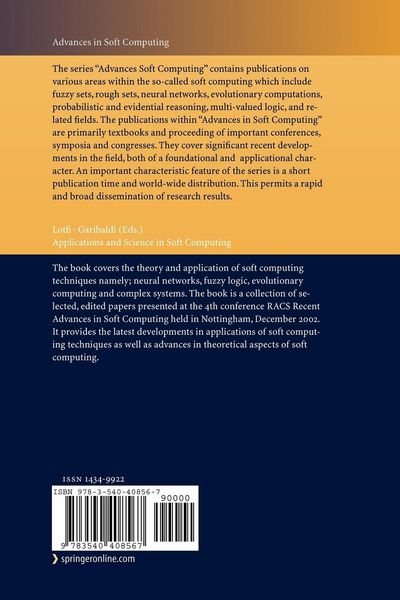
  • Produktbild: Applications and Science in Soft Computing
  • Produktbild: Applications and Science in Soft Computing
  • I — Artificial Neural Networks.- A Recurrent Self-Organizing Map for Temporal Sequence Processing.- Optimisation of Neural Network Topology and Input Parameters for Prosody Modelling of Synthetic Speech.- Using ART1 Neural Networks to Determine Clustering Tendency.- High Performance Associative Memories and Structured Weight Dilution.- Neural Network Analysis of Estimation of Data.- A Compiler and Simulator for Partial Recursive Functions over Neural Networks.- Multistage Neural Networks: Adaptive Combination of Ensemble Results.- On the Fuzzy Spatio-temporal Specification of Multimedia Synchronisation Scenarios.- II — Evolutionary Computing.- An Approach to On-line Design of Fuzzy Controllers with Evolving Structure.- Can a Parallel Agent Approach to Genetic Algorithms Reduce Search Times.- Comparison of Domination Approaches for Diploid Binary Genetic Algorithms.- New Heuristics for Flowshop Scheduling.- Temporal Rule Discovery using Genetic Programming and Specialized Hardware.- Genetic Programming with Guaranteed Constraints.- III — Fuzzy Systems.- Precisiated Natural Language and Protoforms for Human Consistent Data Mining.- Design and Synthesis of Piecewise-Linear Fuzzy Systems.- A New Ranking Method For Fuzzy FMEA.- Representing Reliability and Hesitation in Possibility Theory: A General Framework.- Noise Clustering with a Fixed Fraction of Noise.- Selective Sampling for Combined Learning from Labelled and Unlabelled Data.- IV — Hybrid and Intelligent Systems.- New Results for a Hybrid Decision Tree/Genetic Algorithm for Data Mining.- Embedding Support Vector Machines into Localised Mixtures of Experts.- Gaussian Function Approximation in Neuro-Fuzzy Systems.- Automated Configuration of Multi-Spindle Drilling Gear Machines by Sub-Domain KnowledgeProcessing and Adaptive Algorithms.- Construction of Shape-preserving First-order Takagi-Sugeno Systems via Linear-rational Spline Fuzzy Partitions.- Identification of Dynamic Cause-Effect Relations for Systems Performance Evaluation.- A Multi-layered Immune Inspired Machine Learning Algorithm.- Using Plausible Reasoning for Developing Intelligent Systems.- Towards Model-Independent Mode Detection and Characterisation of Very Long Biomedical Time Series.- Analysis of Rules Discovered by the Data Mining Process.- A Study of Query Generation Strategies for Interactive Constraint Acquisition.- A Multi-agent System as Framework for Learning Algorithms Benchmarking.- Soft Learning: A Conceptual Bridge between Data Mining and Machine Learning.- Heuristics for Kernels Adaptation in Support Vector Machines.- A Study of the Effectiveness of Detailed Balance in Avoiding Premature Convergence in PBIL.- V — Soft Computing Applications.- Application of Computational Intelligence Methods for Intelligent Modelling of Buildings.- An Adaptive Multi Embedded-Agent Architecture for Intelligent Inhabited Environments.- Constraint Neuro-Model based Predictive Control.- An Efficient Hybrid Method of Regression Tree and Fuzzy Inference for Short-term Load Forecasting in Electric Power Systems.- An Iterative Learning Control Method for a Level Control Problem.- Face Verification Using SVM: Influence of Illumination.- A Neuro-Fuzzy Technique for Scene Cut Detection from MPEG-1 Video.- Fuzzy Audio-Visual Feature Maps for Speaker Identification.- Adaptive User Agents for Intelligent Biometric Applications.- Gait Recognition by Moment Based Descriptors.- On a Large Sequence-Based Human Gait Database.