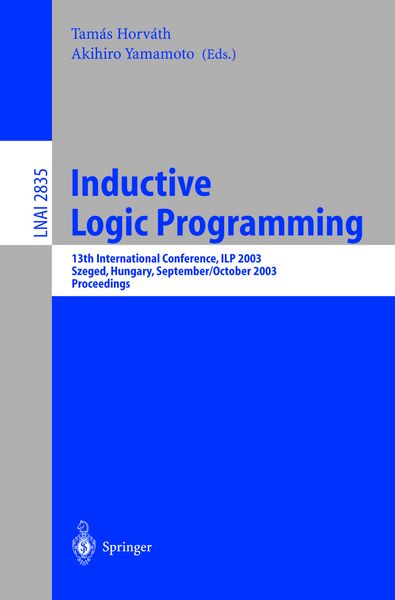
Produktbild: Inductive Logic Programming
Band 2835

Inductive Logic Programming 13th International Conference, ILP 2003, Szeged, Hungary, September 29 - October 1, 2003, Proceedings

51,99 €

inkl. gesetzl. MwSt., Versandkostenfrei


Beschreibung

Produktdetails

Einband

Taschenbuch

Erscheinungsdatum

24.09.2003

Abbildungen

X, 406 p.

Herausgeber

Tamas Horváth + weitere

Verlag

Springer Berlin

Seitenzahl

406

Maße (L/B/H)

23,5/15,5/2,3 cm

Gewicht

628 g

Auflage

2003

Sprache

Englisch

ISBN

978-3-540-20144-1

Beschreibung

Produktdetails

Einband

Taschenbuch

Erscheinungsdatum

24.09.2003

Abbildungen

X, 406 p.

Herausgeber

Verlag

Springer Berlin

Seitenzahl

406

Maße (L/B/H)

23,5/15,5/2,3 cm

Gewicht

628 g

Auflage

2003

Sprache

Englisch

ISBN

978-3-540-20144-1

Herstelleradresse

Springer-Verlag KG
Sachsenplatz 4-6
1201 Wien
AT

Email: ProductSafety@springernature.com

Noch keine Bewertungen vorhanden

Verfassen Sie die erste Bewertung zu diesem Artikel

Helfen Sie anderen Kundinnen und Kunden durch Ihre Meinung.

Kundinnen und Kunden meinen

Bewertungen (0)

  • Produktbild: Inductive Logic Programming
  • Invited Papers.- A Personal View of How Best to Apply ILP.- Agents that Reason and Learn.- Research Papers.- Mining Model Trees: A Multi-relational Approach.- Complexity Parameters for First-Order Classes.- A Multi-relational Decision Tree Learning Algorithm – Implementation and Experiments.- Applying Theory Revision to the Design of Distributed Databases.- Disjunctive Learning with a Soft-Clustering Method.- ILP for Mathematical Discovery.- An Exhaustive Matching Procedure for the Improvement of Learning Efficiency.- Efficient Data Structures for Inductive Logic Programming.- Graph Kernels and Gaussian Processes for Relational Reinforcement Learning.- On Condensation of a Clause.- A Comparative Evaluation of Feature Set Evolution Strategies for Multirelational Boosting.- Comparative Evaluation of Approaches to Propositionalization.- Ideal Refinement of Descriptions in -Log.- Which First-Order Logic Clauses Can Be Learned Using Genetic Algorithms?.- Improved Distances for Structured Data.- Induction of Enzyme Classes from Biological Databases.- Estimating Maximum Likelihood Parameters for Stochastic Context-Free Graph Grammars.- Induction of the Effects of Actions by Monotonic Methods.- Hybrid Abductive Inductive Learning: A Generalisation of Progol.- Query Optimization in Inductive Logic Programming by Reordering Literals.- Efficient Learning of Unlabeled Term Trees with Contractible Variables from Positive Data.- Relational IBL in Music with a New Structural Similarity Measure.- An Effective Grammar-Based Compression Algorithm for Tree Structured Data.