Gutscheinbedingungen

**Gültig bis 06.07.2026 auf fremdsprachige Bücher online auf thalia.at, in der Thalia App ab einem Mindestbestellwert von 30€ und in allen Thalia Buchhandlungen in Österreich. In den Buchhandlungen nur gültig auf lagernde Ware. Einzelne Artikel können ausgeschlossen sein. Ausgenommen sind preisgebundene Artikel & eBooks. Pro Einkauf einmal einlösbar. Nur gültig gegen Vorlage oder im Onlineshop hinterlegter Bonuscard. Infos zur Einlösung in der Buchhandlung sind auf der Bonuscard-Vorteilspreisseite zu finden. Click & Collect nur bei Onlinevorabzahlung möglich. Keine Einlösung bei Scan & Go-Bezahlung. Keine Barauszahlung. Nicht kombinierbar mit anderen Aktionen und Gutscheinen. Gutschein wird auf max. 500€ Bestellwert angerechnet. Nicht gültig für Versandkosten und Services.

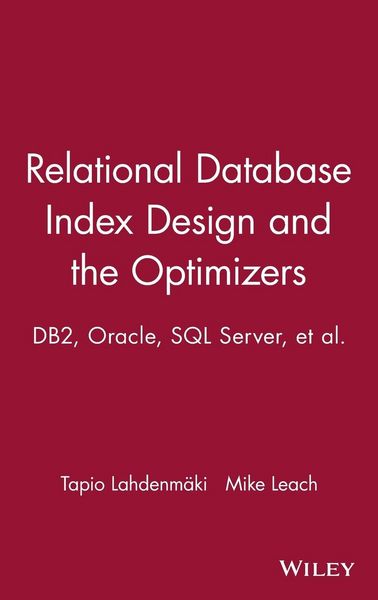
Produktbild: Relational Database Index Design and the Optimizers

Relational Database Index Design and the Optimizers Db2, Oracle, SQL Server, Et Al.

163,99 €

inkl. gesetzl. MwSt., Versandkostenfrei


Beschreibung

Produktdetails

Einband

Gebundene Ausgabe

Erscheinungsdatum

01.07.2005

Verlag

John Wiley & Sons

Seitenzahl

312

Maße (L/B/H)

24/16,1/2,2 cm

Gewicht

663 g

Auflage

1. Auflage

Sprache

Englisch

ISBN

978-0-471-71999-1

Beschreibung

Rezension

"I recommend this book to all those who have anything to do with database performance. It is a must-read for all database administrations, database designers, performance-tuning specialists, and application programmers..." ( Computing Reviews.com , November 20, 2005)

Produktdetails

Einband

Gebundene Ausgabe

Erscheinungsdatum

01.07.2005

Verlag

John Wiley & Sons

Seitenzahl

312

Maße (L/B/H)

24/16,1/2,2 cm

Gewicht

663 g

Auflage

1. Auflage

Sprache

Englisch

ISBN

978-0-471-71999-1

Herstelleradresse

Libri GmbH
Europaallee 1
36244 Bad Hersfeld
DE

Email: GPSR Kontakt

Noch keine Bewertungen vorhanden

Verfassen Sie die erste Bewertung zu diesem Artikel

Helfen Sie anderen Kundinnen und Kunden durch Ihre Meinung.

Kundinnen und Kunden meinen

Bewertungen (0)

Die Leseprobe wird geladen.
  • Produktbild: Relational Database Index Design and the Optimizers
  • Preface.

    1. Introduction.

    Another Book About SQL Performance!

    Inadequate Indexing.

    Myths and Misconceptions.

    2. Table and Index Organization.

    Introduction.

    Index Rows.

    Index Structure.

    Table Row.

    Buffer Pools and Disk I/Os.

    Hardware Specifics.

    DBMS Specifics.

    3. SQL Processing.

    Introduction.

    Predicates.

    Optimizers and Access Paths.

    Filter Factors.

    Materializing the Result Rows.

    Exercises.

    4. Deriving the Ideal Index for a SELECT.

    Introduction.

    Basic Assumptions for Disk and CPU Times.

    Inadequate Index.

    Three-Star Index--The Ideal Index for a SELECT.

    Algorithm to Derive the Best Index for a SELECT.

    Ideal Index for Every SELECT?

    Cost of an Additional Index.

    Recommendation.

    Exercises.

    5. Proactive Index Design.

    Detection of Inadequate Indexing.

    Basic Question (BQ).

    Quick Upper-Bound Estimate (QUBD).

    Cheapest Adequate Index or Best Possible Index: Example 1.

    Cheapest Adequate Index or Best Possible Index: Example 2.

    When to Use the QUBE.

    6. Factors Affecting the Index Design Process.

    I/O Time Estimate Verification.

    Multiple Thin Index Slices.

    Difficult Predicates.

    Filter Factor Pitfall.

    Filter Factor Pitfall Example.

    Exercises.

    7. Reactive Index Design.

    Introduction.

    EXPLAIN Describes the Selected Access Paths.

    Monitoring Reveals the Reality.

    LRT-Level Exception Monitoring.

    Call-Level Exception Monitoring.

    DBMS-Specific Monitoring Issues.

    Exercises.

    8. Indexing for Table Joins.

    Introduction.

    Two Simple Joins.

    Impact of Table Access Order on Index Design.

    Basic Joint Question (BJQ).

    Predicting the Table Access Order.

    Merge Scan Joins and Hash Joins.

    Nested-Loop Joins Versus MS/HJ and Ideal Indexes.

    Joining More Than Two Tables.

    Why Joins Often Perform Poorly.

    Designing Indexes for Subqueries.

    Designing Indexes for Unions.

    Table Design Considerations.

    Exercises.

    9. Star Join Considerations.

    Introduction.

    Indexes on Dimension tables.

    Huge Impact of the Table Access Order.

    Indexes on Fact Tables.

    Summary Tables.

    10. Multiple Index Access.

    Introduction.

    Index ANDing.

    Index ORing.

    Index Join.

    Exercises.

    11. Indexes and Reorganization.

    Physical Structure of a B-Tree Index.

    How the DBMS Finds an Index Row.

    What Happens When a Row IS Inserted?

    Are Leaf Page Splits Serious?

    When Should an Index Be reorganized?

    Volatile Index Columns.

    Long Index Rows.

    Example: Order-Sensitive Batch Job.

    Table Rows Stored in Leaf Pages.

    Cost of Index Reorganization.

    Split Monitoring.

    Summary.

    12. DBMS-Specific Indexing Restrictions.

    Introduction.

    Number of Index Columns,

    Total Length of the Index Columns.

    Variable-Length Columns.

    Number of Indexes per Table.

    Maximum Index Size.

    Index Locking.

    Index Row Suppression.

    DBMS Index Creation Examples.

    13. DBMS-Specific Indexing Options.

    Introduction.

    Index Row Suppression.

    Additional Index Columns After the Index Key.

    Constraints to Enforce Uniqueness.

    DBMS Able to Read an Index in Both Directions.

    Index Key Truncation.

    Function-Based Indexes.

    Index Skip Scan.

    Block Indexes.

    Data-Partitioned Secondary Indexes.

    Exercises.

    14. Optimizers Are Not Perfect.

    Introduction.

    Optimizers Do Not Always See the Best Alternative.

    Optimizers' Cost Estimates May Be Very Wrong.

    Cost Estimate Formulas.

    Do Optimizer Problems Affect Index Design?

    Exercises.

    15. Additional Estimation Considerations.

    Assumptions Behind the QUBE Formula.

    Nonleaf Index Pages in Memory.

    When the Actual Response Time Can Be Much Shorter Than the QUBE.

    Estimating CPU Time (CQUBE).

    CPU Estimation Examples.

    16. Organizing the Index Design Process.

    Introduction.

    Computer-Assisted Index Design.

    Nine Steps Toward Excellent Indexes.

    References.

    Glossary.

    Index.