KI-Beratung Beta

Gutscheinbedingungen

**Gültig am 27.11.2026 auf Spielzeug, Schreibwaren, Filme, Geschenke & Trends, Musik, tolino eReader & Zubehör, Hörbücher und Hörbuch-Downloads, nicht preisgebundene Bücher und Kalender online auf thalia.at und in der Thalia App. Einzelne Artikel können ausgeschlossen sein. Aufgrund der Buchpreisbindung sind deutschsprachige Bücher und eBooks ausgenommen. Zusätzlich ausgenommen sind Abos & Flatrates, Games, Geschenkkarten/-boxen, Shelfies, Software, Zeitschriften sowie einzelne Artikel von tonies®. Pro Einkauf einmal einlösbar. Click & Collect nur bei Onlinevorabzahlung möglich. Keine Barauszahlung. Nicht kombinierbar mit anderen Aktionen und Gutscheinen. Gutschein wird auf max. 500€ Bestellwert angerechnet. Nicht gültig für Versandkosten und Services.

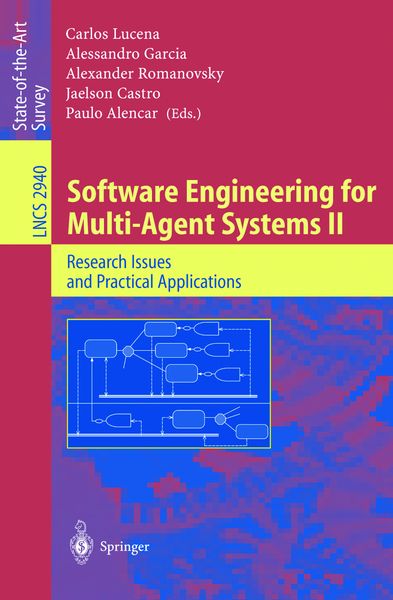
  • Produktbild: Software Engineering for Multi-Agent Systems II
  • Produktbild: Software Engineering for Multi-Agent Systems II
Band 2940

Software Engineering for Multi-Agent Systems II Research Issues and Practical Applications

51,99 €

inkl. gesetzl. MwSt., Versandkostenfrei


Beschreibung

Advances in networking technology have revitalized the investigation of agent technologyasapromisingparadigmforengineeringcomplexdistributedsoftware systems. Agent technology has been applied to a wide range of application - mains, including e-commerce, human-computer interfaces, telecommunications,...

Beschreibung

Advances in networking technology have revitalized the investigation of agent technologyasapromisingparadigmforengineeringcomplexdistributedsoftware systems. Agent technology has been applied to a wide range of application - mains, including e-commerce, human-computer interfaces, telecommunications, and software assistants. Multi-agent systems (MASs) and their underlying t- ories provide a more natural support for ensuring important properties such as autonomy, mobility, environment heterogeneity, organization, openness, and intelligence. As a consequence, agent-based systems are likely to provide new - proaches to dealing with the complexity of developing and maintaining modern software. However, developing robust large-scale agent-based systems will - quire new software engineering approaches. There are currently many methods and techniques for working with individual agents or with systems built using only a few agents. Unfortunately, agent-based software engineering is still in its infancy and existing software engineering approaches are unable to cope with large MASs. The complexity associated with a large MAS is considerable. When a huge number of agents interact over heterogeneous environments, various phenomena occur which are not as easy to capture as when only a few agents are working together. As the multiple software agents are highly collaborative and operate in networked environments, they have to be context-aware and deal with - vironment uncertainty. This makes their coordination and management more di?cult and increases the likelihood of exceptional situations, such as security holes, privacy violations, and unexpected global e?ects. Moreover, as users and softwareengineersdelegatemoreautonomytotheirMASs,andputmoretrustin their results, new concernsarise in real-life applications.

Produktdetails

Einband

Taschenbuch

Erscheinungsdatum

02.03.2004

Abbildungen

XII, 284 p.

Herausgeber Carlos Lucena + weitere

Produktdetails

Einband

Taschenbuch

Erscheinungsdatum

02.03.2004

Abbildungen

XII, 284 p.

Herausgeber
Verlag Springer Berlin
Seitenzahl

284

Maße (L/B/H)

23,5/15,5/1,7 cm

Gewicht

452 g

Auflage

2004

Sprache

Englisch

ISBN

978-3-540-21182-2

Herstelleradresse

Springer-Verlag KG
Sachsenplatz 4-6
1201 Wien
AT

Email: ProductSafety@springernature.com

Noch keine Bewertungen vorhanden

Verfassen Sie die erste Bewertung zu diesem Artikel

Helfen Sie anderen Kundinnen und Kunden durch Ihre Meinung.

Kundinnen und Kunden meinen

Bewertungen (0)

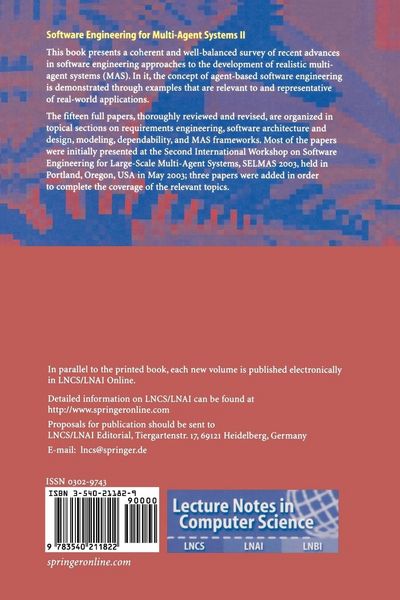
  • Produktbild: Software Engineering for Multi-Agent Systems II
  • Produktbild: Software Engineering for Multi-Agent Systems II
  • Requirements Engineering.- The Agent at the Center of the Requirements Engineering Process.- Lexicon Based Ontology Construction.- Multi-agent Systems and Security Requirements Analysis.- Software Architecture and Design.- Separation of Concerns in Multi-agent Systems: An Empirical Study.- Architecting the Design of Multi-agent Organizations with Proto-frameworks.- A Basic Taxonomy for Role Composition.- Modeling.- Object-Oriented Modeling Approaches to Agent-Based Workflow Services.- Using the MAS-ML to Model a Multi-agent System.- Software Engineering Challenges for Mutable Agent Systems.- Dependability.- Improving Exception Handling in Multi-agent Systems.- On Manageability and Robustness of Open Multi-agent Systems.- Security Mechanisms for Mobile Agent Platforms Based on SPKI/SDSI Chains of Trust.- MAS Frameworks.- Farm: A Scalable Environment for Multi-agent Development and Evaluation.- Role-Based Approaches for Engineering Interactions in Large-Scale Multi-agent Systems.- Evaluating Agent Architectures: Cougaar, Aglets and AAA.