• Produktbild: Second Year Calculus
  • Produktbild: Second Year Calculus

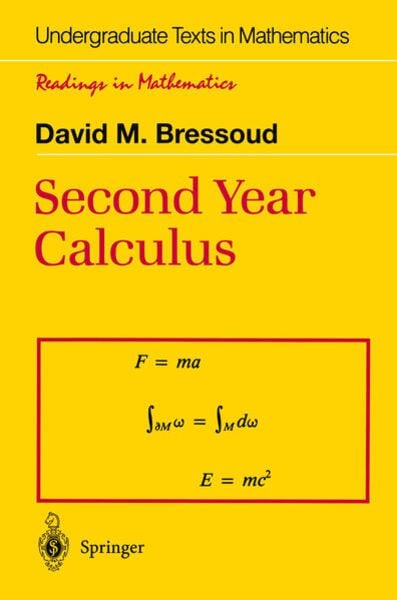
Second Year Calculus From Celestial Mechanics to Special Relativity

Aus der Reihe Readings in Mathematics

61,99 €

inkl. gesetzl. MwSt., Versandkostenfrei


Beschreibung

Produktdetails

Verkaufsrang

26726

Einband

Taschenbuch

Erscheinungsdatum

08.08.1991

Verlag

Springer Us

Seitenzahl

404

Maße (L/B/H)

23,5/15,5/2,2 cm

Gewicht

610 g

Auflage

1st ed. 1991. Corr. 4th printing 2001

Sprache

Englisch

ISBN

978-0-387-97606-8

Beschreibung

Rezension

The subtitle of this book, ``From celestial mechanics to special relativity'' is correctly indicative of its content, and in the preface, the author enthusiastically pleads guilty to blurring the line between mathematics and physics. One of the book's merits is the substantive historical material given. Among other purposes this serves to show the physics setting in which many calculus concepts have their origin. The book eventually gets around to a fairly honest mathematical treatment of the traditional material of advanced calculus via differential forms, but before arriving at this in Chapter 5, mathematics students are likely to have some frustrating experiences. In Chapter 4 one encounters ``we define $\int\sp{bar b}\sb{bar a}f\sb 1(x,y,z)dx+f\sb 2(x,y,z)dy+f\sb 3(x,y,z)dz$ to be the work done by this force field as it moves a particle along the directed line segment from $bar a$ to $bar b$''. Exercise 8 at the end of this section states ``Prove that in an arbitrary force field the amount of work done in moving from $bar a$ to $bar b$ may be dependent on the path''. So, one asks oneself, how is {\it work} defined? Nothing more is to be found than the statement in Chapter 2 that work is force times distance, and the resulting representation as a dot product of vectors. The book has much to recommend it. If the first four chapters are primarily to serve as providing some intuitive foundation, it might be better to more explicitly acknowledge this, and to find a more appropriate formulation for whatever is intended in exercises such as the one cited above. ZENTRALBLATT MATH

Produktdetails

Verkaufsrang

26726

Einband

Taschenbuch

Erscheinungsdatum

08.08.1991

Verlag

Springer Us

Seitenzahl

404

Maße (L/B/H)

23,5/15,5/2,2 cm

Gewicht

610 g

Auflage

1st ed. 1991. Corr. 4th printing 2001

Sprache

Englisch

ISBN

978-0-387-97606-8

Herstelleradresse

Springer-Verlag KG
Sachsenplatz 4-6
1201 Wien
AT

Email: GPSR Kontakt

Noch keine Bewertungen vorhanden

Verfassen Sie die erste Bewertung zu diesem Artikel

Helfen Sie anderen Kundinnen und Kunden durch Ihre Meinung.

Kundinnen und Kunden meinen

Bewertungen (0)

  • Produktbild: Second Year Calculus
  • Produktbild: Second Year Calculus
  • 1 F=ma.- 1.1 Prelude to Newton’s Principia.- 1.2 Equal Area in Equal Time.- 1.3 The Law of Gravity.- 1.4 Exercises.- 1.5 Reprise with Calculus.- 1.6 Exercises.- 2 Vector Algebra.- 2.1 Basic Notions.- 2.2 The Dot Product.- 2.3 The Cross Product.- 2.4 Using Vector Algebra.- 2.5 Exercises.- 3 Celestial Mechanics.- 3.1 The Calculus of Curves.- 3.2 Exercises.- 3.3 Orbital Mechanics.- 3.4 Exercises.- 4 Differential Forms.- 4.1 Some History.- 4.2 Differential 1-Forms.- 4.3 Exercises.- 4.4 Constant Differential 2-Forms.- 4.5 Exercises.- 4.6 Constant Differential k-Forms.- 4.7 Prospects.- 4.8 Exercises.- 5 Line Integrals, Multiple Integrals.- 5.1 The Riemann Integral.- 5.2 Line Integrals.- 5.3 Exercises.- 5.4 Multiple Integrals.- 5.5 Using Multiple Integrals.- 5.6 Exercises.- 6 Linear Transformations.- 6.1 Basic Notions.- 6.2 Determinants.- 6.3 History and Comments.- 6.4 Exercises.- 6.5 Invertibility.- 6.6 Exercises.- 7 Differential Calculus.- 7.1 Limits.- 7.2 Exercises.- 7.3 Directional Derivatives.- 7.4 The Derivative.- 7.5 Exercises.- 7.6 The Chain Rule.- 7.7 Using the Gradient.- 7.8 Exercises.- 8 Integration by Pullback.- 8.1 Change of Variables.- 8.2 Interlude with Lagrange.- 8.3 Exercises.- 8.4 The Surface Integral.- 8.5 Heat Flow.- 8.6 Exercises.- 9 Techniques of Differential Calculus.- 9.1 Implicit Differentiation.- 9.2 Invertibility.- 9.3 Exercises.- 9.4 Locating Extrema.- 9.5 Taylor’s Formula in Several Variables.- 9.6 Exercises.- 9.7 Lagrange Multipliers.- 9.8 Exercises.- 10 The Fundamental Theorem of Calculus.- 10.1 Overview.- 10.2 Independence of Path.- 10.3 Exercises.- 10.4 The Divergence Theorems.- 10.5 Exercises.- 10.6 Stokes’ Theorem.- 10.7 Summary for R3.- 10.8 Exercises.- 10.9 Potential Theory.- 11 E = mc2.- 11.1 Prelude to Maxwell’s Dynamical Theory.-11.2 Flow in Space-Time.- 11.3 Electromagnetic Potential.- 11.4 Exercises.- 11.5 Special Relativity.- 11.6 Exercises.- Appendices.- A An Opportunity Missed 361.- B Bibliography 365.- C Clues and Solutions 367.- Index 382.