Gutscheinbedingungen

**Gültig bis 04.08.2026 ab einem Mindestbestellwert von 30€ auf Spielzeug, Schreibwaren, Filme, Geschenke & Trends, Musik, tolino eReader & Zubehör, Hörbücher und Hörbuch-Downloads (außer Abo), nicht preisgebundene Bücher und Kalender online auf thalia.at und in der Thalia App. Einzelne Artikel können ausgeschlossen sein. Aufgrund der Buchpreisbindung sind deutschsprachige Bücher und eBooks ausgenommen. Zusätzlich ausgenommen sind preisgebundene Artikel, Abos & Flatrates, eBooks, Games, Geschenkkarten/-boxen, Shelfies, Software, Zeitschriften sowie einzelne Artikel von tonies®. Pro Einkauf einmal einlösbar. Click & Collect nur bei Onlinevorabzahlung möglich. Keine Barauszahlung. Nicht kombinierbar mit anderen Aktionen und Gutscheinen. Gutschein wird auf max. 500€ Bestellwert angerechnet. Nicht gültig für Versandkosten und Services. Preisgebundene Artikel sind vom Mindestbestellwert ausgeschlossen.

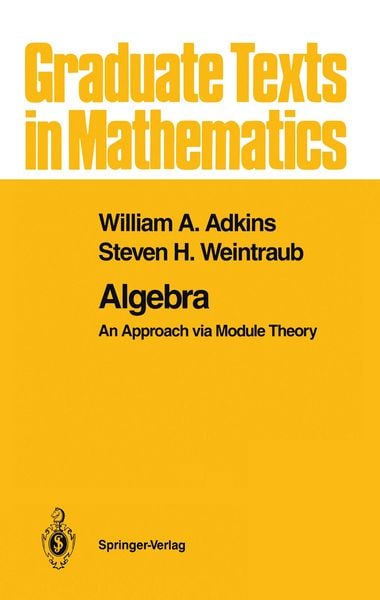
  • Produktbild: Algebra
  • Produktbild: Algebra
Band 136 - 20%

Algebra An Approach via Module Theory

20% sparen

86,99 € UVP 109,99 €

inkl. gesetzl. MwSt., Versandkostenfrei


Beschreibung

Produktdetails

Einband

Gebundene Ausgabe

Erscheinungsdatum

03.09.1992

Verlag

Springer Us

Seitenzahl

526

Maße (L/B/H)

24,1/16/3,5 cm

Gewicht

975 g

Auflage

1st ed. 1992. Corr. 2nd printing 1999

Sprache

Englisch

ISBN

978-0-387-97839-0

Beschreibung

Produktdetails

Einband

Gebundene Ausgabe

Erscheinungsdatum

03.09.1992

Verlag

Springer Us

Seitenzahl

526

Maße (L/B/H)

24,1/16/3,5 cm

Gewicht

975 g

Auflage

1st ed. 1992. Corr. 2nd printing 1999

Sprache

Englisch

ISBN

978-0-387-97839-0

Herstelleradresse

Springer-Verlag KG
Sachsenplatz 4-6
1201 Wien
AT

Email: GPSR Kontakt

Noch keine Bewertungen vorhanden

Verfassen Sie die erste Bewertung zu diesem Artikel

Helfen Sie anderen Kundinnen und Kunden durch Ihre Meinung.

Kundinnen und Kunden meinen

Bewertungen (0)

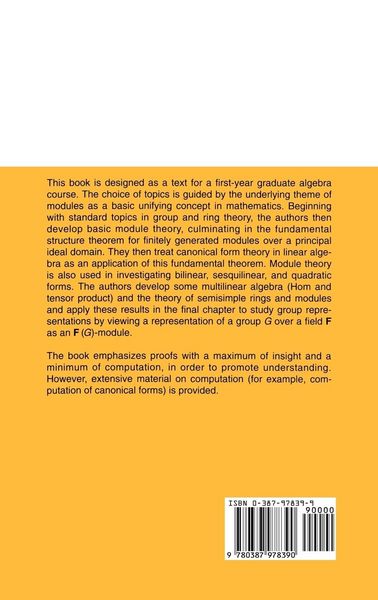
  • Produktbild: Algebra
  • Produktbild: Algebra
  • 1 Groups.- 1.1 Definitions and Examples.- 1.2 Subgroups and Cosets.- 1.3 Normal Subgroups, Isomorphism Theorems, and Automorphism Groups.- 1.4 Permutation Representations and the Sylow Theorems.- 1.5 The Symmetric Group and Symmetry Groups.- 1.6 Direct and Semidirect Products.- 1.7 Groups of Low Order.- 1.8 Exercises.- 2 Rings.- 2.1 Definitions and Examples.- 2.2 Ideals, Quotient Rings, and Isomorphism Theorems.- 2.3 Quotient Fields and Localization.- 2.4 Polynomial Rings.- 2.5 Principal Ideal Domains and Euclidean Domains.- 2.6 Unique Factorization Domains.- 2.7 Exercises.- 3 Modules and Vector Spaces.- 3.1 Definitions and Examples.- 3.2 Submodules and Quotient Modules.- 3.3 Direct Sums, Exact Sequences, and Horn.- 3.4 Free Modules.- 3.5 Projective Modules.- 3.6 Free Modules over a PID.- 3.7 Finitely Generated Modules over PIDs.- 3.8 Complemented Submodules.- 3.9 Exercises.- 4 Linear Algebra.- 4.1 Matrix Algebra.- 4.2 Determinants and Linear Equations.- 4.3 Matrix Representation of Homomorphisms.- 4.4 Canonical Form Theory.- 4.5 Computational Examples.- 4.6 Inner Product Spaces and Normal Linear Transformations.- 4.7 Exercises.- 5 Matrices over PIDs.- 5.1 Equivalence and Similarity.- 5.2 Hermite Normal Form.- 5.3 Smith Normal Form.- 5.4 Computational Examples.- 5.5 A Rank Criterion for Similarity.- 5.6 Exercises.- 6 Bilinear and Quadratic Forms.- 6.1 Duality.- 6.2 Bilinear and Sesquilinear Forms.- 6.3 Quadratic Forms.- 6.4 Exercises.- 7 Topics in Module Theory.- 7.1 Simple and Semisimple Rings and Modules.- 7.2 Multilinear Algebra.- 7.3 Exercises.- 8 Group Representations.- 8.1 Examples and General Results.- 8.2 Representations of Abelian Groups.- 8.3 Decomposition of the Regular Representation.- 8.4 Characters.- 8.5 Induced Representations.- 8.6 Permutation Representations.- 8.7 Concluding Remarks.- 8.8 Exercises.- Index of Notation.- Index of Terminology.