KI-Beratung Beta

Gutscheinbedingungen

**Gültig bis 30.11.2026 auf Spielzeug, Schreibwaren, Filme, Geschenke & Trends, Musik, tolino eReader & Zubehör, Hörbücher und Hörbuch-Downloads, nicht preisgebundene Bücher und Kalender online auf thalia.at und in der Thalia App. Einzelne Artikel können ausgeschlossen sein. Aufgrund der Buchpreisbindung sind deutschsprachige Bücher und eBooks ausgenommen. Zusätzlich ausgenommen sind Abos & Flatrates, Games, Geschenkkarten/-boxen, Shelfies, Software, Zeitschriften sowie einzelne Artikel von tonies®. Pro Einkauf einmal einlösbar. Nur gültig mit im Onlineshop hinterlegter Bonuscard. Click & Collect nur bei Onlinevorabzahlung möglich. Keine Barauszahlung. Nicht kombinierbar mit anderen Aktionen und Gutscheinen. Gutschein wird auf max. 500€ Bestellwert angerechnet. Nicht gültig für Versandkosten und Services.

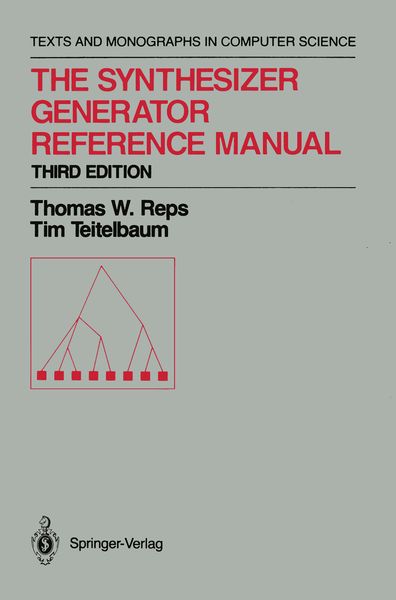
Produktbild: The Synthesizer Generator Reference Manual

The Synthesizer Generator Reference Manual

99,99 €

inkl. gesetzl. MwSt., Versandkostenfrei


Beschreibung

The Synthesizer Generator is a system for automating the implementation of language-based editing environments. The editor designer prepares a specification that includes rules defining a language's context-free abstract syn tax, context-sensitive relationships, display format, and concrete input syntax....

Beschreibung

The Synthesizer Generator is a system for automating the implementation of language-based editing environments. The editor designer prepares a specification that includes rules defining a language's context-free abstract syn tax, context-sensitive relationships, display format, and concrete input syntax. From this specification, the Synthesizer Generator creates a display editor for manipulating objects according to these rules [Reps84]. This volume, The Synthesizer Generator Reference Manual, is intended as the defining document of the system. A companion volume, The Synthesizer Gen erator: A System for Constructing Language-Based Editors [Reps88], provides a more tutorial description of the system; it contains numerous examples that illustrate the specification and use of generated editors, as well as chapters that explain important algorithms of the implementation. The Synthesizer Generator is a generalization of our earlier system, the Cor nell Program Synthesizer [Teitelbaum81], which was a programming environ ment for a specific small dialect of PL/I. It featured a display-oriented, syntax directed editor, an incremental compiler, an execution supervisor supporting source-level debugging, and a file system containing syntactically typed pro gram fragments. Whereas PL/I was built into the Cornell Program Synthesizer, the Synthesizer Generator accepts a formal language definition as input. Although originally conceived as a tool for creating Synthesizer-like environments for arbitrary pro gramming languages, the Synthesizer Generator is more broadly useful. Any textual language with a hierarchical phrase structure grammar is a candidate. vi Preface Interactive theorem proving for formal mathematics and logic, for example, has emerged as a particularlysuitable application.

Produktdetails

Einband

Taschenbuch

Erscheinungsdatum

19.12.1988

Abbildungen

XI, 171 p.

Verlag Springer Us

Produktdetails

Einband

Taschenbuch

Erscheinungsdatum

19.12.1988

Abbildungen

XI, 171 p.

Verlag Springer Us
Seitenzahl

171

Maße (L/B/H)

23,5/15,5/1,1 cm

Gewicht

295 g

Auflage

Third Edition 1989

Sprache

Englisch

ISBN

978-0-387-96910-7

Herstelleradresse

Springer-Verlag KG
Sachsenplatz 4-6
1201 Wien
AT

Email: ProductSafety@springernature.com

Noch keine Bewertungen vorhanden

Verfassen Sie die erste Bewertung zu diesem Artikel

Helfen Sie anderen Kundinnen und Kunden durch Ihre Meinung.

Kundinnen und Kunden meinen

Bewertungen (0)

  • Produktbild: The Synthesizer Generator Reference Manual
  • 1 Introduction.- 2 Specifying an Editor.- 2.1 Lexical Matters.- 2.2 Phyla, Operators, and Terms.- 2.3 Attribute Declarations and Attribute Equations.- 2.4 Function Declarations.- 2.5 Expressions.- 2.6 View and Unparsing Declarations.- 2.7 Concrete Input Syntax.- 2.8 Transformation Declarations.- 2.9 Support for Modular Specifications.- 2.10 Option Declarations.- 2.11 Quantified Declarations.- 3 Using an Editor.- 3.1 Getting Into and Out of an Editor.- 3.2 Executing Commands and Transformations.- 3.3 Buffers, Selections, and Files.- 3.4 Creating, Deleting, and Resizing Windows and Panes.- 3.5 Entering and Editing an Object.- 3.6 Changing the Structural Selection by Traversal of the Edited Term.- 3.7 Changing the Character Selection by Traversal of the Text Buffer.- 3.8 Moving the Object With Respect to the Window.- 3.9 Moving the Locator on the Screen.- 3.10 Changing the Selection with the Locator.- 3.11 Structural Editing.- 3.12 Textual Editing.- 3.13 Access to Computed Attributes.- 3.14 Searching.- 3.15 Alternating Unparsing Schemes.- 4 The SSL Debugger.- 5 Interface to C.- 5.1 Foreign and Exported Functions.- 5.2 Base-Type and Primitive-Phylum Definitions.- 5.3 External Stores and External Computers.- 5.4 Defining Additional Commands.- 5.4.1 Defining commands that have no parameters.- 5.4.2 Defining commands that have parameters.- Appendix A A Sample Specification.- Appendix B Invoking the Synthesizer Generator.- Appendix C List of Editor Commands.- Appendix D Keyboards, Displays, Window Systems, and Mice.- D.1 Keyboards.- D.2 Displays and Window Systems.- D.3 Mice.- Appendix E Demonstration Editors.- E.1 Simple Tutorial Editors.- E.2 Editors for Programming Languages.- E.3 Document Editor.- E.4 Graphics Editor.- E.5 Pedagogical Editors.- E.6 Logic and Program-Verification Editors.- Appendix F Syntax of SSL.