• Produktbild: Come, Let’s Play
  • Produktbild: Come, Let’s Play

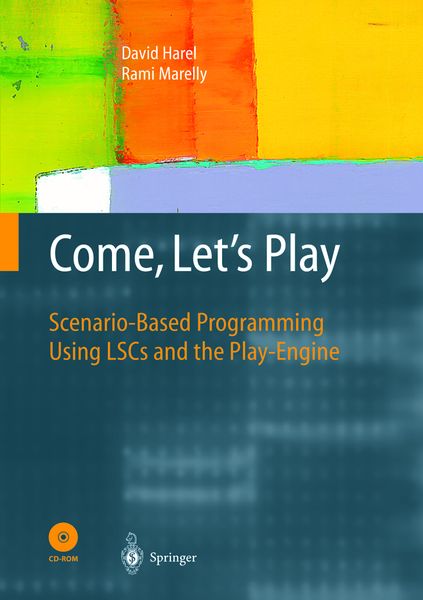
Come, Let’s Play Scenario-Based Programming Using LSCs and the Play-Engine

51,99 €

inkl. gesetzl. MwSt., Versandkostenfrei


Beschreibung

Produktdetails

Einband

Gebundene Ausgabe

Erscheinungsdatum

23.06.2003

Verlag

Springer Berlin

Seitenzahl

382

Maße (L/B/H)

24,8/17,5/3 cm

Gewicht

952 g

Auflage

2003

Sprache

Englisch

ISBN

978-3-540-00787-6

Beschreibung

Rezension

The design of reactive systems is one of the most challenging problems in computer science. This books starts with a critical insight to explain the difficulty of this problem: there is a fundamental gap between the scenario-based way in which people think about such systems and the state-based way in which these systems are implemented. The book then offers a radical proposal to bridge this gap by means of playing scenarios. Systems can be specified by playing in scenarios and implemented by means of a Play-Engine that plays out scenarios. This idea is carried out and developed, lucidly, formally and playfully, to its fullest. The result is a compelling proposal, accompanied by a prototype software engine, for reactive systems design, which is bound to cause a splash in the software-engineering community.
Moshe Y. Vardi, Rice University, Houston, Texas, USA


Scenarios are a primary exchange tool in explaining system behavior to others, but their limited expressive power never made them able to fully describe systems, thus limiting their use. The language of Live Sequence Charts (LSCs) presented in this beautifully written book achieves this goal, and the attached Play-Engine software makes these LSCs really come alive. This is undoubtedly a key breakthrough that will start long-awaited and exciting new directions in systems specification, synthesis, and analysis.
Gérard Berry, Esterel Technologies and INRIA, Sophia-Antipolis, France


The approach of David Harel and Rami Marelly is a fascinating way of combining prototyping techniques with techniques for identifying behavior and user interfaces.
Manfred Broy, Technical University of Munich, Germany

Produktdetails

Einband

Gebundene Ausgabe

Erscheinungsdatum

23.06.2003

Verlag

Springer Berlin

Seitenzahl

382

Maße (L/B/H)

24,8/17,5/3 cm

Gewicht

952 g

Auflage

2003

Sprache

Englisch

ISBN

978-3-540-00787-6

Herstelleradresse

Springer-Verlag KG
Sachsenplatz 4-6
1201 Wien
AT

Email: GPSR Kontakt

Noch keine Bewertungen vorhanden

Verfassen Sie die erste Bewertung zu diesem Artikel

Helfen Sie anderen Kundinnen und Kunden durch Ihre Meinung.

Kundinnen und Kunden meinen

Bewertungen (0)

  • Produktbild: Come, Let’s Play
  • Produktbild: Come, Let’s Play
  • I. Prelude.- 1. Introduction.- 2. Setting the Stage.- 3. An Example-Driven Overview.- 4. The Model: Object Systems.- II. Foundations.- 5. The Language: Live Sequence Charts (LSCs).- 6. The Tool: The Play-Engine.- III. Basic Behavior.- 7. Variables and Symbolic Messages.- 8. Assignments and Implemented Functions.- 9. Conditions.- 10. Branching and Subcharts.- IV. Advanced Behavior: Multiple Charts.- 11. Executing Multiple Charts.- 12. Testing with Existential Charts.- V. Advanced Behavior: Richer Constructs.- Loops.- Transition to Design.- Classes and Symbolic Instances.- Time and Real-Time Systems.- Forbidden Elements.- VI Enhancing the Play-Engine.- Smart Play-Out (with H. Kugler).- Inside and Outside the Play-Engine.- A Play-Engine Aware GUI Editor.- Future Research Directions.- VII Appendices.- A. Formal Semantics of LSCs.- A.1 System Model and Events.- A.2 LSC Specification.- A.3 Operational Semantics.- B. XML Description of a GUI Application.- C. The Play-Engine Interface.- C.1 Visual Basic Code.- D. The GUI Application Interface.- D.1 Visual Basic Code.- E. The Structure of a (Recorded) Run.- References.