Gutscheinbedingungen

**Gültig bis 17.08.2026 auf Schreibwaren & Office-Artikel online auf thalia.at, in der Thalia App und in teilnehmenden Thalia Buchhandlungen in Österreich mit Schulsortiment. In den Buchhandlungen nur gültig auf lagernde Ware. Einzelne Artikel können ausgeschlossen sein. Ausgenommen sind preisgebundene Artikel. Pro Einkauf einmal einlösbar. Nur gültig gegen Vorlage oder im Onlineshop hinterlegter Bonuscard. Infos zur Einlösung in der Buchhandlung sind auf der Bonuscard-Vorteilspreisseite zu finden. Click & Collect nur bei Onlinevorabzahlung möglich. Keine Einlösung bei Scan & Go-Bezahlung. Keine Barauszahlung. Nicht kombinierbar mit anderen Aktionen und Gutscheinen. Gutschein wird auf max. 500€ Bestellwert angerechnet. Nicht gültig für Geschenkkarten, Versandkosten und Services.

  • Produktbild: Using the Borsuk-Ulam Theorem
  • Produktbild: Using the Borsuk-Ulam Theorem
- 11%

Using the Borsuk-Ulam Theorem Lectures on Topological Methods in Combinatorics and Geometry

Aus der Reihe Universitext
11% sparen

72,99 € UVP 82,49 €

inkl. gesetzl. MwSt., Versandkostenfrei


Beschreibung

Produktdetails

Einband

Taschenbuch

Erscheinungsdatum

17.04.2003

Verlag

Springer Berlin

Seitenzahl

214

Maße (L/B/H)

23,5/15,5/1,5 cm

Gewicht

395 g

Auflage

2003

Sprache

Englisch

ISBN

978-3-540-00362-5

Beschreibung

Rezension

From the reviews:


[...]Matousek's lively little textbook now shows that Lovász' insight as well as beautiful work of many others (such as Vreci´ca and Zivaljevi´c, and Sarkaria) have opened up an exciting area of matheamtics that connects combinatorics, graph theory, algebraic topology and discrete geometry. What seemed like an ingenious trick in 1978 now presents itself as an instance of the "test set paradigm": to construct configuration spaces for combinatorial problems such that coloring, incidence or transversal problems may be translated into the (non-)existence of suitable equivariant maps.


The vivid account of this area and its ramifications by Matousek is an exciting, a coherent account of this area of topological combinatorics. It features a collection of mathematical gems written with a broad view of the subject and still with loving care for details. Recommended reading! [..]


Günter M. Ziegler (Berlin)


Zbl. MATH Volume 1060 Productions-no.: 05001


...."The book contains more than 100 exercises, many of them being compressed outlines of interesting results. As such, most of them are both challenging and interesting.


I think this book will be of interest mostly for mathematicians and graduate students. It can certainly be used in a graduate course or seminar. It has an extensive list of references and it covers many interesting and not-so-easy results, with proofs that are sometimes easier than in the original papers. I wouldn't say that this book is an "easy read", but it is very well written, very interesting, and very informative".


Mihaela Poplicher,
MAA Online


"This book is intended to make elementary topological methods more accessible to those who work in other areas of mathematics. … This excellent book is useful for specialists in discrete geometry, combinatorics and computer science who want to learn how algebraic topology can be used in theirdiscipline. It is also very suitable as a textbook for such a course." (Ferenc Fodor, Acta Scientiarum Mathematicarum, Vol. 71, 2005)


"The book is addressed to mathematicians, scientists, and engineers working on signal and image processing and medical imaging. It is written by experts and for experts, but each chapter has an introductory part written for non-specialists, giving them the possibility to find what the chapter is dealing with. The book contains important contributions to the areas mentioned in the title: sampling, wavelets and tomography." (S. Cobzas, Studia universitatis Babes-Bolyai Mathematica, Vol. XLIX (2), 2004)


"This book … is based on a couple of graduate courses in ‘topological combinatorics’ taught by the author … . The book contains more than 100 exercises, many of them being compressed outlines of interesting results. As such, most of them are both challenging and interesting. … It has an extensive list of references and it covers many interesting and no-so-easy results, with proofs that are sometimes easier than in the original papers. … it is very well written, very interesting, and very informative." (Mihaela Poplicher, MAA Online, January, 2005)


"This excellent textbook is based on lecture notes by the author on applications of some topological methods in combinatorics and geometry. … All chapters include exercises and historical and bibliographical notes. Many hints for further reading are given. … topologists will find here some nice applications for their lectures." (Zdzislaw Dzedzej, Mathematical Reviews, 2004 i)


"Matoušek’s lively little textbook now shows that Lovász’ insight as well as beautiful work of many others … have opened up an exciting area of mathematics that connects combinatorics, graph theory, algebraic topology and discrete geometry. … The vivid account of this area and its ramifications by Matoušek is an exciting, a coherent account of this area oftopological combinatorics. It features a collection of mathematical gems written with a broad view of the subject and still with loving care for details. Recommended reading!" (Günter M. Ziegler, Zentralblatt MATH, Vol. 1016, 2003)


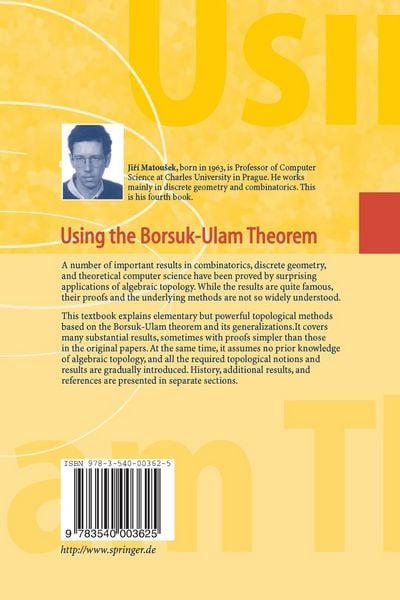
"This textbook explains elementary but powerful topological methods based on the Borsuk-Ulam theorem and its generalizations. It covers many substantial results, sometimes with proofs simpler than those in the original papers." (L'ENSEIGNEMENT MATHEMATIQUE, Vol. 49 (1-2), 2003)

Produktdetails

Einband

Taschenbuch

Erscheinungsdatum

17.04.2003

Verlag

Springer Berlin

Seitenzahl

214

Maße (L/B/H)

23,5/15,5/1,5 cm

Gewicht

395 g

Auflage

2003

Sprache

Englisch

ISBN

978-3-540-00362-5

Herstelleradresse

Springer-Verlag KG
Sachsenplatz 4-6
1201 Wien
AT

Email: GPSR Kontakt

Noch keine Bewertungen vorhanden

Verfassen Sie die erste Bewertung zu diesem Artikel

Helfen Sie anderen Kundinnen und Kunden durch Ihre Meinung.

Kundinnen und Kunden meinen

Bewertungen (0)

  • Produktbild: Using the Borsuk-Ulam Theorem
  • Produktbild: Using the Borsuk-Ulam Theorem
  • Preliminaries.- 1 Simplicial Complexes: 1.1 Topological spaces; 1.2 Homotopy equivalence and homotopy; 1.3 Geometric simplicial complexes; 1.4 Triangulations; 1.5 Abstract simplicial complexes; 1.6 Dimension of geometric realizations; 1.7 Simplicial complexes and posets.- 2 The Borsuk-Ulam Theorem: 2.1 The Borsuk-Ulam theorem in various guises; 2.2 A geometric proof; 2.3 A discrete version: Tucker's lemma; 2.4 Another proof of Tucker's lemma.- 3 Direct Applications of Borsuk--Ulam: 3.1 The ham sandwich theorem; 3.2 On multicolored partitions and necklaces; 3.3 Kneser's conjecture; 3.4 More general Kneser graphs: Dolnikov's theorem; 3.5 Gale's lemma and Schrijver's theorem.- 4 A Topological Interlude: 4.1 Quotient spaces; 4.2 Joins (and products); 4.3 k-connectedness; 4.4 Recipes for showing k-connectedness; 4.5 Cell complexes.- 5 Z_2-Maps and Nonembeddability: 5.1 Nonembeddability theorems: An introduction; 5.2 Z_2-spaces and Z_2-maps; 5.3 The Z_2-index; 5.4 Deleted products good ...; 5.5 ... deleted joins better; 5.6 Bier spheres and the Van Kampen-Flores theorem; 5.7 Sarkaria's inequality; 5.8 Nonembeddability and Kneser colorings; 5.9 A general lower bound for the chromatic number.- 6 Multiple Points of Coincidence: 6.1 G-spaces; 6.2 E_nG spaces and the G-index; 6.3 Deleted joins and deleted products; 6.4 Necklace for many thieves; 6.5 The topological Tverberg theorem; 6.6 Many Tverberg partitions; 6.7 Z_p-index, Kneser colorings, and p-fold points; 6.8 The colored Tverberg theorem.- A Quick Summary.- Hints to Selected Exercises.- Bibliography.- Index.