KI-Beratung Beta

Gutscheinbedingungen

**Gültig bis 30.11.2026 auf Spielzeug, Schreibwaren, Filme, Geschenke & Trends, Musik, tolino eReader & Zubehör, Hörbücher und Hörbuch-Downloads, nicht preisgebundene Bücher und Kalender online auf thalia.at und in der Thalia App. Einzelne Artikel können ausgeschlossen sein. Aufgrund der Buchpreisbindung sind deutschsprachige Bücher und eBooks ausgenommen. Zusätzlich ausgenommen sind Abos & Flatrates, Games, Geschenkkarten/-boxen, Shelfies, Software, Zeitschriften sowie einzelne Artikel von tonies®. Pro Einkauf einmal einlösbar. Nur gültig mit im Onlineshop hinterlegter Bonuscard. Click & Collect nur bei Onlinevorabzahlung möglich. Keine Barauszahlung. Nicht kombinierbar mit anderen Aktionen und Gutscheinen. Gutschein wird auf max. 500€ Bestellwert angerechnet. Nicht gültig für Versandkosten und Services.

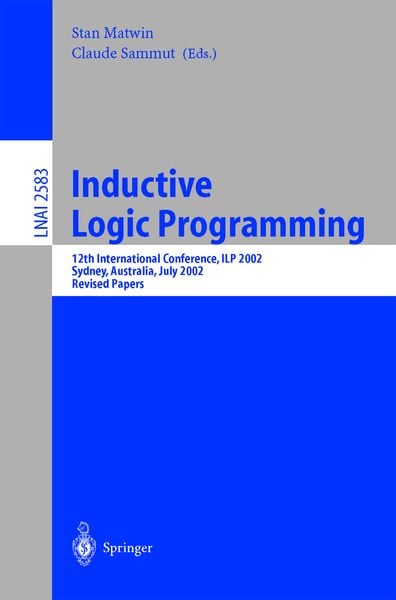
  • Produktbild: Inductive Logic Programming
  • Produktbild: Inductive Logic Programming
Band 2583

Inductive Logic Programming 12th International Conference, ILP 2002, Sydney, Australia, July 9-11, 2002. Revised Papers

51,99 €

inkl. gesetzl. MwSt., Versandkostenfrei


Beschreibung

The Twelfth International Conference on Inductive Logic Programming was held in Sydney, Australia, July 9–11, 2002. The conference was colocated with two other events, the Nineteenth International Conference on Machine Learning (ICML2002) and the Fifteenth Annual Conference on Computational Learning...

Beschreibung

The Twelfth International Conference on Inductive Logic Programming was held in Sydney, Australia, July 9–11, 2002. The conference was colocated with two other events, the Nineteenth International Conference on Machine Learning (ICML2002) and the Fifteenth Annual Conference on Computational Learning Theory (COLT2002). Startedin1991,InductiveLogicProgrammingistheleadingannualforumfor researchers working in Inductive Logic Programming and Relational Learning. Continuing a series of international conferences devoted to Inductive Logic Programming and Relational Learning, ILP 2002 was the central event in 2002 for researchers interested in learning relational knowledge from examples. The Program Committee, following a resolution of the Community Me- ing in Strasbourg in September 2001, took upon itself the issue of the possible change of the name of the conference. Following an extended e-mail discussion, a number of proposed names were subjected to a vote. In the ?rst stage of the vote, two names were retained for the second vote. The two names were: Ind- tive Logic Programming, and Relational Learning. It had been decided that a 60% vote would be needed to change the name; the result of the vote was 57% in favor of the name Relational Learning. Consequently, the name Inductive Logic Programming was kept.

Produktdetails

Einband

Taschenbuch

Erscheinungsdatum

12.02.2003

Abbildungen

X, 358 p.

Herausgeber Stan Matwin + weitere

Produktdetails

Einband

Taschenbuch

Erscheinungsdatum

12.02.2003

Abbildungen

X, 358 p.

Herausgeber
Verlag Springer Berlin
Seitenzahl

358

Maße (L/B/H)

23,5/15,5/2 cm

Gewicht

557 g

Auflage

2003

Sprache

Englisch

ISBN

978-3-540-00567-4

Herstelleradresse

Springer-Verlag KG
Sachsenplatz 4-6
1201 Wien
AT

Email: ProductSafety@springernature.com

Noch keine Bewertungen vorhanden

Verfassen Sie die erste Bewertung zu diesem Artikel

Helfen Sie anderen Kundinnen und Kunden durch Ihre Meinung.

Kundinnen und Kunden meinen

Bewertungen (0)

  • Produktbild: Inductive Logic Programming
  • Produktbild: Inductive Logic Programming
  • Contributed Papers.- Propositionalization for Clustering Symbolic Relational Descriptions.- Efficient and Effective Induction of First Order Decision Lists.- Learning with Feature Description Logics.- An Empirical Evaluation of Bagging in Inductive Logic Programming.- Kernels for Structured Data.- Experimental Comparison of Graph-Based Relational Concept Learning with Inductive Logic Programming Systems.- Autocorrelation and Linkage Cause Bias in Evaluation of Relational Learners.- Learnability of Description Logic Programs.- 1BC2: A True First-Order Bayesian Classifier.- RSD: Relational Subgroup Discovery through First-Order Feature Construction.- Mining Frequent Logical Sequences with SPIRIT-LoG.- Using Theory Completion to Learn a Robot Navigation Control Program.- Learning Structure and Parameters of Stochastic Logic Programs.- A Novel Approach to Machine Discovery: Genetic Programming and Stochastic Grammars.- Revision of First-Order Bayesian Classifiers.- The Applicability to ILP of Results Concerning the Ordering of Binomial Populations.- Compact Representation of Knowledge Bases in ILP.- A Polynomial Time Matching Algorithm of Structured Ordered Tree Patterns for Data Mining from Semistructured Data.- A Genetic Algorithms Approach to ILP.- Experimental Investigation of Pruning Methods for Relational Pattern Discovery.- Noise-Resistant Incremental Relational Learning Using Possible Worlds.- Lattice-Search Runtime Distributions May Be Heavy-Tailed.- Invited Talk Abstracts.- Learning in Rich Representations: Inductive Logic Programming and Computational Scientific Discovery.